
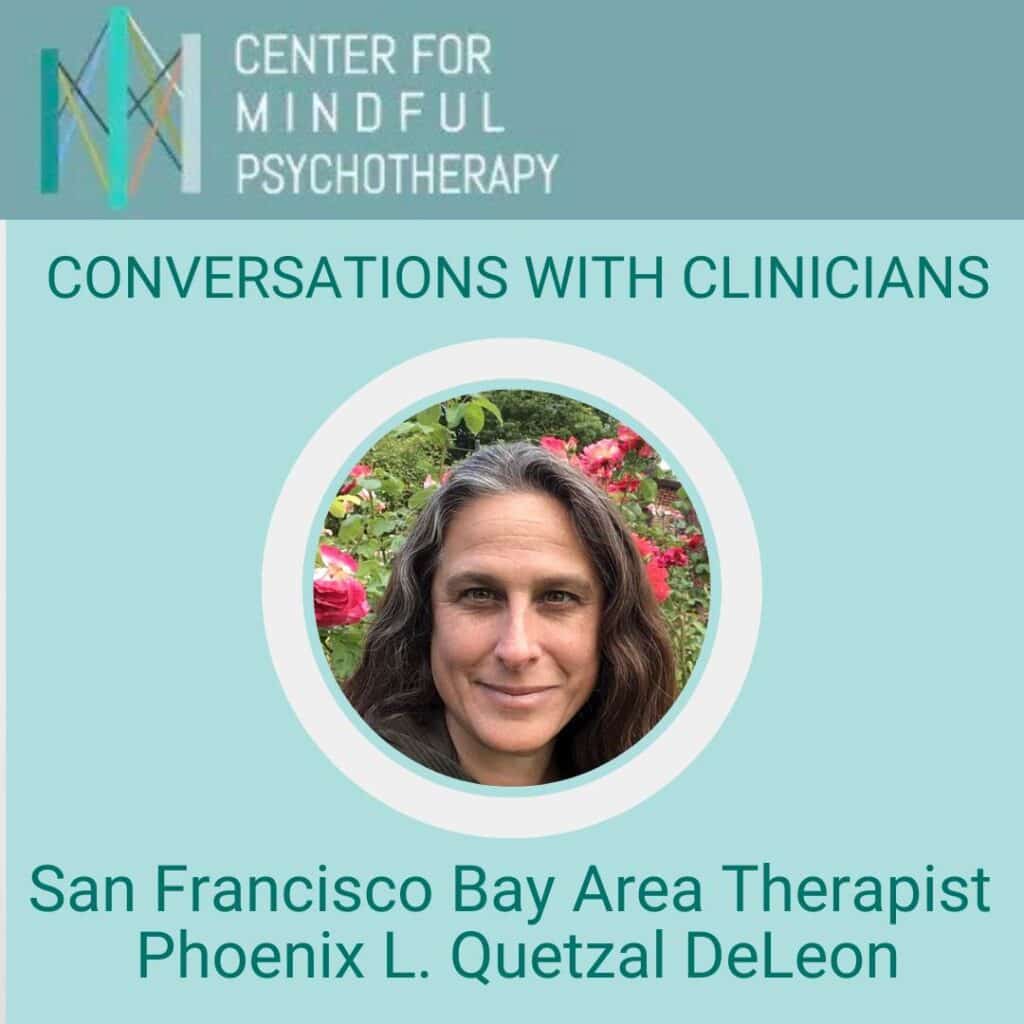
Center for Mindful Psychotherapy is a non profit collective of approximately 100 Associate Marriage and Family Therapists in the San Francisco Bay Area. You can learn more about each of them from perusing our Therapist Directory. In our Conversations with Clinicians series, we interview therapists in more depth. They share more about the work that they do, the clients that they work with, their inspirations, passions, personal interests and more. Today, we’re talking with Phoenix L. Quetzal DeLeón.
Phoenix brings a remarkable depth of embodied wisdom to her practice. Before becoming a Somatic Therapist, she was a teacher for over 25 years and has been a Certified Advanced Rolfer, Rolf Movement Practitioner, and Massage Therapist for many years. She is also a faculty member at the Dr. Ida Rolf Institute. With over 20 years of experience in somatic modalities—studying many different types of hands-on and movement work—Phoenix offers a nuanced understanding of embodiment in therapy. As a queer, mixed-race woman, she brings both personal and professional experience to being present with complex intersections of identity. Her work is grounded in social justice, liberation psychology, relational-cultural theory, Health at Every Size®, indigenous methodologies, and a wide variety of somatic practices. Currently, she is moving through the Level 1 IFS training in the first solely QTBIPOC cohort.
Where is your office located?
My practice is all online. I am located in Santa Clara, California.
What is your therapeutic orientation?
I am a Somatic Therapist, and my work is body-oriented, relational and trauma informed. I also integrate IFS work into my practice.
What are your areas of specialty?
My specialities include working with issues related to stress, anxiety and trauma, especially in the context of marginalized identities. As a queer, mixed-race woman, I have both personal and professional experience in being present with complex intersections of identity, and how this shows up and needs tending in therapeutic space.
I often work with folks around issues such as relationship stress, work-life balance, life transitions, body image, and past (or present/ongoing) traumas. Additionally, I have trained in working with trauma, embodiment, and IFS in the context of social justice and systemic oppression. Currently I am moving through the Level 1 IFS training in the first solely QTBIPOC cohort.
What other modalities inform your work?
Before I became a somatic therapist, I studied massage, Rolfing® and Rolf Movement® work. I have over 20 years of experience with somatic modalities, including studying many different types of hands-on and movement work, and running a private bodywork practice for most of that time. This background has given me a nuanced understanding of working with embodiment in therapy, and allows me to access a diverse range of somatic practices in my clinical work.
What is it like to work with you?
My clients have said that I’m “gentle and firm” in my therapy style. I would describe how I show up in the room as open, curious and compassionate, as well as with a casualness that is rooted in boundaried professionalism. In my sessions, I like to make a lot of space for folks to process feelings and check in with their bodies. I am also comfortable with being more direct and guiding a conversation when that feels needed. Asking gentle questions that offer clients a choice around what, when and how much to explore is one of the ways I support engagement with challenging experiences, and I take care to move at a pace that feels right to each individual.
Who do you LOVE working with?
There are lots of folks I love to work with, I have a pretty eclectic client base and I enjoy that. If I’m going to name a specific group – I would say that I really love working with mixed-race folks who are seeking support with managing stress, anxiety and/or trauma, especially when it’s related to the experience of being mixed-race. In my experience, there is something special about finding a therapist who shares this identity, and is able to relate to their clients from the perspective of lived experience around this. I really like being able to provide clients with this kind of therapeutic support.
What inspires you about this work?
It is such an honor to be a part of people’s healing journeys, and act as a guide and witness to their process along the way. Being a somatic therapist offers many options for engaging with the body, and facilitating these explorations with clients is really inspiring to me. I do a lot of my own embodied practices outside of work to stay in connection with my body, and I teach this work to others, which for me is a profoundly inspiring opportunity.
We’d Love Some Recommendations From You…
… for the best place to cry in the bay area:
Best place to laugh and cry: Waddell Beach out on the coast between Santa Cruz and Pescadero. This is a great spot that offers amazing views, long walks and endless natural beauty.
See What Other Places Therapists Recommend to Laugh and Cry in the SF Bay Area
… for self care practice:
Best free self-care: Attuning to the breath and just noticing the movement of breath, or, connecting with the feet and feeling into the ground. Both of these can be great access points of resource and internal connection.
Best self-care on a budget: Take yourself to your favorite place outside, whether it’s a park, the beach, or somewhere out in nature. Being outside and connecting with the natural world can be such a great resource.
Best self-care at a higher price point: Go someplace like the Well-Within Spa in Santa Cruz or Kabuki in San Francisco, and treat yourself to a massage and then a hot tub.
Favorite non-therapy book:
Circe, Sunshine and Braiding Sweetgrass.
Favorite self-help book/ therapy book:
My favorite therapy books include Embodied Activism; Diverse Bodies, Diverse Practices; and Nurturing Resilience.
Favorite quote:
“Do the best you can until you know better. Then when you know better, do better.” ~Maya Angelou
Other media favorites:
Two of my favorite therapy-related films include Harold and Maude and Good Will Hunting.
If you could sum up in one sentence why someone might go to therapy, what would you say?
I would say that therapy is meant to be a process that supports you and helps you to grow and change, so if that’s what you’re looking for, go for it.
What is one thing that clients might be surprised to learn about you?
I was born and raised in Hawaii.
What is one takeaway moment that you’d like to share from your own experience as a client in therapy?
The moment I learned that I wasn’t the only person struggling with the issues I was facing was such a breakthrough for me. Many years ago when I first started working with a specialized therapist, she told me that what I was experiencing was actually a somewhat common thing, and it took an enormous burden off of me. This helped me to feel more connected to the people around me, and to the process of moving through what I was facing. Knowing that I wasn’t alone made all of the difference.
Anything else? Closing words or something about who you are/ how you identify that you would like to share?
Getting therapy for myself was one of the things that allowed me to become the clinician I am today, and I am so grateful to the therapists I have worked with for their support and guidance. I think that finding the right-fit therapist is a really important first step when seeking therapy. I’d encourage anyone who is looking for a therapist to talk with several different folks before making a choice about who to work with. If you’re interested in finding out more about my work, I invite you to contact me for a free 20-minute consultation.
How can people contact you?
Name: Phoenix L. Quetzal DeLeón
License #: AMFT #129332
Supervisor: Abigail Collins Thompson LMFT #94639
Phone number: (408) 706-2770
Website: therapywithphoenix.com
Email: [email protected]
You can also contact us at Center for Mindful Psychotherapy to learn more about working with any of our associate therapists.
More From Phoenix:
- When Words Aren’t Enough: Understanding How Somatic Therapy Bridges Body and Mind
- Understanding the Messages of the Body: How Somatic Therapy can Help
- Stop Fighting Your Shoulders: A Video Tutorial of a Counterintuitive Somatic Practice for Tension Relief
- Eating in the Light of the Moon: A Therapist’s Book Review