
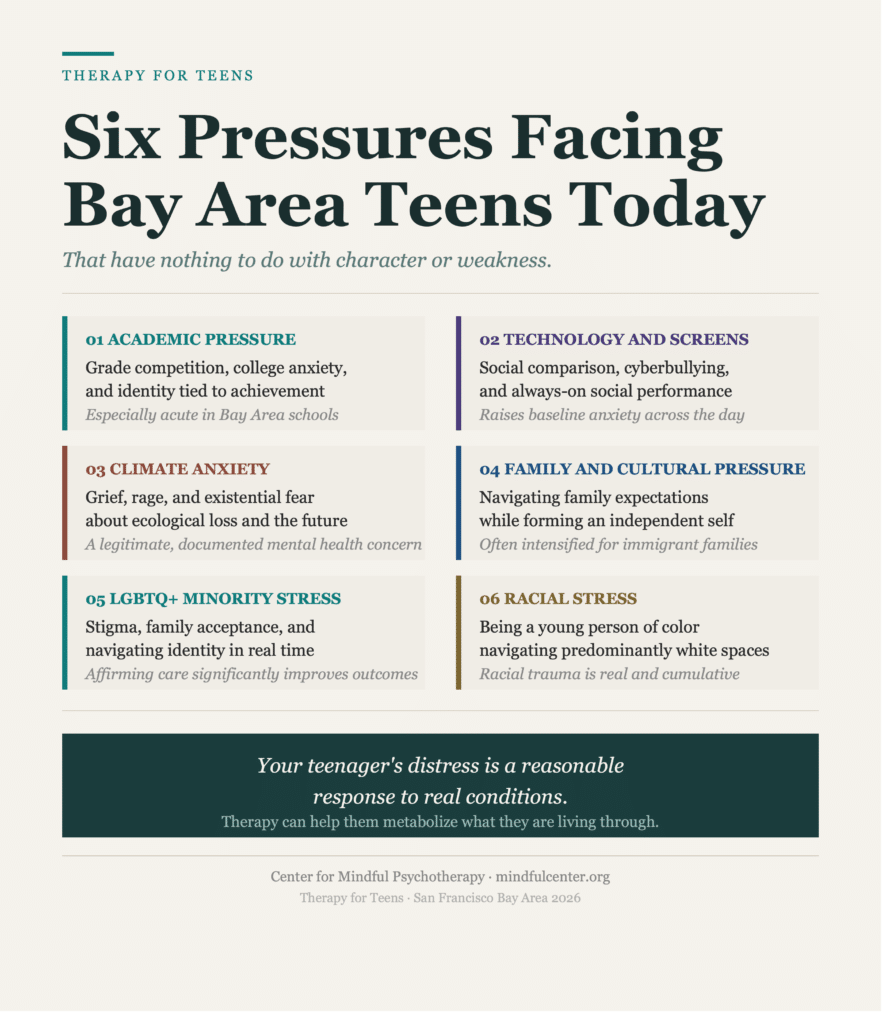
Adolescence has always been demanding. But the particular pressures facing teenagers today in the Bay Area and throughout California are significant: academic competition, social comparison amplified by technology, family expectations, climate anxiety, economic uncertainty, and for many teens, the additional weight of navigating a world that does not always affirm who they are.
Teenagers need therapeutic support that is specifically designed for them. Not a simplified version of adult therapy. Not an approach that treats them as the problem. A space that takes them seriously, meets them at their developmental stage, and gives them something genuinely theirs.
At Center for Mindful Psychotherapy, our therapists who work with adolescents are specifically trained in adolescent development and experienced with the issues that teenagers bring. Some of our therapists offer therapy for teens in the San Francisco Bay Area as well as throughout California via telehealth. Teen therapy is for young people between approximately 12 and 18 years of age.
Browse our Therapist Directory
On This Page:
- Understanding Adolescent Development
- What Brings Teens to Therapy
- How Teen Therapy Is Different
- The Role of Parents
- Therapy for Teens Who Are LGBTQ+
- Therapy for Teens of Color and Immigrant Teens
- Frequently Asked Questions

Understanding Adolescent Development
Adolescence is a period of significant neurological, emotional, and social change. The adolescent brain is actively developing, particularly the prefrontal cortex which governs decision-making, impulse control, and emotional regulation. This means that the emotional intensity of adolescence is not a character flaw or a failure of maturity; it is a feature of the developmental moment.
Teenagers are also doing some of the most important psychological work of a lifetime: forming a sense of identity separate from their families, testing their values and beliefs, navigating peer relationships, and beginning to develop the internal resources they will carry into adulthood. When this work happens in a context of significant stress, trauma, or unmet need, the consequences can be lasting.
Therapy during adolescence can provide the support, perspective, and skill-building that helps teens navigate this period more successfully and build a foundation for adult mental health.
What Brings Teens to Therapy
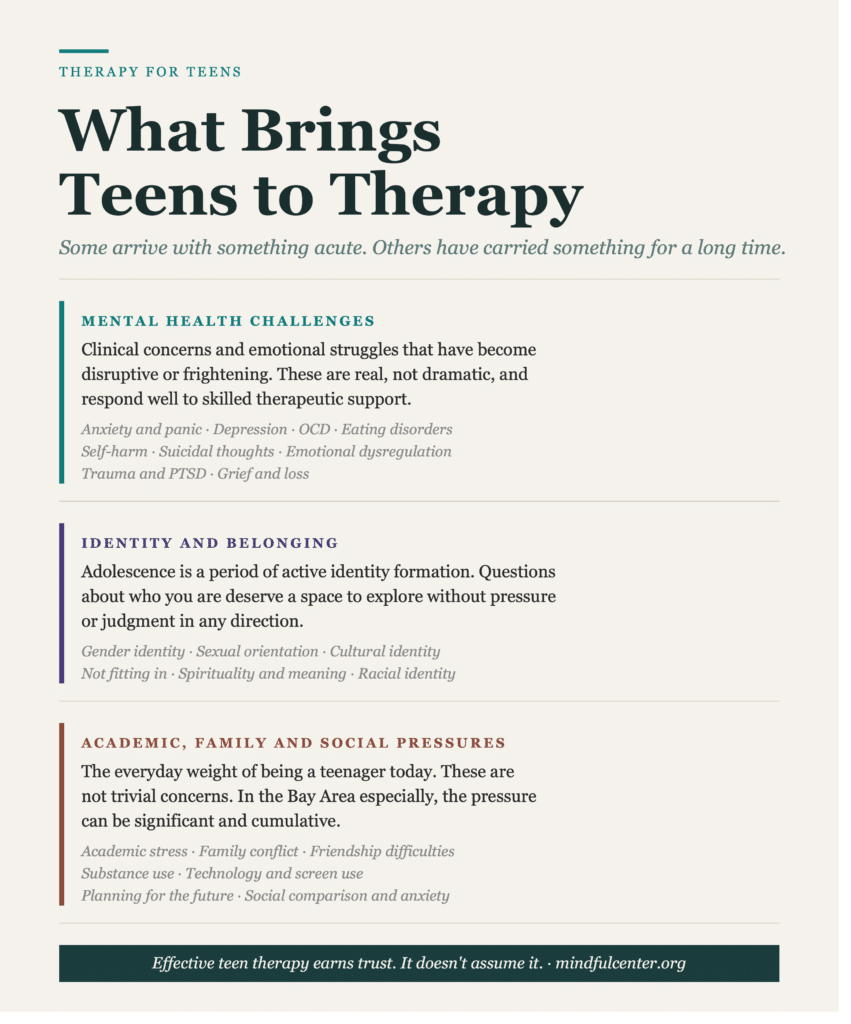
Just like adults, teenagers come to therapy for many different reasons. Some are struggling with something acute. Others have been carrying something for a long time and are finally ready to have somewhere to bring it. Common reasons teens seek or are referred for therapy include:
Mental Health Challenges
- Anxiety, including social anxiety, generalized worry, and panic
- Depression and persistent low mood
- OCD and related concerns
- Eating disorders and body image struggles
- Self-harm or suicidal thoughts
- Emotional dysregulation and difficulty managing intense feelings
Trauma and Difficult Experiences
- Trauma from past or ongoing abuse, assault, or neglect
- Grief and loss, including the death of a family member, friend, or relationship
- Experiences of bullying, harassment, or social exclusion
- Exposure to family violence or significant family instability
- Racial trauma and the psychological impact of discrimination
Identity and Belonging
- Exploring gender identity and what it means for who they are
- Questions of sexual identity and orientation
- Cultural identity and navigating between different cultural worlds
- Not fitting in or feeling fundamentally different from peers
- Spirituality and existential questions about meaning and purpose
Academic, Family, and Social Pressures
- Academic stress and performance anxiety
- Conflict with parents or difficulty with family dynamics
- Friendship challenges and social anxiety
- Navigating romantic relationships
- Substance use and related concerns
- Planning for the future and the anxiety it generates
- Screen and technology use that has become disruptive
How Teen Therapy Is Different
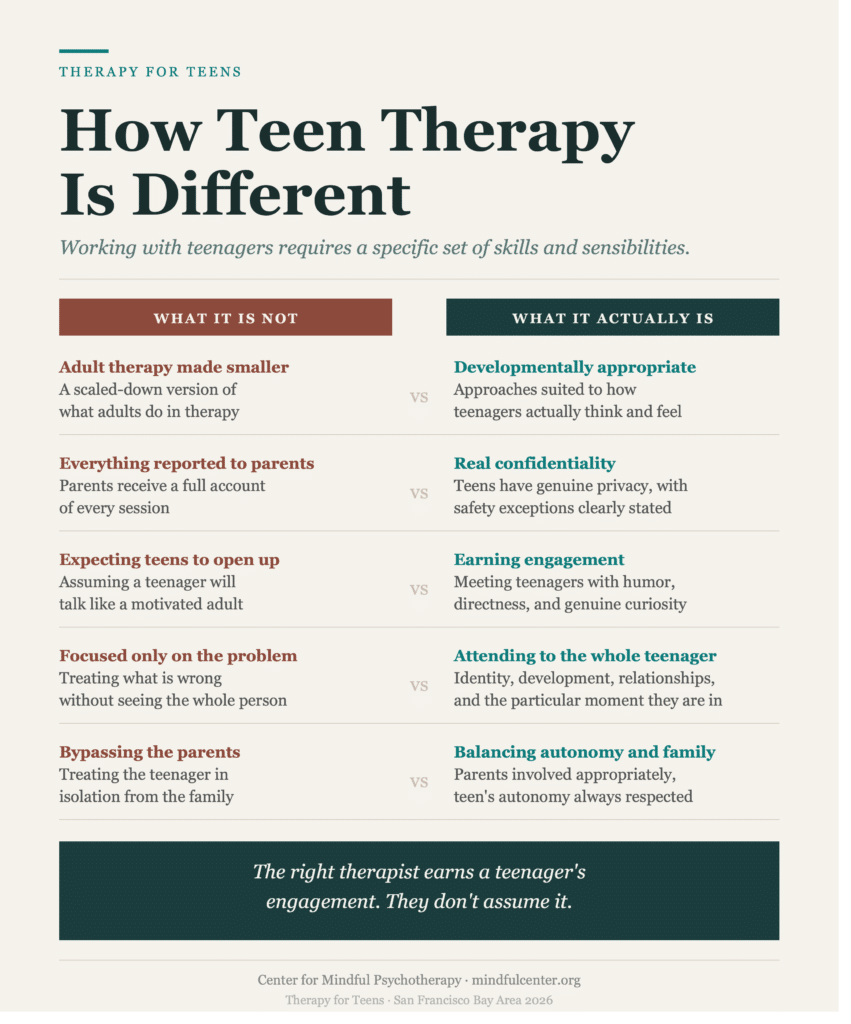
Working therapeutically with teenagers requires a specific set of skills and sensibilities that differ meaningfully from adult therapy.
Confidentiality and Trust
For therapy to work, teenagers need to trust that the therapeutic relationship is genuinely theirs. This means that confidentiality in teen therapy is real, with necessary exceptions for safety. Our therapists are clear with both teens and parents about what is and is not shared, and work to build a relationship in which the teenager feels safe to be honest.
We involve parents and caregivers in ways that serve the teenager’s therapeutic goals without compromising their trust. Parents typically receive updates about themes and progress but not the specific content of what their teen shares.
Engagement on Their Terms
Teenagers are not a captive audience. A teen who does not want to be in therapy will not benefit from therapy, regardless of how skilled the therapist is. Our therapists who work with adolescents are experienced at building rapport with young people who are skeptical, resistant, or simply not sure they want to be there. They engage with humor, directness, and genuine curiosity about the teenager’s experience rather than expecting the teen to adapt to an adult framework.
Developmentally Appropriate Approaches
Some of what works well in adult therapy does not translate directly to adolescent work. Our teen therapists draw from approaches adapted for this population: somatic work that acknowledges the particular volatility of the adolescent nervous system, creative and expressive modalities that engage teens who are not comfortable with pure conversation, and structured skills-based approaches that give teens concrete tools they can actually use.
The Role of Parents
Parents and caregivers play an important role in teen therapy, even though the therapeutic relationship primarily belongs to the teenager.
Most of our teen therapists meet with parents periodically to share relevant information, discuss what is happening at home, and help parents understand and respond to their teenager more effectively. For some families, parent coaching alongside teen therapy is particularly valuable.
The specific structure varies based on the teenager’s age, what is being worked on, and what the therapist recommends. Therapists will discuss this with both the teenager and parents at the outset.
When the Issue Is Partly Relational
Sometimes what brings a teen to therapy is significantly tied to family dynamics. When this is the case, family therapy may be recommended alongside or instead of individual teen therapy, at least for part of the work. Your teen’s therapist will help you think through what configuration makes the most sense.
Therapy for Teens Who Are LGBTQ+
LGBTQ+ teenagers face specific mental health risks related to minority stress, family acceptance, school climate, and the psychological impact of navigating a world that does not always affirm who they are. Research consistently shows that LGBTQ+ youth who have access to affirming support, including affirming therapy, have significantly better mental health outcomes.
Our therapists who work with LGBTQ+ teenagers are affirming of all gender identities and sexual orientations and experienced with the particular concerns that LGBTQ+ teens bring. We do not treat being LGBTQ+ as a problem to be solved or explored as the source of difficulty; we take it as a given and focus on supporting the teenager’s wellbeing in the context of who they actually are.
2024 research from The International Journal of Social Determinants of Health and Health Services recommends that an “approach should address the multiple forms of marginalization and stigmatization that LGBTQ+ youth may experience, enable informed independent decision-making, and uphold the right to freedom of safe self-expression. A rights-based approach to mental health services for LGBTQ+ young people is not prominent. This needs to change if we are to tackle this mental health inequality and improve the mental well-being of LGBTQ+ youth worldwide.”
Therapy for Teens of Color and Immigrant Teens
Teenagers navigating racial identity, immigration, acculturation, or the experience of being a person of color in a predominantly white environment face specific psychological pressures that general therapy does not always address. Racial trauma is real. The experience of code-switching across cultural contexts is exhausting. The pressure of representing one’s family’s hopes while navigating a world shaped by racial and economic inequality is significant.
Look for therapists who have specific experience and training in working with teens of color, immigrant teenagers, and young people navigating complex cultural identities.

Frequently Asked Questions
My teenager says they don’t need therapy. How do I handle this?
Forcing a teenager into therapy rarely works and can backfire. It is often more effective to introduce the idea gradually, normalize it, and give your teen some agency in the process, such as choosing their own therapist or having input into when sessions happen. Sometimes individual sessions with a parent first, to help you understand the dynamics at play and figure out how to approach your teen, are more productive than starting with the teenager directly.
What if my teen is having thoughts of suicide or self-harm?
This requires immediate attention. If your teen is in immediate danger, contact 988 (the Suicide and Crisis Lifeline) or go to your nearest emergency room. If they are expressing thoughts but are not in immediate danger, reaching out for a therapy appointment as soon as possible is the right next step. Our therapists are trained in safety-informed approaches and can assess and address suicidality and self-harm within therapy. Do not wait to see if it passes.
How much do I find out about what my teenager says in therapy?
You will receive updates about themes and overall progress, but not the specific content of sessions. This is intentional: teens need some degree of privacy for therapy to work, and our therapists are explicit with both teens and parents about these boundaries. Exceptions are made for safety; therapists will always disclose concerns about a teen’s safety to parents. If you have specific concerns or questions, sharing them with your teen’s therapist directly is always appropriate.
My teen is resistant to therapy but clearly struggling. What should I do?
A few things can help. Framing matters: describing therapy as a support rather than a treatment for something wrong with them reduces resistance. Giving your teen some control over the choice of therapist or the scheduling of sessions increases buy-in. Starting with a lower-stakes initial meeting before committing to ongoing therapy also helps. And sometimes, working with a therapist yourself first to understand the dynamics at play is more effective than starting with the teenager.
Is teen therapy available online?
Yes. Many teenagers are comfortable with video sessions and find them convenient. Telehealth teen therapy is available to young people throughout California. Some issues, particularly those involving very significant dysregulation or younger adolescents, may be better served by in-person sessions. Your teen’s therapist can help you assess what format is most appropriate.
How do I find the right therapist for my teenager?
Look for a therapist with specific experience working with adolescents, not just adults. Consider identity fit: a teen who is LGBTQ+, a teen of color, or a teen navigating a specific cultural context will often benefit from a therapist who shares relevant aspects of their experience or has substantial training in those areas. And give your teenager some voice in the selection: when teens feel some ownership over who they are working with, they engage more.
Can therapy help with academic stress and performance anxiety?
Yes. Academic pressure is one of the most common concerns we work with in Bay Area teenagers. Therapy can address the anxiety, perfectionism, fear of failure, and identity entanglement with achievement that drive academic stress. It can also help teenagers develop more sustainable relationships with work, performance, and their own worth independent of outcomes.
Browse our Therapist Directory