
Children experience real psychological distress. They carry anxiety, grief, confusion, trauma, and the weight of difficult family dynamics just as adults do. The difference is that children often lack both the developmental capacity and the vocabulary to communicate what they are going through in ways adults can easily recognize.
When a child is struggling, they will show it. Through behavior. Through play. And through changes in how they sleep, eat, or engage with the people around them. Effective child therapy meets children in their own language, using approaches that make sense for how they actually think and process, rather than expecting them to communicate like small adults.
Center for Mindful Psychotherapy offers child therapy in the San Francisco Bay Area and throughout California via telehealth for children up to around age 12. Our therapists who work with children are specifically trained for this population and understand that supporting a child almost always means supporting the family around them as well.
Browse our Therapist Directory
On This Page:
- Signs a Child May Benefit from Therapy
- What Child Therapy Looks Like
- What Child Therapy Addresses
- The Role of Parents and Caregivers
- Frequently Asked Questions

Signs a Child May Benefit from Therapy
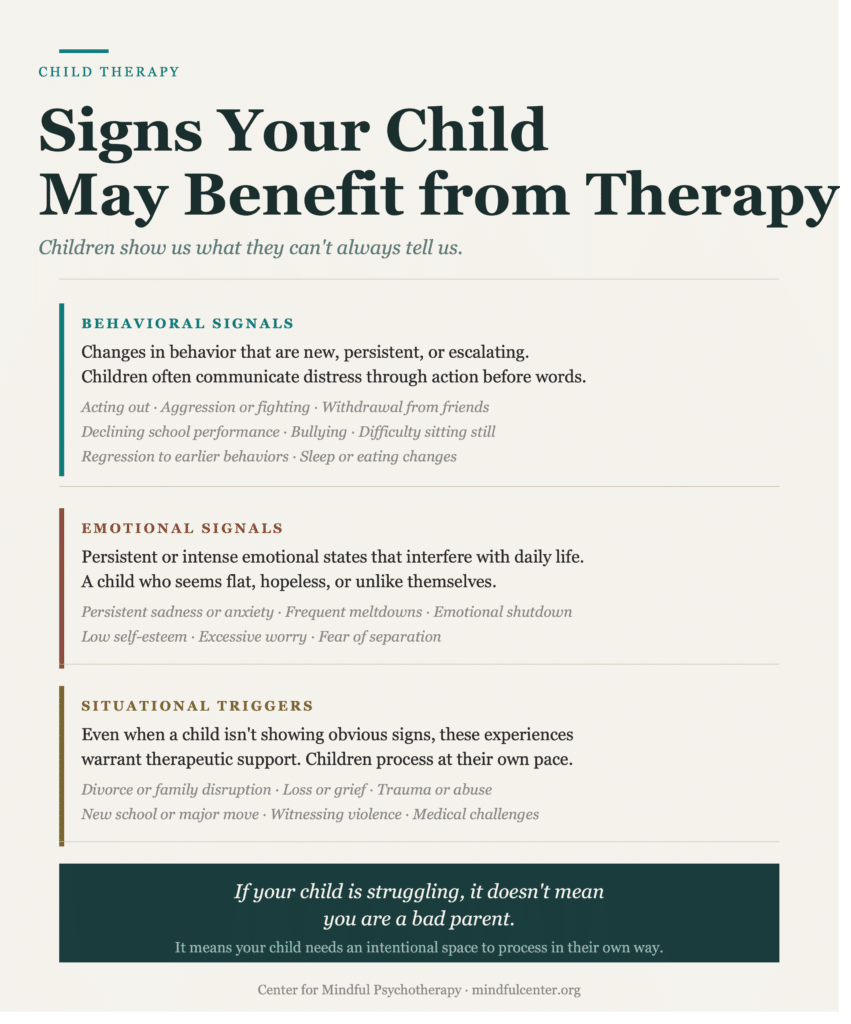
Children communicate distress in many different ways, and not all of them are obvious. Some children act out. Others withdraw. Some develop physical symptoms with no clear medical cause. Signs that a child might benefit from therapeutic support include:
- Significant changes in behavior, mood, or personality
- Persistent anxiety, worry, or fear that interferes with daily life
- Withdrawal from friends, family, or activities they previously enjoyed
- Regression to earlier developmental stages, such as bedwetting in an older child
- Sleep disturbances, nightmares, or significant changes in eating
- Difficulty regulating emotions, including frequent meltdowns or emotional shutdowns
- Behavioral challenges at school or at home that are escalating or persistent
- Excessive aggression, impulsivity, or difficulty with peer relationships
- Exposure to trauma, loss, abuse, or significant family disruption
- Low self-esteem, self-criticism, or statements suggesting hopelessness
- A significant life transition that the child is struggling to adjust to
If your child has experienced a traumatic event, abuse, or significant loss, therapy is an important resource even if they are not showing obvious signs of distress. Children process differently and at different timelines than adults, and early support can prevent lasting effects.
If you are uncertain whether your child needs therapy, reaching out for a consultation is always appropriate. Our therapists can help you assess what kind of support, if any, makes sense for your child’s specific situation.
What Child Therapy Looks Like
Child therapy looks different from adult therapy. Sessions with children are structured around modalities that fit how children actually make meaning, express emotion, and process experience. The therapeutic relationship is central, but the way that relationship develops often happens through activity rather than conversation.
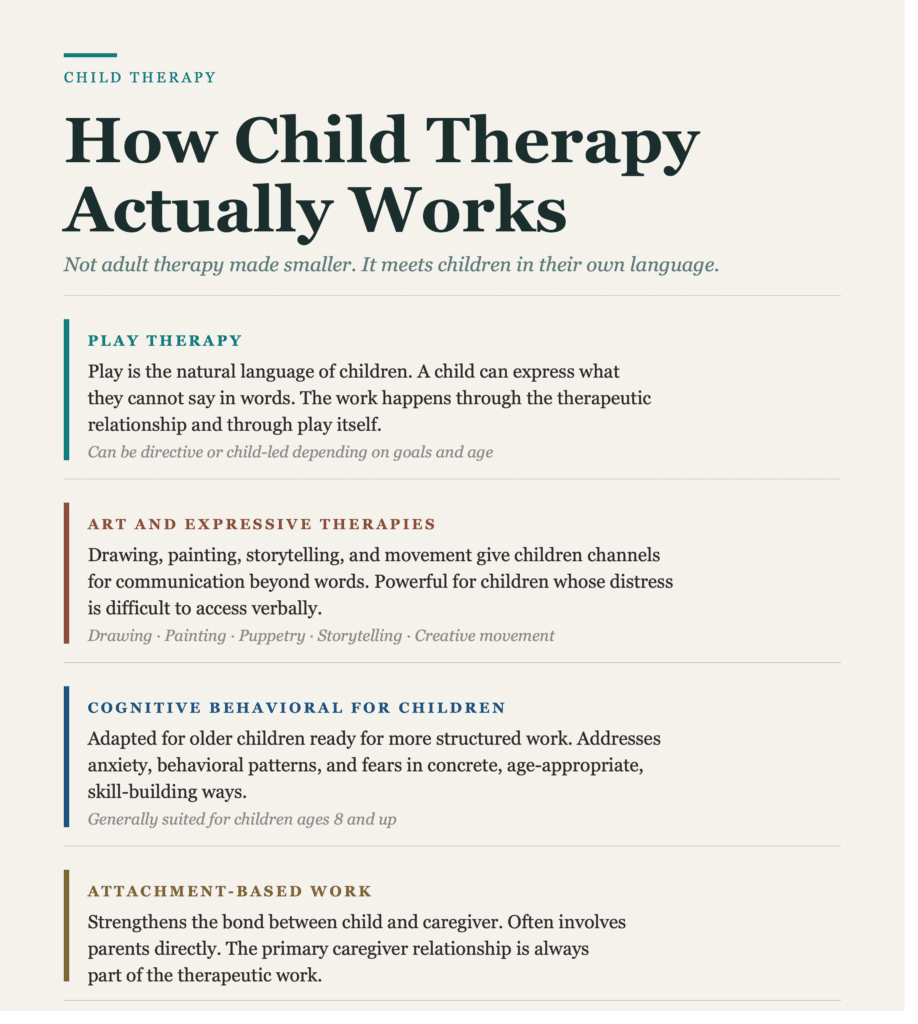
Play Therapy
Play is the natural language of children. In play therapy, the therapist creates a safe, structured environment where a child can express what they may not be able to say in words. Through play, children communicate their inner world, work through difficult experiences, and develop new capacities for emotional regulation and relationship. Play therapy can be directive (where the therapist guides the play toward specific goals) or non-directive (where the child leads and the therapist follows).
Art and Expressive Therapies
Drawing, painting, storytelling, puppetry, and other expressive modalities give children additional channels for communication and processing. For children who are particularly visual or creative, or for those whose distress is difficult to access verbally, expressive approaches can be especially powerful.
Cognitive Behavioral Approaches for Children
For older children and those ready for more structured work, cognitive behavioral approaches can be adapted to address anxiety, behavioral patterns, and specific fears in ways that are concrete, skill-building, and age-appropriate.
Attachment-Based Work
Much of what children bring to therapy is rooted in attachment: the early relationships with caregivers that shape how children experience safety, connection, and their own worthiness of love. Attachment-based approaches with children often involve the parents or caregivers directly, strengthening the primary relationship that is most important to a child’s security.
What Child Therapy Addresses
Our therapists work with children navigating a wide range of challenges, including:
- Anxiety and separation anxiety
- Depression and persistent sadness
- Trauma, including witnessing violence, abuse, or loss
- Grief and bereavement
- Behavioral challenges at school or home
- ADHD and attention-related difficulties
- Autism spectrum conditions and other neurodevelopmental differences
- Learning disabilities and the emotional impact of academic struggles
- Peer relationship difficulties and social skills challenges
- Bullying, whether as a target or as someone engaging in bullying
- Effects of divorce, family conflict, or significant family change
- Adjusting to a new sibling, school, home, or family configuration
- Gender identity and expression exploration
- Cultural identity and belonging
- Sleep difficulties and night fears
- Eating concerns and body image in younger children
- Low self-esteem and difficulty with self-compassion

The Role of Parents and Caregivers
Child therapy at CMP is not a closed door between your child and a therapist. Parents and caregivers are considered essential partners in the work.
In most cases, therapists meet with parents or caregivers regularly, either at the start or end of sessions or in separate parent meetings, to share what is being worked on (in age-appropriate ways that respect the child’s developing sense of privacy), discuss what is happening at home, and give parents strategies they can use to support their child’s progress between sessions.
For many children, especially younger ones, the most powerful change comes not from what happens in the therapy room but from shifts in how parents and caregivers respond to and understand their child. Parent coaching is often woven into child therapy for this reason.
When Parents Need Support Too
Parenting a child who is struggling is hard, and it can bring up a great deal in parents: worry, guilt, confusion, and sometimes memories of their own difficult childhood experiences. If you find yourself needing support as you navigate your child’s challenges, individual therapy or parent coaching is available through our collective as well.

Frequently Asked Questions
At what age can children start therapy?
Children can benefit from therapeutic support from a surprisingly young age. Play therapy and attachment-based work can be effective with very young children, sometimes as young as two or three. The approach is tailored to the child’s developmental stage. If you have a very young child you are concerned about, a consultation can help determine whether and what kind of support makes sense.
“Increasingly, psychologists are also advancing the notion that mental health starts at birth and requires a relational approach that includes both children and caregivers. Beyond reducing adverse childhood experiences (ACEs), the field is exploring how to bolster the positive aspects of childhood, which are now known to help buffer the risks linked to ACEs,” according to a 2026 Monitor on Psychology article by Zara Abrams.
Is child therapy the same as therapy for teens?
Child therapy and teen therapy share some foundational principles, but they are genuinely different in practice. Child therapy, which typically serves children up to around age 12, relies heavily on play, art, and expressive modalities because younger children process experience through action and imagination rather than conversation. Adolescent therapy, by contrast, works with a young person who is developmentally closer to an adult, with a more developed capacity for verbal reflection, a strong need for autonomy and confidentiality, and a distinct set of concerns around identity, peer relationships, and independence. The therapeutic relationship looks different, the approaches are different, and the role of parents is calibrated differently in each. If you are unsure which format is the right fit for your child, our therapists can help you think through what makes most sense based on their age, developmental stage, and what they are bringing.
My child says they don’t want to go to therapy. What should I do?
This is very common, especially with older children who may feel stigmatized or anxious about the unknown. Framing matters: many children do better when therapy is described as a special time to work on feelings with a helper, rather than something for people who have problems. Meeting the therapist first in a low-stakes way can also help. Ultimately, most children who are reluctant at first become engaged once they experience that therapy is not what they feared it would be.
Will my child’s therapist tell me everything that happens in sessions?
No, and this is intentional. Children, especially older ones, benefit from knowing that they have some degree of privacy with their therapist. This helps build the trust that makes therapy effective. Your child’s therapist will keep you appropriately informed about themes and progress, and will always disclose anything related to safety, but will not report everything your child says. If you have questions about confidentiality, discuss them directly with the therapist.
My child has been diagnosed with ADHD. Does therapy help?
Yes, though the kind of therapy matters. While therapy does not change the neurological underpinnings of ADHD, it can address the emotional, relational, and self-esteem dimensions that often accompany it. Children with ADHD frequently struggle with frustration, shame about their differences, peer relationships, and the impact of academic difficulties on how they see themselves. Therapy can address all of these, and can also give parents strategies for supporting their child more effectively.
What if my child is autistic? Is therapy helpful and appropriate?
Yes, though the approach matters enormously. We take a neurodiversity-affirming stance, which means our therapists who work with autistic children aim to support their wellbeing, self-understanding, and quality of life rather than seeking to “normalize” them or eliminate autistic traits. Therapy for autistic children might address anxiety, social navigation (on the child’s own terms), sensory challenges, or the emotional experiences that come with being neurodivergent in a world not designed for neurodivergent people.
Can child therapy be done via telehealth?
Yes, and it can be effective for many children, particularly older children and those who are already comfortable with screens. Play therapy and expressive approaches can be adapted for video with some creativity and the right materials. For younger children or those with very significant dysregulation, in-person may be preferable. Your child’s therapist will help you think through what format makes the most sense.
How long does child therapy typically take?
It depends on what your child is working on. Some children do shorter-term work of a few months around a specific transition or acute challenge. Others benefit from longer ongoing support. Progress in child therapy is also not always linear: children may seem to plateau or even temporarily regress before making significant leaps forward. Your child’s therapist will update you on progress and help you evaluate whether and when to continue.
Browse our Therapist Directory