


So, you are considering individual therapy…
- Do you feel disappointed in yourself, drained of energy, or lonely?
- Have you recently faced a life transition, and now you cannot seem to get back on a rewarding life path?
- Do burdensome emotions or racing thoughts interrupt you throughout your day?
- Are you struggling to find a peaceful state of mind amidst what seems like chaos?
- Do you wish you could live a calmer, more connected life and still be true to yourself?
- Would you like to achieve more, grow more, and feel more alive?
Browse our Therapist Directory
Sometimes the most important thing you can do for yourself is carve out an hour each week that belongs entirely to you. No agenda to meet, no one else’s needs to manage, no performance required. Just you and a therapist, working together toward something that matters.
Individual therapy at Center for Mindful Psychoherapy is available to adults and young adults throughout the San Francisco Bay Area, with telehealth sessions available to anyone in California. Our collective of o~125 Associate Marriage and Family Therapists brings genuine breadth of training across virtually every approach in contemporary psychotherapy, from somatic and body-based work to cognitive, relational, psychodynamic, and identity-affirming care.
People come to therapy for many different reasons. Maybe you know yours. Maybe you’re not sure. Either way is fine. You need only the sense that something could be different, and the willingness to explore what that might look like.
On This Page:
- What Is Individual Therapy?
- The Therapeutic Relationship
- Who Comes to Individual Therapy
- What Individual Therapy at CMP Addresses
- How We Approach Individual Therapy
- Individual Therapy via Telehealth in California
- About Our Therapists
- Frequently Asked Questions
What Is Individual Therapy?
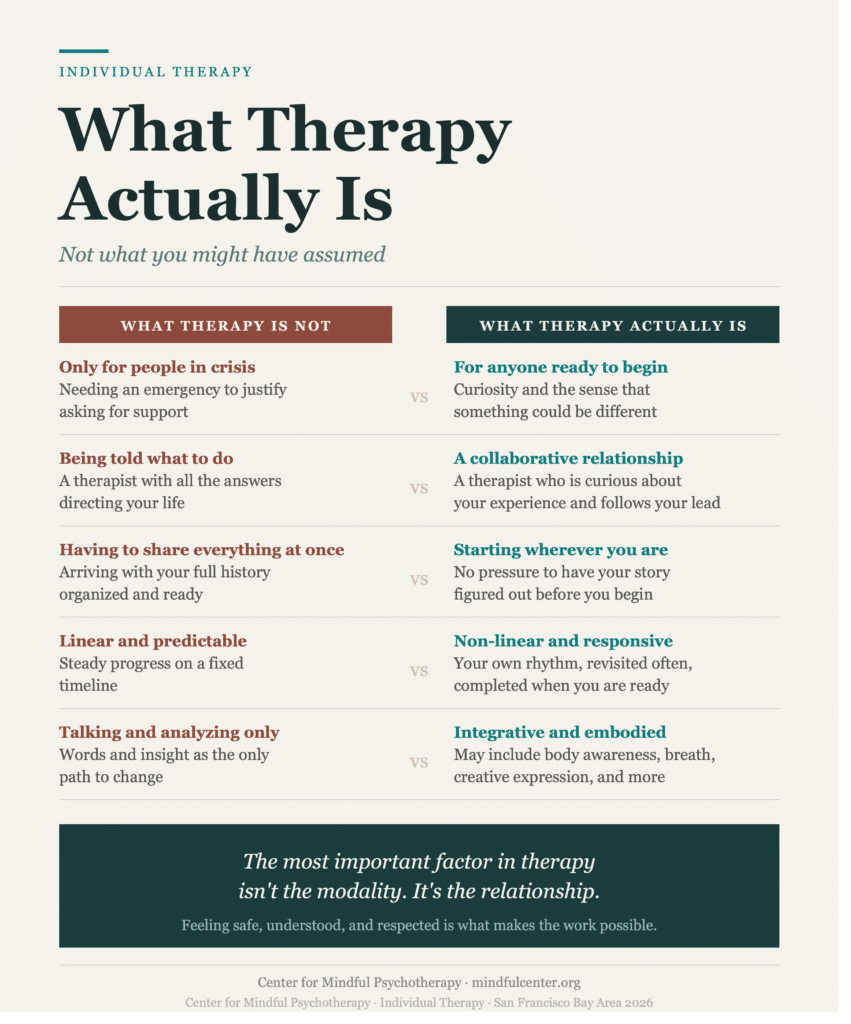
Individual therapy is a private, confidential relationship between one person and one therapist. Sessions are typically 50 minutes and happen weekly, though the frequency and duration can vary based on what you need, the type of therapy you’re doing, and the approach of your therapist.
What happens in a session depends on your therapist’s approach, your goals, and what you bring each week. Some sessions feel like deep conversation. Others involve specific practices: breathwork, body awareness, experiential exercises, or working with imagery and memory. Many involve both. The shape of the work is always responsive to you, not fixed in advance.
Early sessions usually focus on getting to know each other. Your therapist will ask questions, listen carefully, and begin to develop a picture of who you are, what you’re carrying, and what might help. Building a sense of safety and trust is not a preliminary step before the real work begins. For most people, it is where the work begins.
The Therapeutic Relationship
Research on what makes therapy effective consistently points to one thing above all others: the quality of the relationship between client and therapist. Sure the specific modality might matter, the theoretical framework could influence results, the therapist’s training is a factor consider, but none of those are the most important thing. The relationship is the most important thing.
A good therapist is not someone who tells you what to do or who has all the answers. They are someone who is genuinely curious about your experience, who can hold difficult emotions without flinching, who challenges you in ways that feel respectful rather than harsh, and who stays present with you through the uncertainty that real change requires.
We encourage everyone who is starting therapy to trust their instincts about fit. If after a few sessions something does not feel right, it is completely appropriate to try a different therapist. Finding the right therapist match sometimes takes a try or two, and that is a normal and valuable part of the process.
Who Comes to Individual Therapy
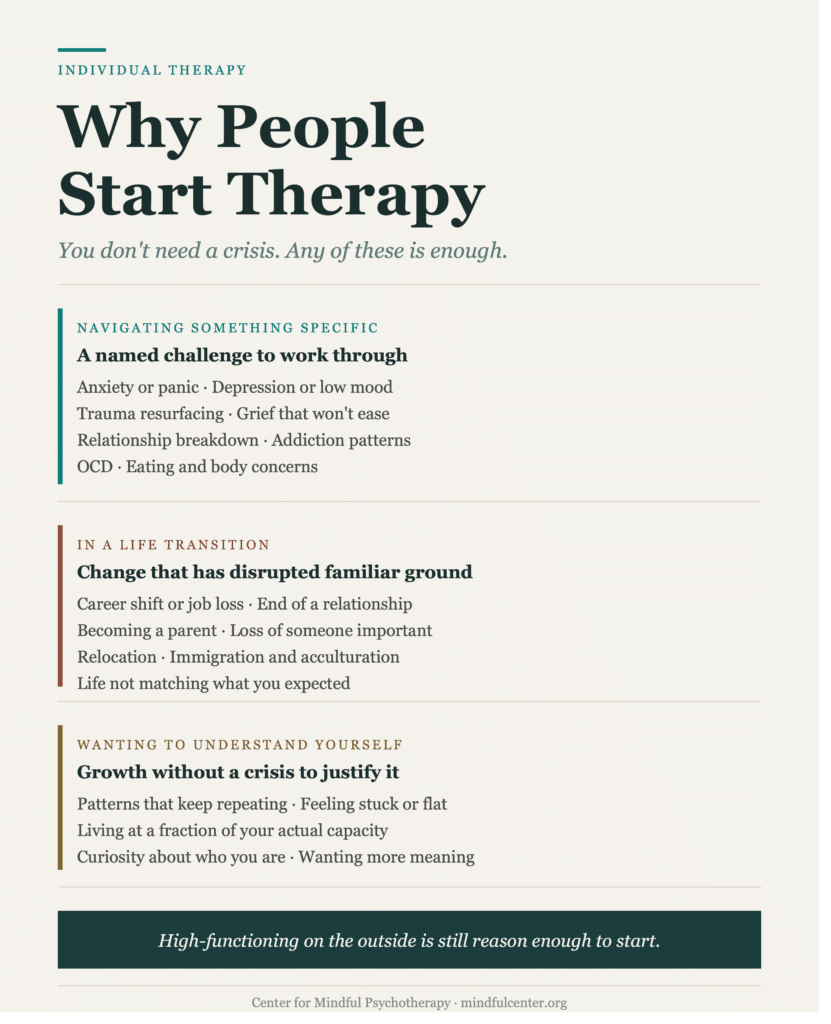
People come to individual therapy at every stage of life and for an enormous range of reasons. Some arrive with something specific they want to address. Others arrive knowing only that something feels off, and that they want support in figuring out what. There’s no right or wrong way to show up to therapy.
People Navigating a Specific Challenge
Anxiety that has become unmanageable. Depression that has settled in and will not lift. A trauma response that surfaces without warning. A relationship that has broken down. Grief that does not ease with time. A pattern of behavior that keeps causing harm despite every intention to change. These are some of the most common reasons people come to therapy, and they are reasons that respond well to skilled, sustained support.
People in Transition
Major life transitions, even welcome ones, ask something of us psychologically. Career changes, relocations, the end of a relationship, the beginning of one, becoming a parent, losing a parent, graduating, retiring: these moments disrupt the familiar structures that give daily life its shape. Therapy can help you find your footing, process what is actually happening, and move forward with more clarity and intention.
Living in the Bay Area brings its own particular version of this pressure. The cost of living forces difficult choices. The pace of the tech industry can crowd out everything else. High outward achievement can coexist with profound inner emptiness. Many of our clients come to therapy not because their life looks bad from the outside, but because something important is missing from the inside.
People Who Want to Understand Themselves Better
Not everyone who comes to therapy is in crisis or facing a specific problem. Some people come because they recognize patterns in themselves they want to understand, old dynamics that keep repeating in relationships, ways of being that once made sense but no longer fit, a sense of living at a fraction of their actual capacity. This kind of work is some of the most meaningful therapy there is, and it does not require a problem statement to justify it.
What Individual Therapy at CMP Addresses
Our therapists work across the full spectrum of challenges that adults and young adults bring to therapy. This includes, but is not limited to:
- Anxiety, panic, and chronic stress
- Depression and mood-related struggles
- Trauma and PTSD, including complex and developmental trauma
- Grief and loss in all their forms
- Relationship patterns, attachment wounds, and difficulty with intimacy
- Identity questions including gender, sexuality, cultural identity, and life purpose
- Work stress, burnout, and career-related concerns
- Life transitions including moves, job changes, relationship shifts, and parenthood
- Eating disorders and body image concerns
- OCD, perfectionism, and self-criticism
- Addiction and recovery, including harm reduction approaches
- Immigration, acculturation, and belonging
- Chronic illness and the emotional dimensions of physical health
- Neurodivergence and the challenges of navigating systems not designed for your mind
- Psychedelic integration
- Growth, self-discovery, and the quieter work of becoming more fully yourself
You do not need to identify precisely with any category. If something here resonates, or if you are simply carrying something you are ready to bring to therapy, that is enough to start.
Find a therapist working with the issues of most concern to you by filtering through the “what we help” dropdown box in our therapist directory.
How We Approach Individual Therapy
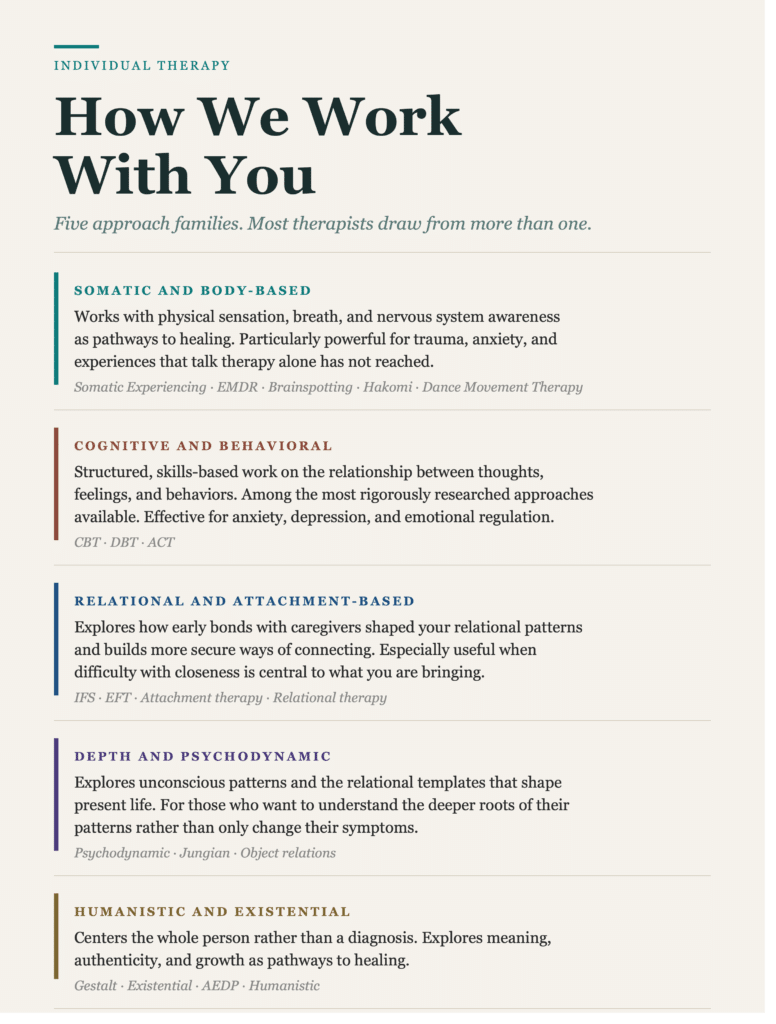
Center for Mindful Psychotherapy is integrative by nature. Our therapists are trained across multiple therapeutic traditions and draw from what each client actually needs rather than applying a single framework to everyone. Mindfulness is woven through much of our work, not as a practice separate from therapy but as an orientation: an attention to present-moment experience that deepens whatever else is happening in the room.
Some of the different approaches therapists may use:
Somatic and Body-Based Approaches
Many of our therapists incorporate body awareness, breath, and nervous system work into individual therapy. These approaches are particularly valuable for trauma, anxiety, and the physical dimensions of emotional experience, and can reach material that purely cognitive approaches sometimes cannot.
Specific somatic modalities available through our collective include Somatic Experiencing, EMDR, Brainspotting, Hakomi, and Relational Somatic Healing.
Cognitive and Behavioral Approaches
For clients who benefit from structured, skills-based work, our therapists offer CBT, DBT, and ACT.
These approaches are among the most rigorously researched in psychotherapy and are particularly effective for anxiety, depression, emotional regulation, and building concrete tools for daily life.
Relational and Attachment-Based Approaches
For clients whose challenges are primarily relational, including difficulty with closeness, attachment patterns formed in early life, or recurring dynamics in relationships, our therapists draw from IFS, EFT, attachment theory, and relational approaches.
Depth and Psychodynamic Approaches
For clients interested in understanding the deeper roots of their patterns, including the unconscious material, early experiences, and relational templates that shape present life, our therapists offer psychodynamic, Jungian, and depth-oriented work.
Humanistic and Existential Approaches
For clients drawn to questions of meaning, authenticity, and growth, our therapists practice humanistic, existential, Gestalt, and AEDP approaches that center the whole person rather than a diagnosis.
Find a therapist working in your preferred modalities by filtering through the “how we help” dropdown box in our therapist directory.

Individual Therapy via Telehealth in California
Most of our therapists offer video sessions through a secure platform, which means you can access individual therapy from anywhere in California. Telehealth sessions function much like in-person sessions for most concerns and are often preferred by clients who value the convenience, privacy, or accessibility of working from home.
If you are in the San Francisco Bay Area, some therapists also offer in-person sessions at various locations. Availability varies by therapist. You can find in-person availability information in individual therapist profiles in our directory.
About Our Therapists
CMP therapists are Associate Marriage and Family Therapists, graduate-trained clinicians who are completing their supervised hours toward full licensure. The MFT training model is systemically and relationally oriented by nature, which means our therapists are trained to understand individuals within the context of the relationships and systems they inhabit.
All CMP therapists work under clinical supervision, which means every client benefits from an additional layer of oversight that many private practices do not provide. Supervision also ensures that our therapists are continuously growing, reflecting on their work, and bringing fresh perspective to each client.
Our collective is intentionally diverse in background, identity, training, and approach. We believe that a therapist who shares relevant aspects of your identity or experience can offer something that a skilled but demographically different therapist cannot, and we have worked to build a collective that reflects the genuine diversity of the Bay Area and California.

Frequently Asked Questions about Individual Therapy
How do I know if I need individual therapy or couples therapy?
The two are not mutually exclusive. Many people do both simultaneously, working on relational dynamics with a partner in couples therapy while also doing individual work on their own patterns. If you are uncertain, a good starting question is what feels most pressing: something about you, or something about a relationship? That can point you in a direction. You can also contact us and we will help you think it through.
What is the difference between a therapist and a counselor?
In California, therapists and counselors often hold similar training. MFTs (Marriage and Family Therapists), LCSWs (Licensed Clinical Social Workers), and psychologists all provide psychotherapy. Our therapists are Associate MFTs, meaning they have completed their graduate training and are working toward full licensure under clinical supervision. The level of care is the same as with a licensed therapist; the difference is the supervisory structure.
I’ve tried therapy before and it didn’t help. Why would this be different?
There are a few reasons therapy might not have helped in the past. The fit with the therapist may not have been right. The approach may not have matched what you actually needed. Or the timing may not have been right for you. All of these are worth thinking about before trying again. If you can identify what felt missing or ineffective in past experiences, that information is genuinely useful for finding a better fit. Many people who felt therapy didn’t help eventually find an approach and a therapist that changes their experience entirely.
How long does individual therapy take?
There is no standard answer because it depends entirely on what you are working on and what you want from therapy. Brief, focused work on a specific issue might take 8 to 16 sessions. Deeper work on long-standing patterns, trauma, or significant life questions often unfolds over months or longer. Many people also find that therapy is most valuable as an ongoing practice rather than a finite course of treatment. You and your therapist will revisit goals and progress regularly, and you are always in control of when you’re ready to complete your work together.
Do I have to talk about my childhood?
Not necessarily. Some therapeutic approaches are very present-focused and do not require excavating the past. Others, like psychodynamic or attachment-based work, do explore how earlier experiences shape current patterns. What you explore in therapy depends on what you want to work on and the approach your therapist uses. If you have a strong preference either way, it is worth mentioning that when you are looking for a therapist.
Can I do therapy if I have never been in therapy before?
Absolutely, and many people find that starting therapy before a crisis is one of the best decisions they’ve made. There is no required level of distress or experience to begin. Many first-time clients feel nervous about what therapy involves or whether they will do it right. Your therapist will orient you, answer your questions, and pace the work to what feels manageable. You do not need to arrive knowing how to be in therapy.
I’m a high-functioning person. Is therapy still relevant for me?
Yes, and you would be in very good company at CMP. Many of our clients are high-achieving, outwardly successful people who nonetheless feel that something important is missing, or that they are living at a fraction of their actual capacity. Functioning well on the outside does not mean everything is working on the inside. Therapy is not only for people in crisis; it is for anyone who wants to understand themselves more deeply and live with greater intention and meaning.
Browse our Therapist Directory