
Reviewed by Kathryn Vercillo, MA Psychology | Last Updated: November 2025
What is Relational Somatic Healing?
Relational Somatic Healing (RSH) is a body centered therapeutic approach that addresses emotional and psychological challenges by integrating the wisdom of the body with the healing power of authentic human connection. Unlike talk therapy alone, RSH uses breathwork, mindful movement, and therapeutic touch to access and transform patterns stored in the nervous system.

Body centered healing for Bay Area residents seeking deeper transformation
When emotional pain lives in the body, words alone cannot release it. For residents of the San Francisco Bay Area seeking therapy that honors the profound connection between physical sensation and emotional experience, Relational Somatic Healing offers a path forward that traditional approaches often miss.
RSH therapy recognizes that our earliest experiences, relationships, and traumas leave imprints not just in our memories but in our muscles, posture, breath patterns, and nervous system responses. A tightness in the chest when speaking up, a collapse in the shoulders when facing criticism, a held breath when anticipating conflict: these somatic patterns carry stories that verbal processing alone cannot fully address.
At Center for Mindful Therapy, our associate therapists bring specialized training in somatic approaches to their work with Bay Area clients. Some of our therapists throughout Oakland, San Francisco, Berkeley, and surrounding communities offer in-person somatic sessions, including RSH sessions, while telehealth options extend access to clients throughout California. Each therapist works under individual clinical supervision, ensuring that this nuanced body centered work unfolds with appropriate guidance and support.
What distinguishes RSH from other somatic therapies is its explicit emphasis on the relational field between therapist and client as a primary vehicle for healing. The quality of presence, attunement, and authentic connection that develops in the therapeutic relationship creates the conditions for deep somatic reorganization. Your therapist serves not as a distant expert but as a collaborative partner, educator, and compassionate witness to your unfolding process.
Browse our Therapist Directory
On This Page:
- Understanding Relational Somatic Healing
- How RSH Therapy Works
- The Role of Therapeutic Touch
- Conditions RSH Therapy Addresses
- Who Benefits Most from RSH
- RSH Compared to Other Somatic Approaches
- Accessing Body Centered Therapy Through Our Collective
- Beginning Your RSH Journey
- Frequently Asked Questions About RSH
Understanding Relational Somatic Healing
Relational Somatic Healing emerged from the integration of Western somatic psychology traditions with Eastern contemplative practices, creating a therapeutic framework that honors the inseparability of body, mind, heart, and spirit. This approach draws from the pioneering work of body psychotherapy, attachment theory, polyvagal research, and mindfulness traditions to offer a comprehensive path toward healing and wholeness.
The foundations of body centered psychotherapy
The body remembers what the mind may forget or suppress. This fundamental insight, now supported by extensive neuroscience research, forms the cornerstone of all somatic approaches to healing. When we experience overwhelming stress, trauma, or relational wounding, our nervous systems encode these experiences in specific patterns of muscular tension, breathing restriction, postural organization, and autonomic arousal.
Consider how anxiety often manifests as shallow chest breathing, tight shoulders, and a forward leaning posture of vigilance. Or how depression frequently appears in the body as collapsed chest, restricted breath, and diminished vitality in the limbs. These are not merely symptoms accompanying psychological states; they are integral components of how those states perpetuate themselves.
RSH therapy works directly with these embodied patterns, helping clients develop awareness of their somatic experience while creating conditions for reorganization and release. This process unfolds not through force or aggressive intervention but through mindful attention, compassionate presence, and the safety of an attuned therapeutic relationship.
Eastern wisdom meets Western psychology
What distinguishes RSH from purely clinical approaches is its integration of contemplative and spiritual dimensions of healing. Drawing from yoga philosophy, Buddhist mindfulness traditions, and other wisdom lineages, RSH honors the spiritual aspects of human experience without imposing any particular belief system.
Practices like breath awareness, present moment attention, and compassionate self observation are woven throughout RSH work. These contemplative elements support the development of what practitioners call “witness consciousness,” the capacity to observe one’s experience without being completely identified with or overwhelmed by it.
This integration proves particularly valuable for Bay Area residents who often seek therapeutic approaches that honor their interest in mindfulness, yoga, or other contemplative practices. RSH creates natural bridges between personal healing work and broader spiritual development.
The primacy of relationship
Perhaps the most distinctive feature of RSH is its explicit recognition that healing happens within and through relationship. The therapeutic relationship is not merely a backdrop against which techniques are applied; it is itself the primary instrument of transformation.
This relational emphasis reflects attachment theory research demonstrating that early relational experiences shape our nervous systems, our sense of self, and our patterns of connection with others. Secure attachment relationships literally build the neural architecture for emotional regulation, self soothing, and healthy interdependence.
For many clients, the therapeutic relationship in RSH becomes a corrective relational experience, offering the attunement, consistency, and safety that may have been missing in earlier formative relationships. Through this embodied experience of healthy connection, new possibilities emerge not just cognitively but cellularly.

How RSH therapy works
Understanding what actually happens in RSH therapy helps potential clients envision how this approach might support their healing journey. While each session unfolds uniquely based on what arises in the moment, certain elements and processes characterize RSH work.
Cultivating somatic awareness
A foundational skill developed in RSH is the capacity to notice and track bodily sensations with curious, nonjudgmental attention. Many people arrive in therapy disconnected from their bodies, either through habitual dissociation, chronic stress, or cultural conditioning that privileges thinking over feeling.
Your therapist will guide you in slowing down and turning attention inward, noticing perhaps a subtle tightness in the throat, a sensation of warmth in the belly, or a quality of numbness in the arms. This may sound simple, but for many clients it represents a profound shift in how they relate to their own experience.
This somatic awareness serves multiple functions. It provides real time information about emotional states and relational dynamics. It anchors attention in present moment experience rather than rumination about past or future. And it creates the foundation for deeper somatic processing work.
Working with breath and energy
Breath patterns both reflect and influence our emotional and physiological states. Chronic anxiety often involves restricted, shallow breathing. Depression may manifest as diminished respiratory vitality. Old trauma frequently lives in held breath patterns that developed as survival responses.
RSH therapists are trained to observe and work skillfully with breath. This might involve simply bringing awareness to natural breathing patterns, or it might include guided breathwork practices designed to access and release held energy. Some RSH therapists incorporate specific pranayama techniques from yoga traditions.
Beyond breath, RSH recognizes what many traditions call life force energy, known as prana in yoga, chi in Chinese medicine, or simply vitality in Western terms. Sessions often involve tracking and supporting the natural flow of this energy through the body, noticing where it moves freely and where it seems blocked or diminished.
Mindful movement and embodiment practices
Unlike therapies conducted entirely while seated, RSH frequently incorporates movement. This might include gentle stretching, expressive movement, yoga postures, or simple walking. Movement practices serve to release physical tension, integrate insights somatically, and support clients in inhabiting their bodies more fully.
These movement elements are always introduced with sensitivity to each client’s comfort level and physical capacity. The goal is never performance or achieving particular postures but rather using movement as a vehicle for awareness, expression, and integration.
The processing of difficult material
When RSH work touches on traumatic memories, overwhelming emotions, or deeply held patterns, specific skills come into play. Therapists help clients pendulate between challenging material and stabilizing resources, preventing overwhelm while allowing genuine processing to occur.
This might look like inviting a client to notice a distressing sensation, then directing attention to an area of the body that feels neutral or pleasant, then returning to the difficult material with greater capacity. This rhythm of contact and release allows the nervous system to digest experiences that were previously too overwhelming to fully process.

The role of therapeutic touch in RSH
One distinctive element of Relational Somatic Healing that sets it apart from most talk therapy approaches is the thoughtful, ethical integration of touch. This aspect deserves particular attention both because of its powerful healing potential and because it raises important considerations around boundaries and consent.
Understanding somatic touch as therapeutic tool
Touch, when offered skillfully within a carefully boundaried therapeutic container, can access dimensions of healing that verbal processing alone cannot reach. Developmental trauma, attachment wounds, and experiences of physical violation leave imprints in the body’s tissue that may respond more readily to somatic intervention than to cognitive approaches.
Therapeutic touch in RSH is not massage, though it shares some similarities. It might involve a therapist placing a hand on a client’s shoulder, supporting the back during breathwork, or offering grounded physical presence while difficult emotions move through. The quality of this touch is characterized by attunement, presence, and deep respect.
Research on attachment and the nervous system supports the healing potential of appropriate touch. Physical contact can stimulate oxytocin release, activate the ventral vagal system associated with safety and connection, and provide missing developmental experiences of being held and supported.
Consent, boundaries, and safety
Any ethical discussion of therapeutic touch must foreground consent and boundaries. In RSH practice, touch is always optional, never required. Clients maintain full agency over whether and how touch is incorporated into their sessions.
Before any touch occurs, therapists discuss the rationale and invite explicit consent. Ongoing consent is maintained throughout, with clients encouraged to communicate immediately if any touch becomes unwanted or uncomfortable. This emphasis on agency can itself be healing for clients whose boundaries were violated in past experiences.
Not all RSH therapists incorporate touch in their work, and for some clients, particularly those with histories of physical or sexual trauma, touch may not be appropriate or may be introduced only very gradually after extensive relational groundwork. The guiding principle is always what serves each individual client’s healing, not any prescribed protocol.
When touch is offered via telehealth
For clients working with RSH therapists via telehealth, direct touch from the therapist is obviously not possible. However, RSH approaches can still be highly effective remotely. Therapists guide clients in self touch practices, directing attention to placing their own hands on areas of tension or need. The relational attunement and verbal guidance from the therapist supports this self directed somatic work.
Many Bay Area clients work with their RSH therapists through a combination of in-person and telehealth sessions, allowing for deeper somatic work when meeting face to face while maintaining connection and continuity through video sessions.

Conditions RSH therapy addresses
Relational Somatic Healing offers particular benefits for a range of psychological and emotional challenges, especially those involving the body’s encoding of difficult experiences. The following conditions represent areas where RSH demonstrates notable effectiveness.
Trauma and post traumatic stress
Trauma fundamentally changes the body. The nervous system, primed for threat detection, may remain stuck in states of hypervigilance or shutdown long after the original danger has passed. Physical tension patterns develop as the body armors itself against anticipated threats. Sleep disruption, startle responses, and intrusive sensations reflect the body’s ongoing processing of unresolved traumatic material.
RSH approaches trauma as a somatic phenomenon requiring somatic resolution. While understanding the story of what happened matters, RSH emphasizes helping the body complete defensive responses that were thwarted during the traumatic event. This might involve supporting a client’s body in finally fighting back, fleeing, or discharging the immense energy mobilized during threat.
The relational dimension of RSH proves crucial in trauma work. Traumatic experiences often involve betrayal, violation, or abandonment by other humans. Healing occurs through new relational experiences that restore trust in human connection and demonstrate that safety and attunement are possible.
Bay Area residents with histories of single incident trauma, complex developmental trauma, or ongoing traumatic stress find RSH particularly effective because it addresses not just cognitive symptoms but the body’s persistent traumatic activation.
Anxiety disorders and chronic worry
Anxiety lives in the body as much as in the mind. Racing heart, shallow breath, tight muscles, restless energy: these somatic experiences both reflect and perpetuate anxious states. Traditional talk therapy addresses anxious thoughts, which matters, but often fails to directly shift the body’s anxiety patterns.
RSH works with anxiety on multiple levels. Breath practices directly influence the autonomic nervous system, shifting from sympathetic activation toward parasympathetic calm. Movement helps discharge the excess energy that accumulates when the nervous system remains in chronic alert. Somatic awareness practices interrupt the automatic escalation of anxiety by anchoring attention in present moment bodily experience.
Perhaps most importantly, the safe relational container of RSH therapy provides corrective experiences for anxious attachment patterns. Many people with chronic anxiety developed their hypervigilance in unpredictable or frightening early environments. The consistent, attuned presence of an RSH therapist offers new reference experiences of relational safety.
Depression and low vitality
Depression often manifests somatically as a quality of deadness, heaviness, or absence. Breath becomes shallow and less vital. Posture collapses. Energy withdraws from the limbs. The body seems to be enacting a kind of giving up.
RSH approaches depression through careful attention to these somatic patterns while respecting the protective functions they may serve. Sometimes depressive collapse represents the body’s wisdom in withdrawing from environments or demands that were genuinely overwhelming. The task is not to forcibly energize a depressed body but to create conditions where natural vitality can safely return.
Breath and movement practices gently invite more energy into the system. The warm, engaged presence of the therapist counters the isolation that often accompanies depression. Over time, clients frequently report feeling more alive, more present in their bodies, more connected to their own desires and interests.
Attachment wounds and relationship patterns
Our earliest relationships with caregivers literally shape our nervous systems. Patterns of reaching out and withdrawing, trusting and protecting, depending and becoming independent, all develop through countless interactions in infancy and childhood. When these early experiences were marked by inconsistency, neglect, intrusion, or misattunement, the resulting attachment patterns affect all subsequent relationships.
RSH is especially well suited to attachment work because it explicitly uses the therapeutic relationship as a context for new relational experiences. The therapist’s consistent presence, reliable attunement, and capacity to repair inevitable ruptures provides experiences that can update the nervous system’s relational templates.
Somatic awareness helps clients notice their habitual attachment patterns as they arise. The impulse to withdraw, the fear of dependency, the desperate clinging when connection threatens to end: these patterns show up in the body and can be tracked, understood, and gradually modified through embodied relational work.
Grief and loss
Grief is not a problem to be solved but a natural human response to loss that requires space to move through the body and psyche. Yet many people feel pressure to “get over” their grief quickly, or they become stuck in prolonged grief that seems unable to complete itself.
RSH honors grief as a somatic process, not merely a cognitive one. The weight of sorrow in the chest, the waves of tears that need release, the physical ache of missing someone: these experiences are welcomed and supported rather than pathologized or rushed.
The relational holding in RSH allows clients to grieve in the presence of a compassionate witness. For many, especially those whose grief was dismissed or whose losses were never acknowledged, this companioned grieving is itself profoundly healing.
Stress related physical conditions
The connection between psychological stress and physical health is now well established. Chronic tension, digestive problems, headaches, immune dysfunction, and many other physical symptoms often have significant stress components.
While RSH does not treat medical conditions, it can support healing when psychological stress contributes to physical symptoms. Learning to recognize and release chronic muscular tension, developing greater stress tolerance through nervous system regulation skills, and processing the emotions that may be expressing themselves somatically all contribute to improved physical wellbeing.
Bay Area residents dealing with stress related symptoms find RSH particularly valuable because it directly addresses the body rather than treating physical and psychological symptoms as separate issues.
Burnout and exhaustion
Modern life, particularly in high pressure professional environments common throughout the San Francisco Bay Area, frequently produces states of burnout and depletion. The nervous system becomes chronically activated, unable to fully rest even during time off. Adrenal resources become depleted. A bone deep exhaustion sets in that sleep alone cannot remedy.
RSH addresses burnout by helping the nervous system recalibrate toward greater parasympathetic capacity. Breath practices, gentle movement, and the experience of being received without demand all support the shift from chronic activation toward genuine rest and restoration.
Beyond symptom relief, RSH helps clients explore the underlying patterns, often rooted in early experiences, that drive them toward overwork and self neglect. This deeper work creates conditions for sustainable change rather than merely temporary relief.

Who benefits most from RSH
While Relational Somatic Healing can support healing for many people, certain individuals find this approach especially aligned with their needs and preferences.
People who feel disconnected from their bodies
Some people arrive in therapy aware that they live primarily “in their heads,” disconnected from physical sensation and embodied experience. This disconnection may have developed as protection from overwhelming physical or emotional experiences, or it may reflect cultural conditioning that devalues the body’s wisdom.
RSH offers a gradual, compassionate path toward greater embodiment. Rather than forcing reconnection, therapists create conditions where the body becomes safe enough to inhabit fully. Many clients describe this process as coming home to themselves in ways they had not known were possible.
Those who have tried talk therapy without full resolution
Many people seeking RSH have already engaged in significant talk therapy work. They may have gained valuable insights, developed understanding of their patterns, and even made important changes. Yet something still feels incomplete. Certain symptoms persist. Old patterns reassert themselves despite cognitive understanding.
For these individuals, RSH offers access to dimensions of experience that talk therapy alone may not have reached. The body holds material that the mind may have processed conceptually but not integrated somatically. RSH completes this integration.
Individuals interested in spirituality and personal growth
RSH’s integration of contemplative traditions with psychological healing appeals to those who sense that their struggles have spiritual as well as psychological dimensions. The approach honors questions of meaning, purpose, and connection to something larger without imposing specific beliefs.
Bay Area residents often appreciate this integration, as many are engaged with yoga, meditation, or other contemplative practices. RSH creates natural bridges between personal therapy work and broader spiritual development.
People seeking alternatives to medication centered treatment
While medication plays an important role in mental health treatment for many people, others prefer to explore non pharmacological approaches first or as complements to medication. RSH offers a pathway to nervous system regulation and emotional healing that does not rely on pharmaceuticals, though it can certainly be combined with medication when appropriate.
RSH compared to other somatic approaches
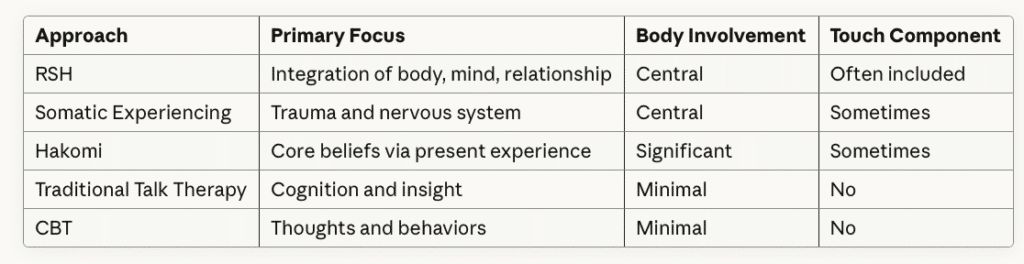
Several body centered therapeutic approaches exist, each with distinct emphases and methods. Understanding how RSH relates to these other modalities helps potential clients choose the approach that best fits their needs.
RSH and Somatic Experiencing
Somatic Experiencing (SE), developed by Peter Levine, focuses specifically on trauma resolution through tracking and completing the body’s thwarted defensive responses. SE emphasizes titration, working with small amounts of traumatic activation at a time, and pendulation between distressing and resourcing states.
RSH shares SE’s attention to the nervous system and somatic processing but places greater emphasis on the relational field and may incorporate touch and movement more extensively. Some RSH practitioners are also trained in SE and integrate both approaches.
RSH and Hakomi
Hakomi, developed by Ron Kurtz, is a mindfulness based somatic psychotherapy that uses the study of present moment experience to access core beliefs and patterns. Like RSH, Hakomi emphasizes the therapeutic relationship and uses mindfulness as a central tool.
RSH and Hakomi share significant common ground. One way you might look at it is that RSH might be considered a broader umbrella that can incorporate Hakomi methods while also drawing from other somatic traditions, yoga philosophy, and various contemplative practices.
RSH and traditional talk therapy
Traditional psychotherapy approaches like CBT, psychodynamic therapy, or humanistic therapy work primarily through verbal exchange. They develop insight, challenge distorted thinking, explore unconscious patterns, and process emotions through conversation.
RSH does not reject these cognitive and verbal dimensions but adds somatic and relational elements that many clients find essential for complete healing. Many people work with both an RSH therapist and a more traditional talk therapist, finding that the approaches complement each other.
Why choose body centered therapy through our collective
Center for Mindful Therapy offers a distinctive model for accessing quality therapeutic care throughout the San Francisco Bay Area and California. Understanding this model helps potential clients appreciate the unique value available through our collective.
Diverse practitioners with somatic training
Our collective includes associate marriage and family therapists who have pursued specialized training in body centered approaches. Some have completed formal RSH certification programs, while others bring training in Somatic Experiencing, Hakomi, yoga therapy, or other somatic modalities that inform their RSH oriented practice.
This diversity means that clients can find practitioners whose specific training and approach resonates with their needs. Some therapists emphasize trauma work, others focus on attachment and relationships, and still others specialize in particular populations or presenting concerns.
Supervised quality care
Each associate therapist in our collective works under individual clinical supervision with an experienced licensed clinician. This supervision structure ensures that even complex clinical situations receive appropriate oversight and guidance.
For clients, this means access to the enthusiasm, availability, and dedication of emerging therapists combined with the wisdom and oversight of senior clinicians. It is a model that prioritizes both accessibility and quality.
Accessible rates and flexible options
As associate therapists gaining hours toward licensure, our practitioners offer their services at rates lower than those of many licensed clinicians in the Bay Area. This makes body centered therapy accessible to clients who might otherwise be unable to afford this specialized work.
Some of our therapists throughout San Francisco, Oakland, Berkeley, Marin, and other Bay Area locations offer in-person sessions. Telehealth options extend access to clients throughout California. This flexibility allows clients to find arrangements that fit their preferences and circumstances.
Community and values alignment
Center for Mindful Therapy operates as a nonprofit collective guided by values of accessibility, diversity, and holistic wellbeing. Choosing to work with one of our therapists means supporting an organization committed to expanding access to quality mental health care.
Many Bay Area residents appreciate aligning their therapy investment with these values, knowing that their participation supports a mission of accessible, mindful, integrative care.

Beginning your RSH journey
Starting therapy requires courage, and starting body centered therapy may feel particularly vulnerable. The following information helps you understand what to expect as you begin RSH work through Center for Mindful Therapy.
Honoring your readiness
There is no universal right time to begin therapy. You may feel clearly ready, eager to engage. Or you may feel ambivalent, drawn toward healing but uncertain about the process. Both are valid starting points.
RSH honors your pace and agency. You will never be pushed to do more than you are ready for. The collaborative relationship between you and your therapist means that you remain in control of your own healing process while benefiting from your therapist’s expertise and support.
Your first session
Initial RSH sessions typically involve getting to know each other and establishing the foundation for your work together. Your therapist will be curious about what brings you to therapy, your history, your goals, and how you experience yourself in your body.
This first meeting is also about assessing fit. RSH work requires a particular quality of relational connection, and both you and the therapist are evaluating whether the match feels right. It is entirely appropriate to try sessions with more than one therapist before committing to ongoing work.
You might be invited to notice your present moment bodily experience, to bring attention to breath, or to observe sensations as you speak about difficult topics. This introduces you to the somatic attention that will deepen in subsequent sessions.
What ongoing sessions look like
After establishing the therapeutic foundation, RSH sessions typically follow the flow of present moment experience rather than a rigid structure. You might arrive with something specific you want to explore, or you might begin by simply noticing what is present in your body and psyche.
Sessions often include periods of conversation interspersed with more explicitly somatic work. Your therapist might invite you to close your eyes and track internal sensations, to experiment with different breathing patterns, or to engage in gentle movement. If touch is part of your work together, it might be offered to support what is arising.
The close of sessions typically includes time for grounding and integration. You might be invited to sense your body’s contact with the chair, to take some full breaths, or to orient to the room. This transition helps you return to daily life resourced rather than destabilized.
Between sessions
Healing continues between sessions. You may notice dreams arising that seem connected to your therapy work. Emotions may surface unexpectedly. Insights may dawn days after a session. These experiences are natural parts of the integration process.
Your therapist may offer simple practices to support you between sessions. These might include breath awareness exercises, self touch practices, or mindful movement suggestions. These are invitations rather than homework, and you remain free to engage with them as feels right.
Self care between sessions supports your nervous system’s capacity for healing. Adequate sleep, nourishing food, gentle movement, time in nature, and connection with supportive people all contribute to your wellbeing and your capacity for therapeutic work.
Finding your therapist
Our therapist directory allows you to browse practitioners who offer RSH and related somatic approaches. You can filter by specialties, identities, availability, and modality options including in-person or telehealth.
Reading therapist profiles gives you a sense of each practitioner’s voice, training, and approach. When you find someone who resonates, you can reach out to schedule an initial consultation.
If you are unsure where to start, contact us to help you navigate options and find a therapist suited to your needs.
Browse our Therapist Directory
Frequently asked questions about RSH

Q: How often should I attend RSH therapy sessions?
A: Most clients begin RSH therapy with weekly sessions, which allows sufficient time for integration between meetings while maintaining momentum in the work. Weekly frequency supports the development of the therapeutic relationship, which is central to RSH’s effectiveness. Your nervous system benefits from the regularity and predictability of consistent sessions, especially in the early stages of treatment.
As therapy progresses and you develop greater internal resources, some clients transition to biweekly sessions. Others find that the depth of RSH work benefits from maintaining weekly frequency even over longer periods. Your therapist will collaborate with you to find a rhythm that serves your healing goals, your nervous system’s capacity for processing, and your practical circumstances. There is no universal formula; the right frequency depends on the intensity of what you are working through, your resources for integration, and your overall stability.
Q: What happens if I become overwhelmed or have a strong emotional reaction during a session?
A: Experiencing intense emotions or sensations during RSH is both normal and often a sign that meaningful material is being accessed. Your therapist is specifically trained to help you navigate these moments safely. RSH practitioners use techniques like pendulation, which involves gently shifting attention between distressing material and neutral or pleasant sensations, to prevent overwhelm while still allowing genuine processing.
If you do become flooded, your therapist will guide you back to the present moment through grounding techniques. This might include feeling your feet on the floor, orienting to the room by noticing colors or objects, or focusing on your breath. Sessions always include time at the end for settling and integration, so you leave feeling grounded rather than destabilized. Part of the healing in RSH involves learning that intense experiences can arise and then pass, building your capacity to tolerate and move through difficult emotions rather than being controlled by them.
Q: I struggle to feel sensations in my body. Can RSH still work for me?
A: Yes, and in fact this is one of the most common starting points for RSH clients. Many people arrive in therapy with limited awareness of bodily sensations, a state sometimes called alexisomia. This disconnection often developed as an intelligent protective response to overwhelming experiences. When the body held too much pain, fear, or confusion, tuning it out became a survival strategy.
RSH approaches this gently, without any pressure to immediately access sensations you cannot yet perceive. Your therapist might begin with very simple practices, such as noticing the temperature of your hands or the weight of your body in the chair. Over time, with patience and safety, somatic awareness typically develops. Many clients who believed they simply could not feel their bodies discover that sensation was always there, waiting for conditions safe enough to be noticed. This gradual reconnection with embodied experience is itself a profound part of the healing journey.
Q: Do I need to describe my trauma in detail for RSH therapy to be effective?
A: No. Unlike some therapeutic approaches that emphasize detailed narrative processing, RSH works primarily with present moment bodily experience. You never need to recount traumatic events in graphic detail for healing to occur. In fact, excessive verbal retelling can sometimes retraumatize rather than heal, especially when the body is not included in the processing.
In RSH, you might reference that something difficult happened without describing specifics. The focus then shifts to how that experience lives in your body now: the tension in your shoulders, the constriction in your breath, the impulse to collapse or flee. Working directly with these somatic patterns allows transformation without requiring verbal elaboration of painful details. Some clients eventually choose to share more of their stories as trust develops, but this always remains your choice. The healing happens through the body’s release and reorganization, not through the recounting of narrative.
Q: Can I continue RSH while also working with a psychiatrist or taking psychiatric medication?
A: Absolutely. RSH integrates well with psychiatric care, and many clients work with both an RSH therapist and a psychiatrist simultaneously. Medication can provide stabilization that actually makes somatic processing more accessible. When your nervous system has pharmaceutical support, you may have greater capacity to engage with difficult material without becoming overwhelmed.
We do recommend that all your providers are aware of each other, so care can be coordinated. Some clients find that as RSH helps them develop internal regulation skills, their medication needs shift over time. Any medication changes should always be made in collaboration with your prescribing physician, never unilaterally. RSH therapists are not qualified to advise on medication, but we respect the important role psychiatric care plays for many clients and view it as complementary rather than conflicting.
Q: How is RSH different from yoga classes or breathwork workshops I could attend?
A: While RSH incorporates elements found in yoga and breathwork, the therapeutic context creates fundamentally different conditions for healing. In a yoga class or breathwork workshop, you follow a predetermined sequence alongside other participants with a teacher who does not know your personal history. The focus is on the practice itself rather than your individual psychological material.
RSH sessions are tailored specifically to you. Your therapist tracks your moment to moment experience and adjusts accordingly. When difficult emotions or sensations arise, you are not expected to continue through a sequence but rather to slow down and explore what is emerging. The relational attunement of your therapist, their knowledge of your history, and their ability to help you process what arises creates a container for healing that group classes cannot provide. Many clients find that RSH actually deepens their yoga or breathwork practice by helping them work through blocks and patterns that limited their previous engagement with these modalities.