
Families are systems. When something shifts in one part of the system, every other part is affected. A child struggling at school sends ripples through the household. A parent’s illness changes the roles everyone plays. A long-buried family secret surfaces and nothing feels stable anymore. Family therapy recognizes this interconnection and works with it directly, bringing relevant family members together to address what is happening between them, not only within each individual.
At Center for Mindful Psychotherapy, we offer family therapy in person and online throughout the San Francisco Bay Area as well as through telehealth for families anywhere in California. We work with families in many different configurations and at many different stages of difficulty or growth.
Browse our Therapist Directory
On This Page:
- What Makes Family Therapy Different from Individual Therapy
- What Family Therapy Addresses
- How Family Therapy Works
- How Long Family Therapy Takes
- Our Approach
- Frequently Asked Questions

What Makes Family Therapy Different from Individual Therapy
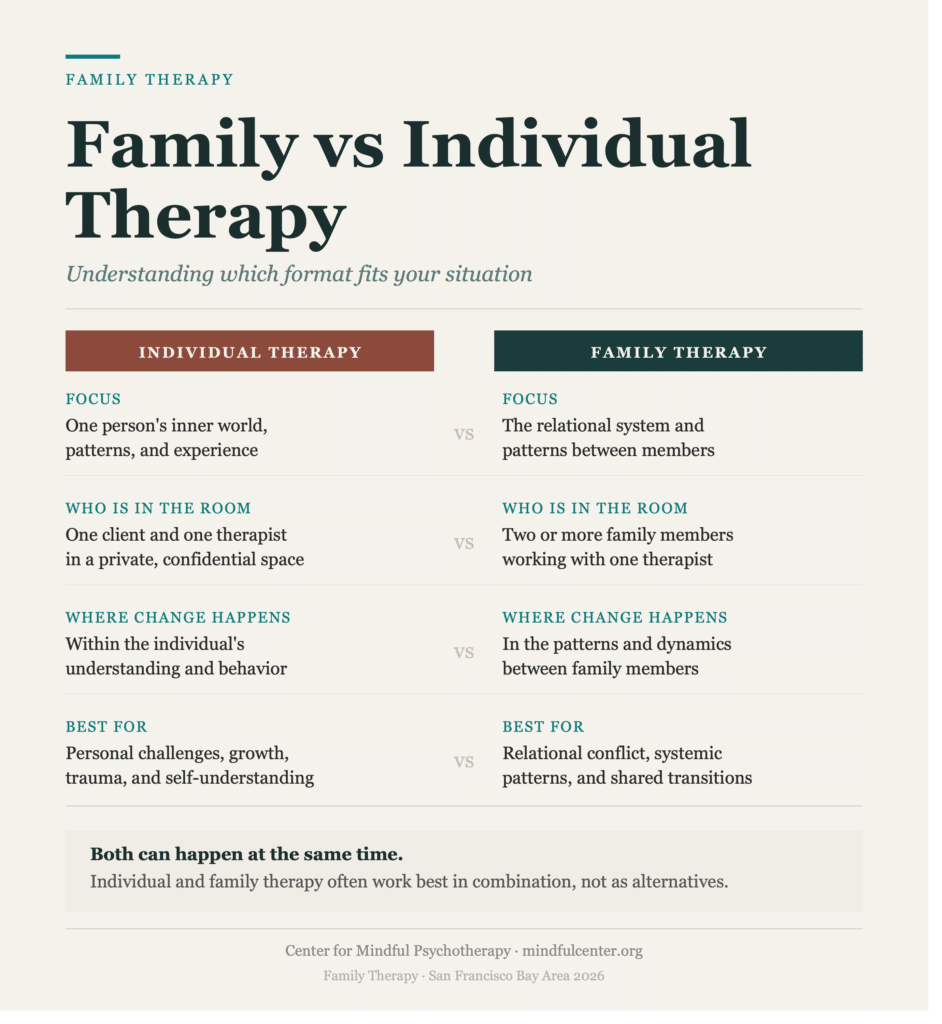
Individual therapy focuses on one person’s inner world, patterns, and experience. Family therapy focuses on the relational system: the patterns of interaction, communication, and meaning-making that develop between family members over time.
A behavior that looks like a personal problem in isolation often makes perfect sense as a role within a family system. A child acting out may be expressing something the family system cannot otherwise articulate. An adolescent’s withdrawal may be a response to dynamics that have nothing to do with the adolescent directly. Family therapy works at the level where these patterns actually live, which is often the level where they can most efficiently change.
Family therapists are trained in systems thinking: the understanding that individuals cannot be fully understood apart from the relational contexts that shaped them. This perspective does not assign blame to any one family member but instead helps everyone involved see the patterns they participate in and find more constructive ways of relating.
What Family Therapy Addresses
Our therapists work with families navigating a wide range of challenges, including:
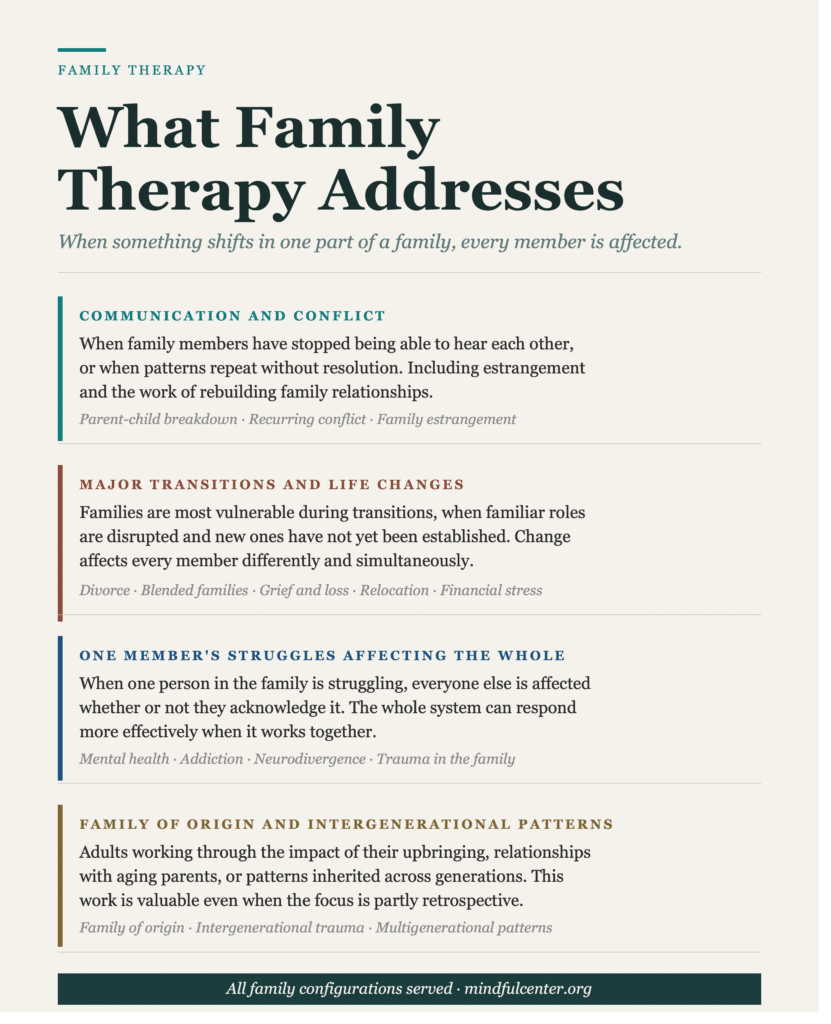
Communication and Conflict
When family members have stopped being able to hear each other, or when communication has become characterized by escalation, withdrawal, or patterns that repeat without resolution, family therapy can help slow the dynamic down and create conditions for genuine understanding.
- Parent and child communication breakdown
- Recurring conflict that does not resolve
- Difficulty navigating different communication styles or needs
- Family members who have become estranged
Major Transitions and Life Changes
Families are most vulnerable during transitions, when familiar roles and structures are disrupted and new ones have not yet been established.
- Divorce and separation
- Blended family dynamics and step-parenting
- Relocation and adjustment to a new community
- The death or serious illness of a family member
- A child leaving home or returning home
- Financial stress and its effects on family relationships
- Immigration and the particular pressures of building life in a new country
A Family Member’s Struggles Affecting the Whole System
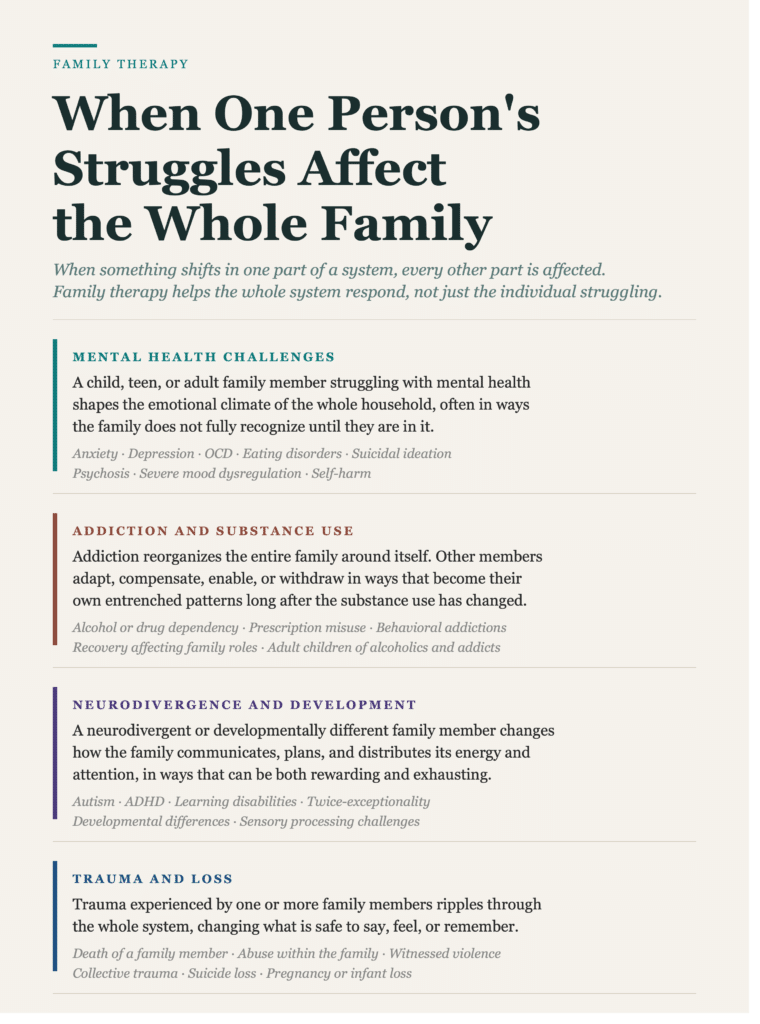
When one person in a family is struggling, everyone else is affected, whether or not they acknowledge it. Family therapy can help the whole system respond more effectively and supportively. Examples include:
- A child or adolescent experiencing significant mental health challenges
- A family member’s addiction and its impact on everyone around them
- A family member’s neurodivergence or developmental differences
- Trauma that has affected one or more family members
Family of Origin and Intergenerational Patterns
Some family therapy focuses not on current family relationships but on the lasting effects of the family someone grew up in. Adults working through the impact of their upbringing, relationships with aging parents, or patterns inherited across generations can find family therapy valuable even when the work is partly retrospective.
- Family of origin challenges and the patterns inherited from childhood
- Intergenerational trauma and its transmission across generations
- Changing relationships with parents as everyone gets older
- Adult siblings navigating complex family legacies

How Family Therapy Works
Family therapy sessions typically involve two or more family members working with a single therapist. Sessions may include the whole family or specific subsets of the family, depending on what is most useful at different points in the work.
The therapist’s role is not to take sides or identify who is right and who is wrong. It is to facilitate understanding, help family members hear each other more clearly, interrupt cycles that have become entrenched, and support the development of more constructive patterns. The therapist holds the system in mind even when working with individual members.
Family therapy is often combined with individual therapy. A child might see the family therapist in sessions with parents and also have their own individual therapist. Parents might do couples work alongside family sessions. The specific structure will depend on what your family is navigating and what your therapist recommends.
What Makes Family Therapy Work
Research published in 2025 in The Journal of Marriage and Family Therapy found that “helpful factors included therapist warmth, kindness, and genuine care; therapist connecting with family in a sensitive, respectful, and nonjudgmental manner; effective use of therapeutic techniques that facilitated self-reflection, emotional expression, communication, and perspective-taking; therapy sessions conducted collaboratively with active family participation; focusing on family strengths and resources; and tailoring format to family needs.”
How Long Family Therapy Takes
Duration varies significantly depending on what brings a family to therapy. Some families do focused, shorter-term work on a specific issue: a few months of sessions to navigate a transition or develop new communication tools. Others engage in longer-term work addressing deep-seated patterns, significant trauma, or complex relational dynamics. Your therapist will help you think through a realistic timeframe based on your situation and goals.
Our Approach
Our family therapists draw from systems-based approaches including family systems theory, structural and strategic family therapy, attachment-based work, and narrative approaches. Many integrate trauma-informed perspectives that recognize how past experiences shape current family dynamics. Mindfulness, multicultural considerations and social justice lenses are also part of how many of our therapists understand and engage with family systems.
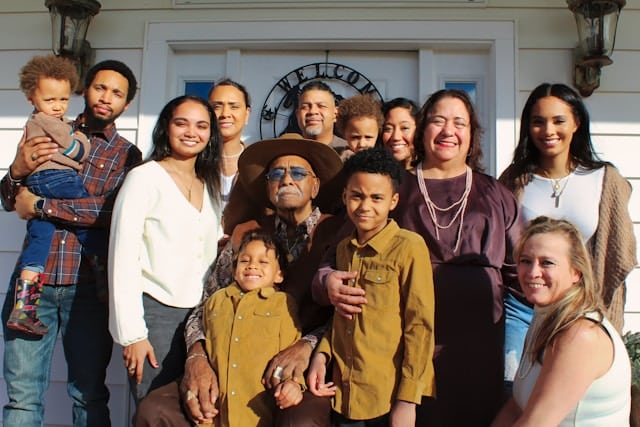
We work with families in all their configurations, including nuclear families, blended families, multigenerational families, families of choice, LGBTQ+ families, single-parent families, and families navigating differences of race, culture, religion, or background within the family itself.
Frequently Asked Questions
Does everyone in the family have to attend sessions?
Not necessarily. Which family members attend depends on what the therapy is addressing. Some family therapy includes everyone; some involves particular subgroups. Parents might attend without children for some sessions, or siblings might work together without parents. Your therapist will help determine the most productive configuration for what your family is working on.
My child is struggling. Should we do family therapy or get them their own therapist?
Often both are valuable. A child who is struggling benefits from their own therapeutic relationship where they have privacy and a space that is entirely theirs. Family therapy addresses the systemic context surrounding the child’s experience, which is often as important as the individual work. Many families find that both happening simultaneously produces the best outcomes. We can help you think through what makes sense for your specific situation.
We are a blended family. Is family therapy useful for us?
Blended families navigate some of the most complex relational territory there is: loyalties, stepparent roles, half-sibling dynamics, co-parenting with ex-partners, and the integration of different family cultures and histories. Family therapy is often particularly valuable for blended families, and therapists experienced with these dynamics can provide both structure and perspective that makes the work more efficient.
Can family therapy help if one family member refuses to attend?
Yes. Systems change when any part of the system changes, which means work done by those family members who are willing to engage can create meaningful shifts even without everyone in the room. Individual or partial-family therapy can also help you understand the systemic dynamics at play and respond to other family members more effectively.
We are an immigrant family navigating cultural differences across generations. Is that something you work with?
Yes, and we have therapists with specific experience and training in this area. Families navigating differences between first-generation and subsequent-generation experiences, questions of acculturation, language, identity, and belonging across generations, and the particular pressures that immigration places on family systems are all within the scope of our work.
Is family therapy available via telehealth?
Yes. Family therapy sessions can be conducted via telehealth, which can be particularly convenient when family members are in different locations or have scheduling challenges. Video sessions work well for family therapy when participants have a private and comfortable space. Your therapist will help you think through the logistics.
Browse our Therapist Directory