

Reviewed by Kathryn Vercillo, MA Psychology | Last Updated: January 2026

What Are Relational, Attachment, and Systems Therapies?
Relational, attachment, and systems therapies understand human experience through the lens of connection. These approaches recognize that we are shaped by relationships, both the external bonds with others and the internal relationships among different aspects of ourselves. Healing happens through transforming these relational patterns.
We Are Wired for Connection
Human beings develop within relationships. The quality of our earliest bonds shapes our sense of self, our capacity for intimacy, and even our internal landscape. When those early relationships were inconsistent, neglectful, or traumatic, we develop protective patterns that once kept us safe but may now interfere with the closeness we desire.
These therapies address patterns at multiple levels. Attachment and relational approaches heal wounds from early relationships and create new experiences of secure connection. Couples therapies transform how partners interact and bond. Family systems therapy addresses multigenerational patterns and family dynamics. And Internal Family Systems works with the relationships among different parts of your own psyche.
What unites this family of approaches is the conviction that relationship is not just the context for healing but the mechanism of healing itself. Whether working with your internal parts, your partner, or your family of origin, change happens through new relational experiences.
At Center for Mindful Therapy, many of our Associate Marriage and Family Therapists throughout the San Francisco Bay Area are specifically trained in relational and systems thinking. You can find therapists skilled in individual attachment work, couples therapy, family systems approaches, and parts work throughout our collective.
Browse our Therapist Directory
On This Page:
- Shared Foundations
- Individual Relational Approaches
- Couples Therapy Approaches
- Systems and Parts Approaches
- Comparing These Approaches
- Choosing the Right Approach

Shared Foundations
Attachment Science
Most approaches in this family draw on attachment theory, the research demonstrating that humans have an innate need for close emotional bonds. The quality of early attachment relationships creates internal working models that guide our expectations about connection throughout life. Brain imaging studies confirm that secure attachment shapes neural development and that earned security through therapeutic relationships can create lasting change.
Research published in the Journal of Affective Disorders demonstrates that attachment focused family therapies produce significant improvements in adolescent depression and suicidal ideation. The review found that adolescents who received attachment based treatment showed greater and faster reductions in symptoms compared to those receiving standard care, with 87% achieving recovery by the end of treatment. These findings support the core premise that repairing attachment relationships creates a foundation for healing.
Systems Thinking
Systems approaches recognize that elements within any system interact in ways that create emergent patterns. These patterns cannot be understood by examining individual elements in isolation. Change in one part of the system affects the whole, whether that system is a family, a couple, or the internal landscape of your psyche.
Relationship as Healing
These therapies share a core conviction: the therapeutic relationship itself is a vehicle for change. The therapist’s attunement, responsiveness, and genuine presence are not just nice additions to technique but are therapeutic interventions themselves. You experience something different in relationship, and this new experience rewrites old patterns.
Individual Relational Approaches
Attachment Therapy
Attachment therapy works directly with patterns established in earliest relationships. When caregivers were inconsistent, unavailable, or frightening, children develop adaptive strategies that persist into adulthood. Through consistent attunement with a therapist, you build what researchers call earned secure attachment, discovering that your needs are not too much and that closeness does not require losing yourself.
Best for:
Repeating relationship patterns, difficulty trusting, fear of abandonment or engulfment, feeling unworthy of love.
Relational Therapy
Relational therapy emphasizes the mutual influence between therapist and client, acknowledging that both people in the room are affected by the encounter. Close attention to what happens in the present moment creates opportunities to explore patterns and experience something different. Ruptures and repairs in the therapeutic relationship teach that disconnection does not have to mean abandonment.
Best for: Struggling with authenticity in relationships, presenting a false self, feeling repeatedly misunderstood, seeking self understanding through the lens of relationship.

Couples Therapy Approaches
Emotionally Focused Therapy (EFT)
Developed by Sue Johnson, EFT applies attachment theory to couples. It views relationship distress as stemming from insecure attachment bonds and negative interaction cycles. Rather than teaching communication skills, EFT helps partners access deeper emotions beneath their conflicts and express attachment needs directly. When a criticizing partner can say they feel abandoned and scared, and a withdrawing partner can respond with reassurance, the relationship transforms.
Best for: Couples in distress who still have positive feelings beneath conflicts, affairs, emotional distance, trauma’s impact on relationship.
PACT Couples Therapy
Psychobiological Approach to Couple Therapy, developed by Stan Tatkin, integrates attachment theory with neuroscience. PACT helps couples understand how their nervous systems interact and teaches them to become experts on each other’s triggers and regulatory patterns. The approach is highly interactive, using in session exercises to create live experiences rather than just talking about problems.
Best for: Couples with insecure attachment histories, difficulty with emotional regulation, conflicts that escalate quickly, trouble reading each other’s cues.
Gottman Method
Developed by John and Julie Gottman through decades of research, this method identified specific behaviors that predict relationship success and failure. Couples learn to replace the “Four Horsemen” (criticism, contempt, defensiveness, stonewalling) with healthier patterns and build positive connection through daily practices. The approach provides concrete, research backed tools.
Best for: Couples who appreciate structure and practical tools, any relationship stage from serious distress to enrichment, those who want clear guidance on what to do differently.

Systems and Parts Approaches
Internal Family Systems (IFS)
Developed by Richard Schwartz, IFS understands the psyche as containing multiple parts organized around a core Self. Parts include Managers (who maintain control), Firefighters (who react impulsively to extinguish pain), and Exiles (wounded parts carrying pain from the past). Rather than eliminating parts, IFS builds harmonious relationships among them, with Self providing compassionate leadership.
Best for: Internal conflict, self sabotage, trauma, anxiety, depression, eating disorders, addictions, inner critic struggles, patterns that seem to have “a mind of their own.”
Family Systems Therapy
Family systems therapy encompasses approaches that understand individual difficulties within family relationship patterns. Rather than locating problems inside one person, these approaches examine roles, boundaries, and communication within the family unit. Structural, strategic, and Bowenian approaches each offer different emphases, from family organization to interaction sequences to multigenerational patterns.
Best for: Family conflicts, parent child difficulties, multigenerational patterns, individual struggles that exist within family context, adult children working on family of origin issues.
Comparing These Approaches
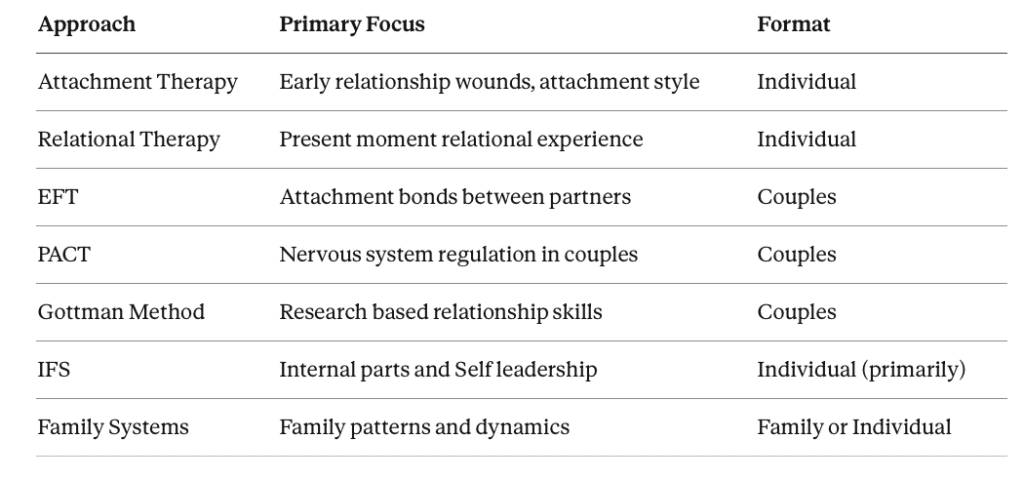
By Focus
By Approach Style
- More Experiential: EFT, Relational Therapy, IFS emphasize in session emotional experience as the vehicle for change.
- More Structured/Educational: Gottman Method and PACT include significant psychoeducation and skill training alongside emotional work.
- More Exploratory: Attachment Therapy, Relational Therapy, and Family Systems may involve more open ended exploration of patterns.

Choosing the Right Approach
What Is the Scope?
If you want to work on your own patterns individually, Attachment Therapy, Relational Therapy, or IFS provides that space. On the other hand, if you and a partner want to work together, EFT, PACT, or Gottman Method offers specialized couples treatment. If family dynamics are central, Family Systems therapy addresses those patterns.
What Is the Focus?
If early attachment wounds feel central, Attachment Therapy works directly with those roots. Perhaps you experience internal conflict among different aspects of yourself; IFS provides a framework. If your relationship needs help, the couples approaches each offer different emphases: emotional restructuring (EFT), nervous system attunement (PACT), or practical skills (Gottman).
You Do Not Have to Choose Alone
Many of our therapists are trained in multiple approaches and can help determine what fits. Some integrate elements from different modalities based on what serves each client. An initial consultation allows you to discuss concerns and get professional guidance.
Each approach has its own comprehensive page with detailed information:
Find a Therapist
Our directory allows you to filter by therapeutic approach. Read profiles to understand each therapist’s specific training. Our therapists offer these approaches both in person throughout the Bay Area and via telehealth across California.
Browse our Therapist Directory
For questions, contact us. We are happy to help.