


Are You And Your Partner Drifting Apart?
-
- Is your relationship in a crisis due to a recent infidelity, betrayal or loss in your family?
- Do you feel a gradual distance growing between you and your partner over time?
- Have you recently gone through a major life transition such as moving, changing jobs, raising children or making a more serious commitment?
- Are you frustrated by the way you and your partner communicate?
- Do you wonder why your relationship doesn’t look like the healthy relationships you’ve witnessed between others?
- Do you wish you could reignite a loving connection with your partner?
Browse our Therapist Directory
Every relationship has seasons. There are periods of closeness and ease, and periods of distance, confusion, or pain. Sometimes the distance grows gradually and almost imperceptibly. Sometimes a single event shatters trust overnight. And sometimes two people simply find themselves needing new tools for what life is asking of them now.
Couples and relationship therapy creates a structured, supported space for partners to slow down, hear each other differently, and work through what has become stuck. At Center for Mindful Psychotherapy, we offer relationship therapy in the San Francisco Bay Area and throughout California via telehealth for couples and partners of every configuration.
You do not need to be in crisis to seek couples therapy, and you do not need to be on the verge of separating. Many couples come to therapy as a proactive investment in a relationship that matters deeply to them. Others come after significant rupture and are trying to determine whether repair is possible. Both are valid reasons to start.
Who Couples and Relationship Therapy Is For
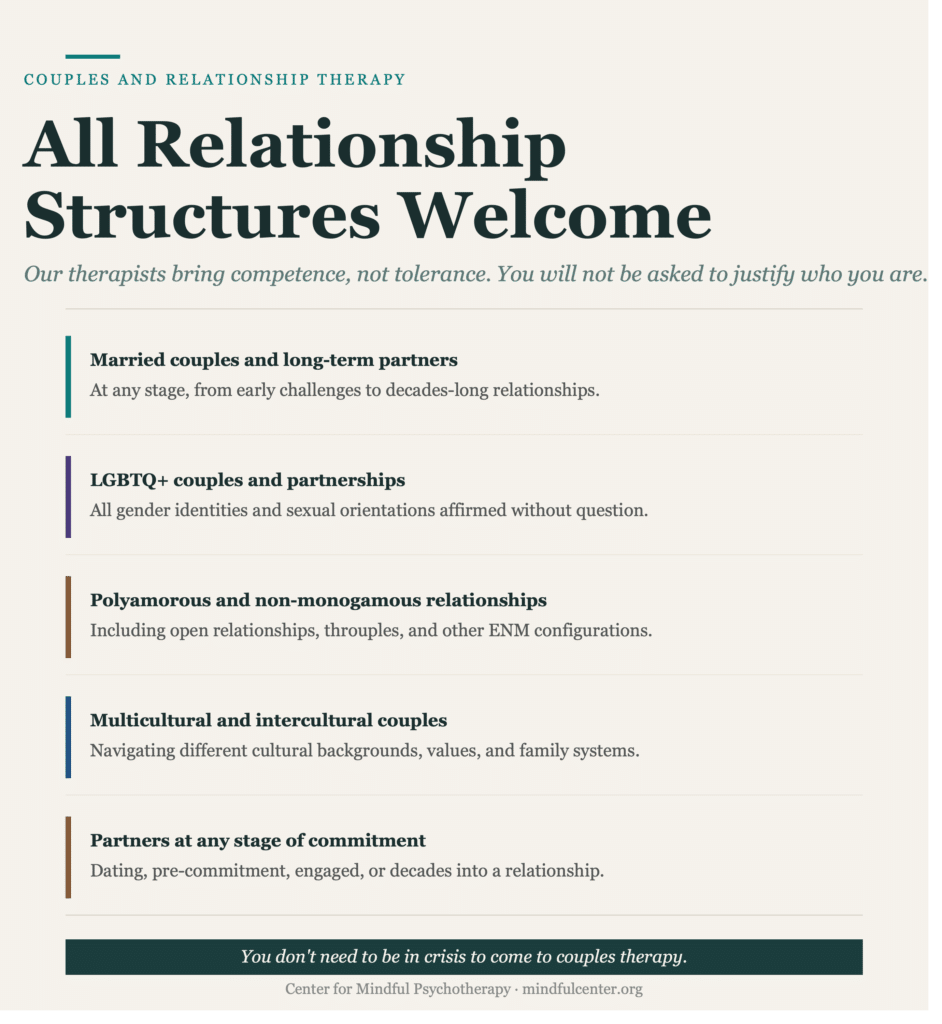
We welcome all partnership structures and relationship configurations. Our therapists work with:
- Married couples and long-term partnerships
- People who are dating and want to build a stronger foundation
- Partners preparing for a major life commitment
- Non-monogamous relationships including polyamorous, open, and other ethically non-monogamous structures
- Same-sex and LGBTQ+ partnerships
- Multicultural and intercultural couples navigating different backgrounds, values, and expectations
- Partners navigating separation or divorce and wanting to do so with care
- Couples managing co-parenting relationships after a relationship has ended
Many of our therapists are trained to work affirmingly with diverse relationship structures and are experienced with the specific dynamics that each configuration can bring. You will not be asked to justify your relationship structure or explain why you have chosen it.
Common Reasons Couples Seek Therapy
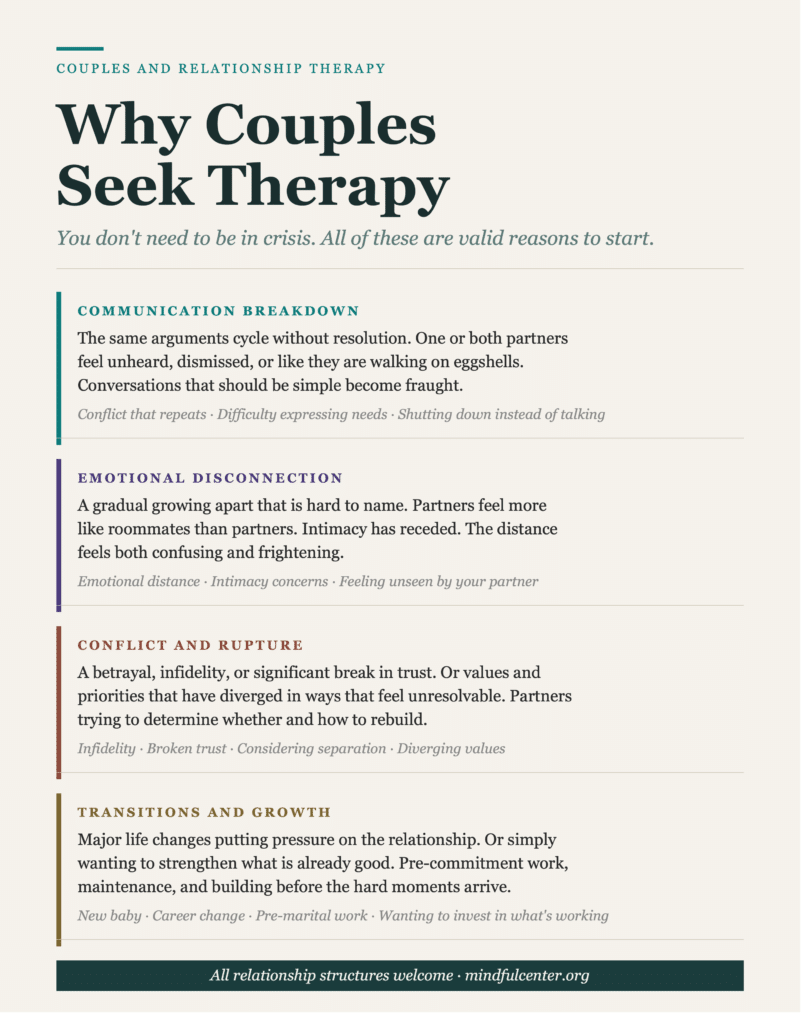
People come to relationship therapy for many different reasons. Some of the most common include:
Communication Breakdown
When communication has become painful, circular, or shut down entirely, even small interactions can carry enormous weight. Many couples find themselves stuck in the same arguments, using the same words, with the same outcome, and no clear path out. A therapist can help you slow the pattern down and understand what is actually happening beneath the words.
Emotional and Physical Distance
Gradual disconnection is one of the most common and most painful experiences in relationships. Life gets busy. Partners stop turning toward each other. Intimacy recedes. The distance that grows between two people who once felt close can feel both confusing and frightening. Therapy can help identify when and how the disconnection began and create conditions for genuine reconnection.
Infidelity and Betrayal
A betrayal, whether sexual infidelity, emotional affair, or another form of broken trust, creates a profound rupture in the relational foundation. Therapy after betrayal is not about deciding whether to stay or go, though that may become clearer through the process. It is about having a supported space to process the grief, anger, and confusion that betrayal produces, and to determine together what repair, if any, is possible.
Major Life Transitions
Having a child, losing a parent, changing careers, relocating, launching children into adulthood, facing illness: major transitions put pressure on relationships in ways partners often do not anticipate. Roles shift. Time becomes scarce. Old agreements stop working. Therapy during transitions can help partners navigate change without losing each other in the process.
Navigating Non-Monogamy
Ethically non-monogamous relationships navigate a distinctive set of challenges around communication, jealousy, time management, boundaries, and identity. Our therapists who work with non-monogamous couples and throuples are affirming of these structures and experienced with the specific questions they raise.
Building a Stronger Foundation
Some couples come to therapy not because something is wrong but because they want to strengthen what they have. Pre-marital or pre-commitment therapy, maintenance work during a stable period, and skills-building before major transitions are all valuable uses of couples therapy and do not require a presenting problem.
Find a therapist working with the issues of most concern to you by filtering through the “what we help” dropdown box in our therapist directory.
How Our Therapists Work with Couples
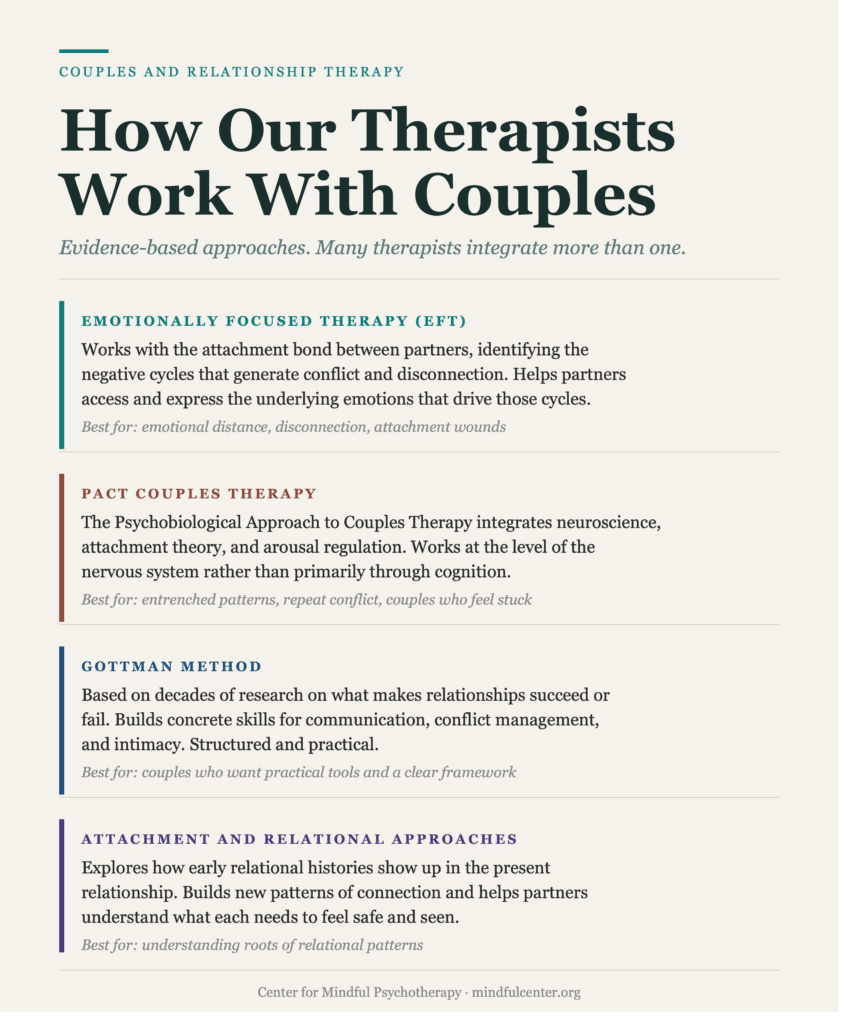
Our therapists draw from a range of evidence-based approaches to relationship work. Many integrate more than one framework depending on what a couple brings. The consistent thread across all of our work is attention to the emotional experience underneath the surface conflict, and to what each partner needs in order to feel genuinely seen and safe.
Emotionally Focused Therapy (EFT)
EFT is one of the most extensively researched approaches to couples therapy. It works with the attachment bond between partners, identifying the negative cycles that generate conflict and disconnection and helping couples access and express the underlying emotions that drive those cycles. The goal is to create more secure, responsive connection.
PACT Couples Therapy
The Psychobiological Approach to Couples Therapy integrates neuroscience, attachment theory, and arousal regulation. PACT is particularly effective for couples who feel stuck in entrenched patterns that have proven resistant to other approaches, because it works at the level of the nervous system and attachment biology rather than primarily through cognition.
Gottman Method
Based on decades of research on what makes relationships succeed or fail, the Gottman Method helps couples identify specific behaviors that predict relationship distress and build concrete skills for communication, conflict management, and intimacy. It is structured and practical, and works well for couples who appreciate a clear framework.
Attachment-Based and Relational Approaches
Many of our therapists weave attachment theory and relational approaches into couples work, helping partners understand how their early relational histories show up in the present relationship and building new patterns of connection.
Find a therapist working in your preferred modalities by filtering through the “how we help” dropdown box in our therapist directory.
Individual Therapy Alongside Couples Work
Many people engaged in couples therapy also find value in doing individual therapy simultaneously, either with the same therapist (in separate sessions) or with a different therapist. Individual therapy can support the couples work by giving each partner space to process their own experience, work on personal patterns that contribute to relational dynamics, and develop resources that serve both them and the relationship.
If you are considering individual therapy alongside couples work, let your therapist know. They can help you think through whether to work with the same provider or different ones, and how to coordinate the two.

Frequently Asked Questions about Couples Counseling
My partner is reluctant to try therapy. What should I do?
This is one of the most common questions we hear. If one partner is willing and one is not, starting with individual therapy is often a productive first step. Working on your own patterns and understanding of the relationship dynamic can create genuine change in the relational system even without both partners in the room. Sometimes when one partner starts making shifts, the other becomes more open to the process.
Can therapy save our relationship?
Therapy can provide the tools, space, and support for partners to do the work that relationships require. Whether a relationship survives and improves depends on both partners’ willingness to engage honestly with that work. Therapy cannot guarantee any particular outcome, but research on approaches like EFT consistently shows significant improvements in relationship satisfaction and connection for couples who engage fully with the process.
What if we decide to separate during therapy?
Sometimes therapy clarifies that separation is the right path. A skilled therapist can support couples through this process as well, helping partners separate with as much care and clarity as possible, navigate co-parenting if relevant, and process the grief and complexity that comes with the end of a significant relationship. Deciding to separate is not a failure of therapy.
Do we both have to attend every session?
Typically yes, though there may be moments in the process where individual sessions with one partner are useful, depending on what is arising. Your therapist will guide the structure. Some therapists also offer a combination of conjoint and individual sessions as part of the couples work.
We are in a throuple or polyamorous relationship. Do you work with us?
Yes. Our therapists who specialize in relationship work are experienced with polyamorous and other non-monogamous configurations and work affirmingly with all relationship structures. Therapy with more than two partners can require some logistical coordination, and your therapist will work with you on what format serves your situation best.
Is couples therapy available via telehealth?
Yes. Most of our therapists offer video sessions for couples, which means you can access relationship therapy from anywhere in California. Some couples find telehealth convenient; others prefer in-person for this kind of intimate work. Some therapists offer both. You can find availability information in individual therapist profiles.
How is couples therapy different from individual therapy focused on relationships?
Individual therapy explores your own patterns, history, and experience of the relationship. Couples therapy brings both partners into the room and focuses on the relational dynamic itself: how you interact, what cycles you get stuck in, and what each of you needs to feel safe and connected. Many people find both valuable and do them at the same time.
Browse our Therapist Directory