


Reviewed by Kathryn Vercillo, MA Psychology | Last Updated: March 2025
You may have heard the phrase inner child in therapy circles, in self-help books, or perhaps even said somewhat skeptically to a friend. It can sound abstract, even a little soft. But inner child work is grounded in some of the most substantive thinking in developmental psychology and trauma treatment, and its effects on adult healing are very real.
Understanding what inner child work actually involves, and why it matters for adults navigating anxiety, relational patterns, self-worth struggles, and grief, can help you decide whether this approach belongs in your own healing process.
Browse our Therapist Directory
Where the Concept Comes From
The idea that our childhood experiences leave a lasting psychological imprint is not new. Carl Jung described the inner child as an archetype representing early life, wonder, and vulnerability. John Bradshaw, a psychologist and author whose work on the subject became widely influential in the 1990s, described the wounded inner child as a core concept in understanding shame, codependency, and trauma.
Contemporary therapy models have since integrated these ideas in more clinically rigorous ways. Internal Family Systems therapy, developed by psychologist Richard Schwartz, identifies what it calls exile parts, aspects of the self that carry the emotional burden of early painful experiences and are often kept hidden or suppressed by other protective parts. Attachment-focused therapies draw on the developmental research of John Bowlby and Mary Ainsworth to understand how early relational experiences create lasting templates for how we connect with others.
What these frameworks have in common is this: your present-day emotional life is not separate from your past. The patterns you notice in relationships, the ways you respond to criticism, the emotions that feel disproportionate to their triggers, these often have roots in early childhood experiences that have never fully been processed or witnessed.
What Inner Child Work Looks Like in Practice
Inner child work can take many forms depending on the therapist, the modality, and the client. In its most basic form, it involves developing a conscious, compassionate relationship with the younger parts of yourself, particularly the parts that experienced painful, confusing, or overwhelming situations early in life.
This might involve visualization, guided imagery, or written exercises where you imagine speaking with a younger version of yourself. It might involve working with the body, since many early experiences are stored somatically and can be accessed through physical awareness. It might involve expressive arts, collage, movement, or other creative modalities that give voice to experiences that predate language.
A skilled therapist will help you approach this work at a pace that feels manageable. The goal is not to re-traumatize by re-entering painful experiences without support. It is to offer those early parts of yourself the witnessing, validation, and compassionate attention they may have needed and not received at the time.
What Inner Child Work Can Address
People come to inner child work with a wide range of presenting concerns. Some of the most common include:
- Repeating relational patterns, particularly in romantic relationships or family dynamics
- Chronic self-criticism and difficulty with self-compassion
- People-pleasing, difficulty with boundaries, or fear of conflict
- Unexplained emotional reactions that feel out of proportion
- Difficulty trusting others or feeling fundamentally unworthy of love
- Grief over what was missing in childhood, a sometimes unexpected but important dimension of healing
It is also a meaningful thread within broader trauma treatment, particularly for adults who experienced emotional neglect, inconsistent caregiving, or family systems shaped by addiction, illness, or generational patterns of harm.
The Role of the Body in Inner Child Work
Early experiences, especially those that occurred before language developed, are frequently stored in the nervous system and the body rather than in explicit narrative memory. This is why purely cognitive approaches can sometimes feel insufficient for this kind of work.
Body-focused and somatic approaches offer a way in. By paying attention to sensation, posture, breath, and physical holding patterns, clients can begin to access and process experiences that are not available through thinking alone. Research on somatic therapies and their role in trauma treatment, including work published in journals such as the Journal of Traumatic Stress and Trauma, Violence, and Abuse, consistently supports the value of body-inclusive approaches in healing early relational wounds.
Spotlight: Missed Opportunities Workshop in the East Bay
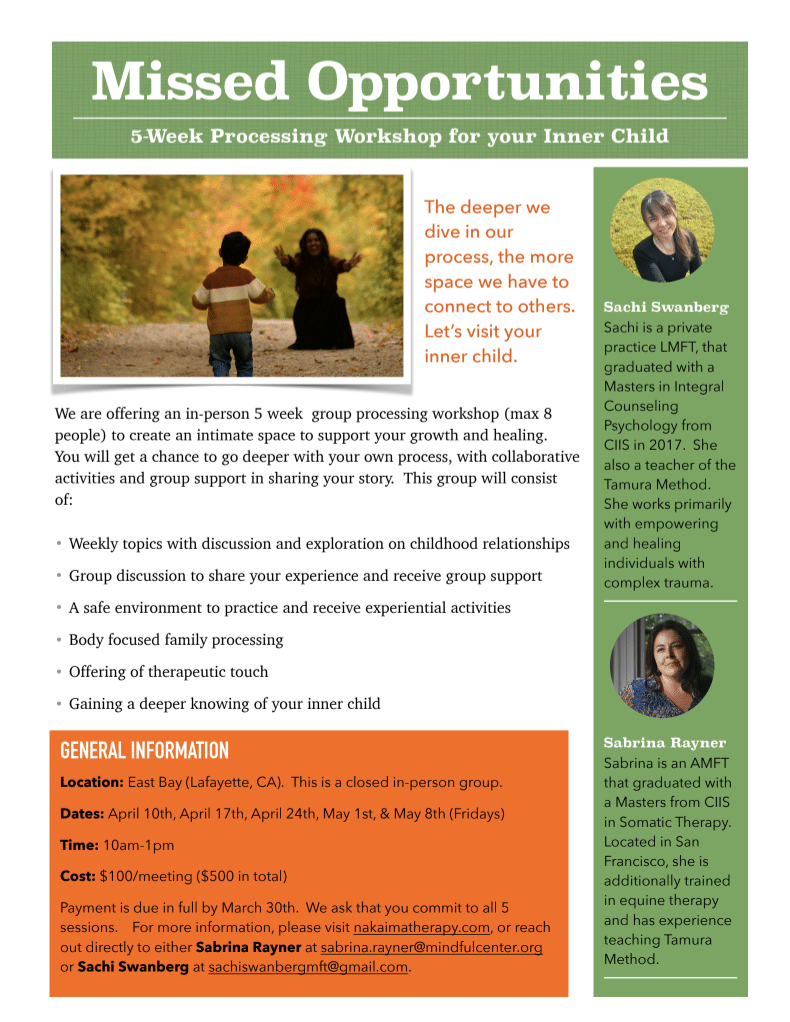
An example of this kind of integrated inner child work is available right now in the East Bay through the Missed Opportunities workshop, a five-week group processing experience co-facilitated by Sachi Swanberg, LMFT, and Sabrina Rayner, AMFT.
Sachi brings expertise in complex trauma and the Tamura Method, a body-focused approach to family systems processing. Sabrina, a somatic therapist with additional training in equine therapy, brings a grounded, body-aware perspective to the relational work. Together, their skill sets create a rich container for the kind of nuanced, layered inner child exploration this work calls for.
The workshop is intimate by design, limited to eight participants. It is structured as a closed group. That means the same members meet together for all five sessions. This continuity builds the trust necessary for deeper processing. It meets on Friday mornings in Lafayette, California, April 10 through May 8. For information and registration, visit nakaimatherapy.com.
Is Inner Child Work Right for You
Inner child work is not the starting point for everyone. Timing matters. If you are in an acute mental health crisis, start there first. A therapist can help you determine when deeper work is appropriate. Foundational safety and stabilization come before depth work.
For those who feel ready, this work offers something profound. It is a chance to revisit early experiences with new eyes. Not to change the past, but to finally witness it. The parts of yourself that have been waiting can finally be seen.
At Center for Mindful Therapy, our Associate Therapists bring diverse training to this work. Many specialize in attachment-based, somatic, and parts work approaches. They work with these themes in both individual and group settings. In-person availability varies by therapist location throughout the Bay Area. Telehealth is available across California.
Browse our Therapist Directory