

Reviewed by Kathryn Vercillo, MA Psychology | Last Updated: December 2024
What is Somatic Therapy?
Somatic therapy recognizes that emotional experiences, trauma, and stress are stored not just in the mind but throughout the body. This therapeutic approach uses bodily awareness and physical sensations as pathways to healing, helping you process and release what talk therapy alone might miss.
Healing Through the Body’s Wisdom
Your body remembers what your mind might struggle to articulate. That tension in your shoulders, the knot in your stomach, the shallow breathing that arrives with anxiety all carry information about your emotional landscape. Somatic therapy invites you to listen to these physical signals and use them as guides toward deeper healing.
At the Center for Mindful Therapy, our Associate Marriage and Family Therapists integrate somatic approaches into their work with clients throughout the San Francisco Bay Area. Some of our therapists offer in-person sessions in locations spanning from San Francisco to Oakland, Berkeley, and Marin County, while telehealth options make this body-centered work accessible to clients across California.
Unlike traditional talk therapy that focuses primarily on cognitive understanding, somatic therapy recognizes that healing must include the physical body. When you experience trauma, chronic stress, or overwhelming emotions, your nervous system responds by creating protective patterns. These patterns might have served you well initially, helping you survive difficult circumstances. Over time, however, they can become obstacles, manifesting as chronic tension, disconnection from your body, or difficulty regulating emotions.
Through gentle attention to physical sensations, movement, breath, and posture, somatic therapy helps you renegotiate these patterns. You learn to recognize when your body is signaling distress, develop tools to regulate your nervous system, and gradually release stored trauma. This work happens at the pace your body sets, honoring your inherent capacity for healing.
Browse our Therapist Directory
On This Page:
- Understanding the Body Mind Connection in Therapy
- How Somatic Therapy Works
- Conditions and Challenges Somatic Therapy Addresses
- What Happens in a Somatic Therapy Session
- Somatic Therapy Compared to Traditional Approaches
- Key Benefits of Body Centered Therapy
- Finding a Somatic Therapist in the Bay Area
- Getting Started with Somatic Therapy
- Frequently Asked Questions
Understanding the Body Mind Connection in Therapy

Your nervous system does not distinguish between physical and emotional threat. When you experience emotional pain, your body responds with the same protective mechanisms it would activate for physical danger. Your heart rate increases, muscles tense, breath becomes shallow. These physiological responses happen automatically, managed by the autonomic nervous system before your conscious mind even registers what’s occurring.
The Nervous System’s Role in Emotional Health
The autonomic nervous system has two primary branches. The sympathetic nervous system activates your fight or flight response, preparing you to face threats. The parasympathetic nervous system promotes rest, digestion, and healing. In a well-regulated nervous system, these branches work in harmony, allowing you to respond appropriately to different situations and return to calm afterward.
Chronic stress, trauma, and emotional overwhelm can dysregulate this system. You might find yourself stuck in a state of hypervigilance, constantly prepared for danger even when you’re safe. Alternatively, you might experience shutdown, a protective numbing that disconnects you from both physical sensations and emotions. These states become default modes, operating beneath your awareness and shaping how you experience the world.
Somatic therapy works directly with your nervous system, teaching you to recognize these states and develop capacity to shift between them intentionally. Rather than trying to think your way out of stuck patterns, you learn to work with your body’s innate wisdom and healing capacity.
Interoception and Emotional Awareness
Interoception refers to your ability to sense internal bodily states. This includes recognizing hunger, thirst, temperature, pain, muscle tension, heart rate, and breath. Research shows that people with greater interoceptive awareness tend to have better emotional regulation, higher emotional intelligence, and improved mental health outcomes.
Many people have learned to ignore or override bodily signals. You might push through fatigue, dismiss discomfort, or automatically tense against uncomfortable emotions. This disconnection serves as protection, yet it also limits your ability to care for yourself effectively and respond appropriately to your environment.
A growing body of research supports this connection between internal body awareness and mental health. According to a study in Frontiers in Psychology, clear links have been found between compromised interoceptive function and psychiatric disorders including depression, anxiety, and addiction. The researchers note that somatic therapy leverages this connection by using structured attention to internal sensations as a primary therapeutic tool, helping clients rebuild the body awareness that trauma and chronic stress often disrupt.
Somatic therapy strengthens interoceptive awareness through mindful attention to physical sensations. As you develop this capacity, you gain clearer information about your emotional states, needs, and boundaries. A tightness in your chest might signal anxiety before your thoughts catch up. A heaviness in your limbs might indicate depression or grief needing attention. Learning this internal language transforms how you relate to yourself and others.
The Window of Tolerance
Daniel Siegel introduced the concept of the “window of tolerance” to describe the zone where you can effectively process emotions and respond to stress. Within this window, you feel connected, present, and capable. You can think clearly, feel your emotions without being overwhelmed, and engage meaningfully with others.
When stress or emotional intensity pushes you outside your window of tolerance, you move into either hyperarousal (anxiety, panic, anger, hypervigilance) or hypoarousal (depression, numbness, disconnection, shutdown). In these states, your capacity for processing experiences diminishes significantly.
Trauma, chronic stress, and difficult early experiences can narrow your window of tolerance, making it easier to become dysregulated. Somatic therapy aims to widen this window gradually. Through practices that help you stay present with increasingly challenging sensations and emotions, you build capacity to remain regulated under greater stress. This expansion happens slowly, respecting your nervous system’s need for safety and predictability.

How Somatic Therapy Works
Somatic therapy encompasses various techniques united by a common principle: the body serves as both a resource and a gateway for healing psychological distress. Therapists trained in somatic approaches combine talk therapy with attention to physical experience, creating an integrated path toward wellness.
Tracking Physical Sensations
The foundation of somatic work involves tracking, the practice of noticing and describing physical sensations as they arise moment to moment. Your therapist might ask you to notice what you feel in your body when discussing a difficult topic. You might notice tension in your jaw, warmth in your chest, a flutter in your stomach, or heaviness in your legs.
Initially, this might feel challenging, especially if you’ve spent years disconnected from physical awareness. Therapists guide this process gently, helping you develop vocabulary for internal experience. Over time, tracking becomes more natural, providing valuable information about your emotional state and helping you stay grounded during difficult conversations.
Pendulation and Resourcing
Pendulation describes the natural movement between states of activation and relaxation that occurs when processing difficult material. Rather than diving immediately into painful memories or emotions, somatic therapists help you establish resources first. Resources might include pleasant sensations in your body, memories of safety, connection to supportive relationships, or awareness of your current environment.
During sessions, you might move between touching on challenging material and returning to these resources. This oscillation prevents overwhelm, allowing your nervous system to process difficult experiences in manageable doses. Each time you pendulate, you build evidence that difficult sensations and emotions are temporary, that you can move through them and return to safety.
Titration
Titration refers to working with small, manageable amounts of emotional or traumatic material at a time. Rather than flooding yourself with overwhelming memories or sensations, you approach difficult territory gradually, like gradually increasing the dosage of medicine to find the right therapeutic level.
Your therapist helps you identify edges, places where you begin to feel overwhelmed, and works within your capacity. This approach respects your nervous system’s limits while still moving toward healing. Over time, your capacity increases, and what once felt overwhelming becomes more manageable.
Grounding Techniques
Grounding practices help you connect to present moment reality and your physical environment. When anxiety, panic, or traumatic memories pull you into the past or future, grounding brings you back to now. Techniques might include:
- Noticing five things you can see in the room
- Feeling your feet on the floor or your body in the chair
- Orienting to the space around you by looking around slowly
- Placing hands on solid surfaces and noticing texture and temperature
- Using breath awareness to anchor attention in the present
These practices become tools you can use between sessions, helping you manage difficult moments in daily life.
Bilateral Stimulation and Movement
Some somatic approaches incorporate bilateral stimulation, alternating attention between left and right sides of the body. This might involve tapping, eye movements, or alternating sounds. Bilateral stimulation appears to facilitate processing of traumatic memories and integration of difficult experiences.
Movement also plays an important role in many somatic therapies. Gentle movements, stretching, or completing interrupted defensive responses (like pushing away or running) can help release stored activation. Your therapist might guide you through simple movements that correspond to emotional states or help your nervous system complete protective responses that were frozen during traumatic events.
Breathwork
Breath serves as a bridge between conscious and unconscious processes. While breathing happens automatically, you can also control it intentionally. This makes breathwork a powerful tool for nervous system regulation.
Different breathing patterns activate different nervous system states. Slow, deep breathing stimulates the parasympathetic nervous system, promoting calm. Faster breathing can activate energy when you’re feeling stuck or shut down. Your therapist might teach specific breathing techniques and help you notice how different patterns affect your emotional state and physical sensations.

Conditions and Challenges Somatic Therapy Addresses
Somatic therapy offers effective treatment for a wide range of psychological and emotional challenges. By working directly with the nervous system and addressing how experiences are stored in the body, this approach reaches symptoms that might resist purely cognitive interventions.
Trauma and Post Traumatic Stress
Trauma changes how your nervous system functions, often leaving you stuck in patterns of hypervigilance or shutdown. When you experience trauma, your body’s natural defensive responses (fight, flight, freeze) may be thwarted or overwhelmed. This incomplete response cycle can leave traumatic activation stored in your body, emerging as intrusive memories, nightmares, panic responses, or emotional numbing.
Traditional trauma therapy focuses on processing memories through narrative. While valuable, this approach sometimes retraumatizes clients by overwhelming their nervous systems. Somatic therapy takes a gentler path, working with the body’s responses to trauma before addressing narrative details. You might notice and release tension patterns, complete protective movements that were interrupted during the traumatic event, or slowly expand your window of tolerance before ever discussing specifics of what happened.
Peter Levine’s Somatic Experiencing, one influential somatic trauma therapy, focuses on releasing bound energy from incomplete protective responses. Through careful attention to physical sensations and gradual processing, clients can resolve trauma symptoms without necessarily recounting traumatic narratives in detail. This makes somatic approaches particularly valuable for preverbal trauma, complex trauma, or situations where talking about experiences feels too overwhelming.
Bay Area residents dealing with trauma from various sources including childhood experiences, accidents, violence, natural disasters, or medical procedures often find somatic therapy provides relief where other approaches fell short. By working with your body’s natural healing capacity rather than fighting against defensive patterns, this therapy helps restore a sense of safety and present moment awareness.
Anxiety and Panic Disorders
Anxiety lives in your body as much as your mind. The racing heart, shallow breathing, muscle tension, and stomach discomfort that accompany anxiety are not just symptoms of the problem but part of the problem itself. When your body remains in a state of activation, your mind interprets this as danger, creating a feedback loop that perpetuates anxiety.
Somatic therapy interrupts this cycle by teaching you to work directly with physical manifestations of anxiety. Rather than trying to think your way out of anxious thoughts, you learn to regulate your nervous system through breath, movement, and sensation awareness. As your body calms, your mind naturally follows.
Many anxiety sufferers have developed patterns of bracing or holding tension in specific areas. You might chronically tighten your shoulders, clench your jaw, or hold your breath without awareness. These patterns maintain nervous system activation even when you’re not consciously feeling anxious. Somatic work helps you recognize and release these holdings, reducing baseline activation levels.
Panic attacks represent your nervous system’s alarm system activating inappropriately. While terrifying, panic attacks are not dangerous. Somatic therapy helps you understand panic as a nervous system response, reducing the fear of panic itself. You learn techniques to interrupt panic’s escalation and tools to recover more quickly when attacks do occur. Over time, as your nervous system becomes more regulated, panic attacks typically decrease in frequency and intensity.
Depression and Low Energy States
Depression often manifests as heaviness, fatigue, and disconnection from physical sensations. While cognitive approaches address depressive thoughts, somatic therapy works with the body’s shutdown response that often underlies depression. When your nervous system perceives threats as inescapable, it may move into a conservation mode characterized by low energy, motivation, and pleasure.
Somatic approaches to depression emphasize gentle activation and reconnection with the body. Rather than pushing through fatigue or fighting against low energy, you learn to work with your nervous system’s need for safety. Small movements, breath practices, and attention to any sensations of aliveness, however subtle, can begin shifting you out of shutdown states.
Depression frequently involves loss of interoceptive awareness. You might feel numb, disconnected, or unable to sense your body clearly. Somatic therapy gradually rebuilds this connection, helping you notice small shifts in sensation, energy, and emotion. As your internal awareness strengthens, you often experience increased capacity for pleasure, connection, and engagement with life.
For clients throughout Oakland, Berkeley, San Francisco, and surrounding Bay Area communities managing depression, somatic approaches offer tools for shifting stuck states without requiring enormous cognitive effort. The emphasis on small, achievable changes respects the reality of limited energy while still moving toward healing.
Chronic Pain and Somatic Symptoms
Chronic pain often has both physical and emotional components. Even when structural causes are addressed, pain can persist due to nervous system sensitization and unconscious tension patterns. Emotional stress and trauma can also manifest as physical symptoms including headaches, digestive issues, chronic fatigue, and unexplained pain.
Somatic therapy does not dismiss the reality of physical symptoms. Instead, it explores the relationship between physical sensations, emotions, and stress responses. You might discover that certain pain patterns correspond to emotional states or that releasing emotional tension reduces physical symptoms. Even when pain has clear physical causes, improving nervous system regulation and releasing chronic muscle tension can provide significant relief.
Mindfulness based approaches help you change your relationship to pain. Rather than fighting against sensations, you learn to observe them with curiosity and acceptance. This shift often reduces the emotional suffering surrounding pain, even when the sensation itself remains. Additionally, somatic practices can help you distinguish between pain that requires medical attention and pain driven by nervous system reactivity.
Relationship Difficulties and Attachment Issues
Your body communicates constantly in relationships, often without your conscious awareness. You might tense when someone gets too close, lean away when feeling uncomfortable, or notice your heart rate increase during conflict. These physical responses stem partly from your attachment history and past relational experiences.
If you experienced insecure attachment in childhood, your nervous system may have learned to associate relationships with either overwhelming intensity or painful disconnection. These patterns continue into adult relationships, shaping how you connect with partners, friends, and family. Somatic therapy helps you recognize these bodily patterns and develop new possibilities for relational engagement.
Through somatic work, you might notice how your body responds during discussions of relationships, what physical sensations arise when you feel close to someone or when you experience distance. This awareness provides information about your needs, boundaries, and triggers. As you develop greater capacity to stay present with uncomfortable sensations, you often find increased ability to remain connected during difficult conversations and tolerate intimacy without becoming overwhelmed.
Eating Disorders and Body Image Issues
Eating disorders and body image struggles often involve profound disconnection from the body. You might experience your body as an object to control rather than an integral part of who you are. Disordered eating patterns can also serve to regulate uncomfortable emotions, providing temporary relief from anxiety, sadness, or overwhelm.
Somatic therapy addresses these issues by helping you rebuild a compassionate relationship with your body. Through mindful attention to hunger, fullness, and satisfaction cues, you learn to distinguish physical from emotional needs. As you develop greater interoceptive awareness, eating often becomes less chaotic and more attuned to actual physical requirements.
Body image work in somatic therapy emphasizes embodiment, the felt sense of being in and of your body. Rather than focusing exclusively on changing thoughts about appearance, you practice experiencing your body from the inside, noticing sensations of strength, capability, pleasure, and aliveness. This shift from external to internal awareness often naturally improves body image.
Grief and Loss
Grief is inherently physical. The ache in your chest, the heaviness throughout your body, the exhaustion and difficulty breathing all reflect the bodily reality of loss. Traditional grief counseling often focuses on processing emotions cognitively, but somatic approaches honor grief’s physical dimension.
Somatic therapy provides space to feel grief in your body without rushing to understand or resolve it. You might explore where you hold sadness, how loss manifests physically, and what your body needs to move through the grieving process. Some clients find that tears come more easily when they focus on physical sensations rather than thoughts. Others discover that gentle movement or touch helps release grief that felt stuck.
The body also holds memories of what you’ve lost. Certain sensations, postures, or movements might trigger grief responses even years after a loss. Somatic work helps you process these embodied memories, gradually integrating loss in a way that allows you to carry forward while honoring what was.
Stress Related Conditions
Chronic stress keeps your nervous system in a state of ongoing activation, leading to numerous physical and emotional symptoms. You might experience sleep problems, digestive issues, headaches, irritability, difficulty concentrating, or frequent illness. While you may understand intellectually that you need to reduce stress, changing ingrained patterns often requires more than intellectual insight.
Somatic therapy teaches you to recognize early signs of stress in your body and intervene before reaching overwhelm. You learn practices to shift your nervous system out of fight or flight and into rest and recovery. These tools become part of your daily routine, helping you manage stress more effectively and recover more quickly when stressful situations arise.
For Bay Area residents navigating demanding careers, high cost of living, and the unique stressors of this region, somatic approaches offer practical skills for maintaining balance. The emphasis on regulation and resilience helps you meet life’s challenges without sacrificing your wellbeing.

What Happens in a Somatic Therapy Session
Somatic therapy sessions combine elements familiar from traditional talk therapy with unique attention to bodily experience. Understanding what to expect can help you approach your first session with less anxiety and greater openness.
The Initial Consultation
Your first session focuses on understanding what brings you to therapy and beginning to establish safety. Your therapist will ask about your concerns, history, and goals while also paying attention to nonverbal cues. You might notice your therapist commenting on your posture, breath, or facial expressions, an early introduction to the somatic emphasis on body awareness.
This initial meeting also involves explaining how somatic therapy works. Your therapist will describe the role of the nervous system in emotional health, introduce concepts like the window of tolerance and regulation, and clarify what to expect in future sessions. You’ll have opportunities to ask questions and express any concerns about the approach.
Establishing safety is paramount in somatic work. Your therapist will emphasize that you control the pace of therapy, that you can pause or stop at any time, and that the goal is working within your capacity rather than pushing through overwhelm. This collaborative foundation allows your nervous system to begin relaxing its protective guard.
Typical Session Structure
Most sessions begin with a check in, an opportunity to share how you’re feeling and what you’d like to work on. Your therapist might ask you to notice your body as you speak, beginning the practice of dual awareness, simultaneously attending to both content and physical experience.
As you discuss concerns or challenges, your therapist will periodically ask you to pause and notice sensations in your body. “What do you notice happening in your body as you talk about this?” or “Where do you feel that emotion in your physical self?” These questions guide your attention inward, building interoceptive awareness.
You might spend time working directly with sensations, exploring a particular area of tension, heaviness, or discomfort. Your therapist guides you to describe the sensation in detail: its location, quality, size, temperature, movement. This focused attention often causes sensations to shift, intensify, or dissolve. You track these changes, learning that physical and emotional states are fluid rather than fixed.
Some sessions might include movement work. Your therapist might guide you through gentle movements, help you complete a protective gesture (like pushing away), or encourage you to find movements that express how you’re feeling. Movement can release stuck energy and provide new information about emotional states.
Other sessions emphasize breath work, teaching you specific breathing techniques for regulation. You might practice square breathing (equal counts for inhale, hold, exhale, hold), extending your exhale to activate parasympathetic calming, or using breath to stay present with difficult emotions.
Pacing and Safety
Somatic therapy moves at the pace your nervous system can tolerate. If you become overwhelmed during a session, your therapist will help you return to your window of tolerance through grounding, resourcing, or shifting attention to more neutral or pleasant sensations. This pattern of approaching difficult material, then returning to safety, builds your capacity gradually.
You might not process major traumas or intense emotions every session. Some sessions focus on building skills, strengthening resources, or simply practicing presence with your body. This foundation supports deeper work when you’re ready.
Your therapist remains attuned to signs of overwhelm including changes in breathing, color, eye contact, or vocal tone. When these signs appear, your therapist will slow down, check in, and help you regulate. This attunement builds trust and helps your nervous system learn that it’s safe to explore difficult territory.
Between Sessions
Somatic therapy continues between sessions. You might notice sensations, emotions, or dreams that emerge as your body processes material from therapy. Your therapist will likely suggest practices to do at home including breath work, grounding exercises, or simple body awareness practices.
Some clients experience increased emotional sensitivity or awareness after beginning somatic therapy. This heightened sensitivity reflects your nervous system beginning to thaw from protective numbing. While temporarily uncomfortable, this increased awareness ultimately serves healing.
Your therapist might recommend journaling about physical sensations, tracking patterns in your body’s responses to stress, or simply spending a few minutes each day in quiet awareness of your body. These practices deepen the work happening in sessions and help you integrate somatic awareness into daily life.

Somatic Therapy Compared to Traditional Approaches
Understanding how somatic therapy differs from and complements other therapeutic approaches can help you determine if it’s right for you or how it might work alongside other treatment.
Somatic Therapy vs. Cognitive Behavioral Therapy
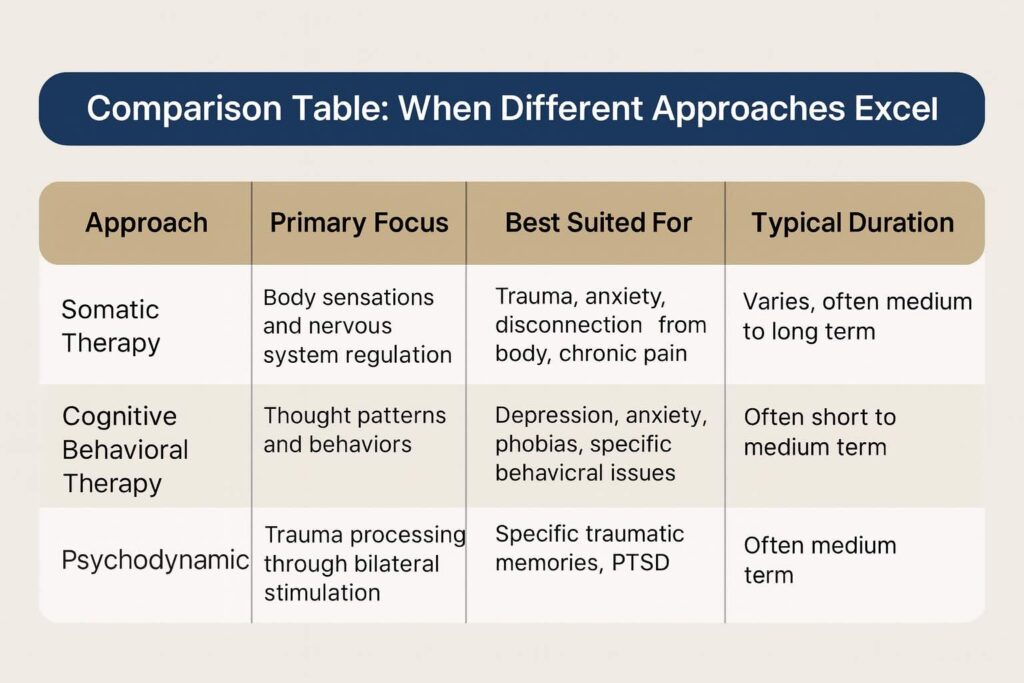
Cognitive Behavioral Therapy (CBT) focuses on identifying and changing thought patterns that contribute to emotional distress. The emphasis is cognitive, working with beliefs, interpretations, and thinking patterns. CBT is highly effective for many conditions and offers practical tools for managing symptoms.
Somatic therapy works from a different starting point, addressing the body’s role in emotional experience. Rather than focusing primarily on thoughts, somatic approaches attend to physical sensations, nervous system states, and the body’s stored responses to past experiences. This can be particularly valuable when cognitive approaches alone haven’t provided sufficient relief or when issues have strong physiological components.
These approaches complement each other well. You might use CBT to address thought patterns while simultaneously working somatically to regulate your nervous system and release stored tension. Many of our therapists integrate both approaches, offering comprehensive treatment that addresses both cognitive and physiological aspects of mental health.
Research in stress physiology supports the value of integrating these approaches. A review published in Healthcare explains that during acute stress, the brain curtails higher executive functions in favor of primal survival responses, making purely cognitive interventions less effective in those moments. Body-based “bottom-up” strategies that emphasize sensory awareness can help rebalance the nervous system, creating the conditions where cognitive processing becomes more accessible. This understanding supports using somatic interventions alongside cognitive approaches for comprehensive care.
Somatic Therapy vs. Traditional Talk Therapy
Traditional psychodynamic or insight oriented therapy emphasizes understanding your psychological patterns, exploring past experiences, and gaining insight into how history shapes present behavior. This approach values the therapeutic relationship and uses conversation as the primary tool for healing.
Somatic therapy incorporates these elements while adding explicit attention to the body. Insight remains valuable, but it’s accompanied by physiological change. You might understand cognitively why you react certain ways, yet somatic work helps your nervous system actually update its responses rather than remaining stuck in old patterns despite cognitive understanding.
Some people find that years of talk therapy provided valuable insights without creating the emotional or behavioral changes they sought. Adding somatic components can help bridge this gap between intellectual understanding and lived change. Your body learns new patterns through direct experience rather than through thinking about things differently.
Somatic Therapy vs. Mindfulness Based Approaches
Mindfulness practices cultivate present moment awareness and accepting observation of thoughts, emotions, and sensations. These practices improve emotional regulation, reduce reactivity, and support mental health. Many people benefit significantly from mindfulness based therapies like Mindfulness Based Stress Reduction or Dialectical Behavior Therapy.
Somatic therapy shares mindfulness’s emphasis on present moment awareness and incorporates many mindfulness practices. The key difference lies in working actively with sensations rather than simply observing them. While mindfulness might involve noticing tension without necessarily changing it, somatic therapy uses that awareness as a starting point for exploration and release.
These approaches integrate naturally. Your somatic therapist might teach mindfulness practices while also guiding more active work with physical sensations. The combination offers both the stabilizing benefits of mindfulness and the active healing potential of somatic interventions.
Comparison Table: When Different Approaches Excel
Key Benefits of Body Centered Therapy
Somatic therapy offers distinct advantages that make it valuable either as a standalone approach or as a complement to other therapeutic work.
Accessing Preverbal and Implicit Memories
Not all significant experiences are stored as explicit memories you can recall and describe. Trauma that occurred before you developed language, experiences you survived by dissociating, or events you don’t consciously remember can still profoundly affect your present functioning. These implicit memories live in your body as sensations, postural patterns, and automatic responses.
Somatic therapy can access and heal these preverbal and implicit experiences without requiring explicit recall. Through working with sensations and body patterns, you can resolve the effects of early experiences even when you don’t remember specific details. This makes somatic approaches particularly valuable for developmental trauma and complex PTSD.
Developing Emotional Regulation Skills
One of the most valuable benefits of somatic therapy is learning practical skills for regulating your emotional state. You develop ability to notice when you’re becoming dysregulated, tools to shift your nervous system state, and capacity to stay present with increasingly intense emotions without becoming overwhelmed.
These skills transfer to daily life, helping you manage anxiety before it escalates to panic, recognize when you’re moving toward depression and intervene earlier, stay calmer during conflicts, and recover more quickly from stress. The emphasis on building capacity makes somatic therapy inherently empowering.
Healing Without Retraumatization
Traditional trauma therapy sometimes requires detailed recounting of traumatic experiences, which can retraumatize clients. Somatic approaches offer gentler pathways to healing, working with the body’s responses to trauma rather than necessarily revisiting traumatic content explicitly.
While some trauma work does involve memories, somatic therapy keeps you within your window of tolerance throughout. Titration and pendulation protect against overwhelm, allowing healing to occur without reactivating trauma responses. This makes somatic therapy accessible for people who found traditional trauma therapy too overwhelming.
Reconnecting Mind and Body
Modern life often encourages disconnection from your body. You might learn to override physical signals of hunger, fatigue, or discomfort. You might spend most of your time in your head, attending to thoughts and screens rather than bodily experience. This disconnection contributes to anxiety, depression, and physical health problems.
Somatic therapy reverses this disconnection, helping you rediscover your body as a source of wisdom, pleasure, and guidance. This reconnection often brings increased vitality, improved self care, clearer boundaries, and greater sense of aliveness. You learn to trust your body’s signals rather than constantly overriding them.
Addressing Root Causes, Not Just Symptoms
While managing symptoms is important, somatic therapy aims deeper, addressing the nervous system dysregulation underlying many psychological symptoms. By working at this foundational level, changes often generalize across multiple areas of life. Improved nervous system regulation might simultaneously reduce your anxiety, improve your sleep, enhance your relationships, and increase your overall resilience.
Supporting Holistic Wellness
Somatic therapy recognizes that mental, emotional, and physical health are inseparable. By working with the whole person, this approach supports overall wellbeing. Many clients report not just reduction in target symptoms but also improved physical health, better sleep, more energy, and enhanced quality of life.

Finding a Somatic Therapist in the Bay Area
Choosing a therapist is one of the most important factors in successful therapy outcomes. When seeking somatic therapy specifically, certain considerations can help you find the right fit.
Specialized Training and Credentials
Our Associate Marriage and Family Therapists at the Center for Mindful Therapy bring diverse training backgrounds and integrate somatic principles into their practice. When browsing our therapist directory, look for clinicians who specifically mention somatic training or body based approaches. Many of our therapists have completed additional certifications in somatic modalities beyond their foundational AMFT training. This specialized education prepares them to guide you skillfully through body centered healing.
The Importance of Supervision
All therapists at the Center for Mindful Therapy are Associate MFTs working under licensed supervision. This structure provides important benefits. Your therapist receives ongoing consultation on their cases, access to additional perspectives when challenges arise, and continuous professional development. For somatic work, which requires skill in reading nonverbal cues and managing nervous system activation, this supervision adds an extra layer of quality care.
The supervised structure also makes therapy more accessible financially. Our therapists offer sessions at rates significantly lower than licensed private practitioners while maintaining high quality care through their supervision relationships and ongoing training.
Modality Integration
Many therapists integrate somatic approaches with other therapeutic modalities including trauma focused therapy, attachment based therapy, mindfulness practices, and cognitive behavioral techniques. This integration allows your therapist to tailor treatment to your specific needs, using somatic interventions when they’re most helpful while drawing on other tools as appropriate.
When reviewing therapist profiles, notice how clinicians describe their approach. Some emphasize somatic work heavily while others use it as one tool among many. Consider what level of somatic focus feels right for you and look for therapists whose described approach aligns with your preferences.
Practical Considerations
Location and session format matter. Some of our therapists offer in-person sessions at offices throughout the Bay Area including San Francisco, Oakland, Berkeley, Marin, and other communities. Other therapists provide exclusively telehealth services or offer both options.
Somatic therapy can be done effectively via telehealth, though some people prefer in-person work, especially when beginning therapy. Fortunately, many somatic techniques translate well to video sessions. Your therapist can guide you through body awareness practices, breathwork, and grounding exercises remotely. Some clients appreciate the ability to do somatic work in their own space where they might move, cry, or rest more comfortably than in an office setting.
When reviewing therapist profiles in our directory, you’ll find information about each clinician’s location, whether they offer in-person or telehealth sessions (or both), their specialties, and their therapeutic approach. This information helps you identify therapists whose logistics and style match your needs.
The Therapeutic Relationship
Research consistently shows that the quality of the therapeutic relationship predicts outcomes more strongly than specific techniques used. This is especially true in somatic work where you’re learning to trust your body and your experience. Finding a therapist with whom you feel safe, understood, and respected is essential.
Most therapists offer brief phone consultations before you commit to first sessions. Use these conversations to get a sense of the therapist’s style, ask questions about their approach, and notice how you feel talking with them. Trust your gut response. Your body often knows before your mind does whether someone feels safe and supportive.
Cultural Competency and Identity
Your identity, background, and life experiences shape how you experience therapy. Finding a therapist who understands your cultural context, identity, or specific life circumstances can be important. Our therapist directory allows you to filter by various factors and many therapists list specific populations or identities they’re particularly equipped to work with.
The Bay Area’s diversity is reflected in our collective. We have therapists from various backgrounds who speak multiple languages and bring different cultural perspectives to their work. Don’t hesitate to prioritize these factors in your search.
Getting Started with Somatic Therapy
Our online therapist directory allows you to search by specialty, location, session format, and other factors. Each profile includes information about the therapist’s approach, training, areas of focus, and practical details like availability and contact information.
Read profiles carefully, paying attention not just to credentials but to how therapists describe their work. Notice whose approach resonates with you. If you’re drawn to multiple therapists, that’s wonderful. You might schedule initial consultations with several clinicians to help you decide.
When you find a therapist you’d like to work with, reach out directly using the contact information on their profile. Many therapists respond within one to two business days. If you don’t hear back promptly, don’t take it personally. Therapists sometimes have full caseloads and may provide referrals to colleagues with availability.
For questions about the Center for Mindful Therapy generally or help navigating the directory, you can call our main number at (415) 766-0276 or visit our contact page. We’re here to support you in finding the right therapeutic match.
Browse our Therapist Directory
Frequently Asked Questions About Somatic Therapy

Q: How do I know if somatic therapy is right for me instead of traditional talk therapy?
A: Somatic therapy works particularly well if you’ve tried talk therapy without getting the results you hoped for, if you struggle to identify or express emotions, if you experience physical symptoms related to stress or trauma, or if you have trauma that occurred before you could verbalize it. Many people benefit from combining both approaches, using talk therapy to gain insight and understanding while adding somatic work to create actual physiological change.
Consider somatic therapy if you notice your body responds strongly to stress and emotions, if you experience chronic tension or pain without clear medical causes, if you dissociate or feel disconnected from your body, or if you’re dealing with trauma, especially complex or developmental trauma. The body based approach offers unique advantages for these situations that cognitive approaches alone might miss.
That said, you don’t need to choose between somatic and traditional therapy. Many therapists integrate both approaches, and you can work somatically with one therapist while also doing separate talk therapy if that serves your needs. The therapeutic relationship matters more than the specific modality, so finding a therapist you trust who uses approaches that resonate with you represents the most important decision.
Q: Can somatic therapy really work through video sessions or does it require in-person work?
A: While some people initially assume somatic therapy must be in-person because it’s body focused, the work translates surprisingly well to telehealth. Your therapist can guide you through body awareness exercises, breath work, grounding practices, and movement explorations via video. Many somatic techniques actually work better when you’re in your own comfortable, private space where you can move freely, make noise, or rest as needed.
Telehealth somatic therapy offers several advantages. You avoid commute time and can schedule sessions more flexibly. You work in your own environment where you might feel safer letting emotions emerge. You can wrap yourself in your own blanket, have tissues handy, or take time after sessions to rest without needing to drive home. For clients throughout California who don’t live near therapists offering their specialized approaches, telehealth makes body based work accessible.
That said, some situations benefit from in-person work. If you’re dealing with significant dissociation, if you struggle with focus during video sessions, or if you simply prefer face to face interaction, in-person options work well. Some of our therapists offer both formats, allowing you to choose based on your preferences and circumstances. Either way, effective somatic therapy happens through the relationship and the attention you bring to your experience, not through the specific setting.
Q: What’s the difference between somatic therapy and somatic experiencing?
A: Somatic experiencing (SE) is a specific type of somatic therapy developed by Peter Levine focused specifically on trauma resolution. SE works with how trauma affects the nervous system, using techniques to release incomplete protective responses and restore regulation. It’s highly effective for PTSD, complex trauma, and shock trauma from accidents, violence, or natural disasters.
Somatic therapy is the broader category encompassing SE along with other body based approaches including Sensorimotor Psychotherapy, Hakomi, body centered psychotherapy, and various integrative methods. While all share attention to bodily experience and nervous system regulation, they differ in specific techniques, theoretical foundations, and areas of focus. Some somatic therapies address trauma specifically while others work with anxiety, depression, relationship issues, or personal growth.
When choosing a therapist, look at their specific training rather than just the general term somatic therapy. Our therapist profiles indicate what approaches clinicians use and what issues they’re best equipped to address. If you’re dealing primarily with trauma, a therapist trained in SE or other trauma focused somatic approaches makes sense. For other concerns, various somatic methods may be equally effective.
Q: How long does somatic therapy take to work? Will I be in therapy forever?
A: The timeline for somatic therapy varies significantly based on what you’re addressing, your goals, and your unique healing process. Some people experience meaningful shifts within weeks, noticing improved nervous system regulation, reduced anxiety, or better emotional awareness. More substantial changes, particularly around trauma or long standing patterns, typically require months to years of consistent work.
Somatic therapy tends to work more quickly than you might expect for certain issues, particularly when those issues have strong physiological components. If you’re primarily seeking better stress management and emotional regulation skills, you might achieve your goals in several months. If you’re addressing complex trauma or deeply rooted patterns, healing typically requires longer commitment.
Many people work with somatic therapists intensively for a period, then transition to less frequent sessions or periodic check ins as needed. You’re not locked into therapy indefinitely. As you develop regulation skills and process core material, you become increasingly capable of managing on your own. Your therapist will work collaboratively with you on pacing and will support you in ending therapy when you’ve reached your goals or feel ready to continue your healing journey independently.
Q: Is somatic therapy evidence based? What does research say about its effectiveness?
A: Yes, research supports somatic therapy’s effectiveness, particularly for trauma, PTSD, anxiety, and depression. Studies on Somatic Experiencing have demonstrated significant reductions in PTSD symptoms, improved emotional regulation, and decreased anxiety and depression in various populations. Research on Sensorimotor Psychotherapy and other somatic approaches similarly shows positive outcomes.
The mechanisms underlying somatic therapy are increasingly well understood through neuroscience research. We now know that trauma and chronic stress affect the nervous system, not just thoughts and memories. Body based interventions that work directly with nervous system regulation offer logical, scientifically grounded pathways to healing. Research on interoception, the ability to sense internal bodily states, demonstrates strong connections between body awareness and emotional health, supporting somatic therapy’s emphasis on developing this capacity.
Beyond specific outcome studies, the principles underlying somatic therapy align with established neuroscience findings about how trauma affects the brain and body, how memory systems work, and how regulation develops. The integration of somatic approaches into mainstream trauma treatment reflects growing recognition of their value. Organizations including the Substance Abuse and Mental Health Services Administration recognize body based approaches as important components of trauma informed care.
Q: Will somatic therapy help with my anxiety if I don’t have trauma?
A: Absolutely. While somatic therapy is particularly well known for trauma treatment, it’s highly effective for anxiety even when you don’t have significant trauma history. Anxiety fundamentally involves nervous system dysregulation and physical symptoms including racing heart, shallow breathing, muscle tension, and digestive upset. Somatic therapy directly addresses these physiological components.
Through somatic work, you learn to recognize early signs of anxiety in your body and intervene before it escalates. You develop practical tools for regulating your nervous system including specific breathing techniques, grounding practices, and ways to release tension. As you build greater awareness of your body’s signals, you often catch anxiety earlier and manage it more effectively.
Many people find that while cognitive approaches helped them understand their anxiety intellectually, they still experienced the physical symptoms that made anxiety so distressing. Adding somatic techniques addresses these physical manifestations directly. You’re not just learning to think differently about your anxiety but actually changing how your nervous system responds to perceived threats. This dual approach, working with both thoughts and physiological responses – often provides more comprehensive relief than cognitive work alone.
Q: Do I need to talk about painful memories or can I heal without retelling my trauma story?
A: One of the significant advantages of somatic therapy is that healing can occur without necessarily recounting traumatic narratives in detail. While some people find it helpful to discuss what happened to them, it’s not always necessary and sometimes isn’t helpful, particularly if it retraumatizes you.
Somatic approaches work with how trauma is stored in your body rather than requiring you to relive memories cognitively. You might notice and release tension patterns, complete protective movements that were interrupted during traumatic events, or gradually expand your nervous system’s capacity to handle distress without ever discussing specific events. The body can reorganize and heal through direct experience without your conscious mind necessarily understanding all the details.
That said, some verbal processing often naturally emerges as you work somatically. As your body releases held patterns, memories, emotions, or insights sometimes surface. Your therapist helps you integrate these experiences at a pace you can tolerate. The key difference from traditional talk therapy is that narrative isn’t the primary vehicle for healing. Your body’s wisdom guides the process, and words serve to support integration rather than being the main therapeutic tool.
Browse our Therapist Directory
Citations:
- Nicholson, W. C., Sapp, M., Miller Karas, E., Duva, I. M., & Grabbe, L. (2025). The body can balance the score: Using a somatic self-care intervention to support well-being and promote healing. Healthcare, 13(11), 1258. https://doi.org/10.3390/healthcare13111258
- Payne, P., Levine, P. A., & Crane-Godreau, M. A. (2015). Somatic experiencing: Using interoception and proprioception as core elements of trauma therapy. Frontiers in Psychology, 6, 93. https://doi.org/10.3389/fpsyg.2015.00093