


Reviewed by Kathryn Vercillo, MA Psychology | Last Updated: May 2026
A few years ago, Mental Health America offered a simple framework for how anyone can engage with mental health awareness work: learn, act, advocate. The framing was originally tied to a specific year’s theme, but the structure has stayed with us. It maps cleanly onto the work of building mental wellness, both personally and collectively, and it offers an entry point for people who want to do something but are not sure where to start.
At the Center for Mindful Psychotherapy, we serve clients across San Francisco and the broader Bay Area. We see firsthand how engaging with mental health changes lives, both for the person who is engaging and for the people around them. This piece offers a practical guide to learning, acting, and advocating, with specific suggestions for each.
Browse our Therapist Directory
Why This Mental Health Framework Works
Many people care about mental health but feel overwhelmed by the question of what to do. Mental health can feel like a problem too big to solve, especially when you are also navigating your own day to day life. The learn, act, advocate framework breaks the work into three accessible categories, each of which offers entry points at any level of capacity.
Learn Comes First
You cannot effectively act or advocate from a place of confusion. Building your mental health literacy is foundational, and the work of learning is itself a meaningful contribution. The more accurately we understand mental health, the more we can recognize what is happening for ourselves and the people around us, and the more we can contribute to conversations that move things forward.
Act Is Where Theory Meets Daily Life
Knowledge that does not change your behavior is incomplete. Acting on what you learn means adjusting how you treat yourself, how you support others, and how you build the small architecture of your daily life. This is where mental wellness actually happens.
Advocate Extends Your Care Outward
If learning is for the self and acting is for the immediate circle, advocating is for the system. It means using your voice, your time, your resources, or your privilege to make mental health more accessible for people who do not currently have what they need.
Learn: Building Your Mental Health Literacy
The “learn” piece of the framework is about expanding your understanding of mental health, mental illness, and the conditions that shape both.
Read Beyond the Headlines
Most people get their mental health information from social media, headlines, and personal anecdotes. These can be useful but also tend to oversimplify. Reading more deeply, from contemporary clinicians, researchers, and people with lived experience, builds a more accurate picture.
Some authors worth knowing this year include Dr. Pooja Lakshmin on the difference between performative wellness and real self care, Tricia Hersey on rest as a justice practice, Stephanie Foo on healing from complex PTSD, Dr. Thema Bryant on culturally responsive trauma work, and Cathy Park Hong on the texture of racialized experience. Their books and essays are widely available and worth your time.
Listen and Watch
If reading is not your primary mode, podcasts and documentaries can do a lot of the same work. Therapy for Black Girls, Latinx Therapy, Hidden Brain, and The Light Podcast with Dr. Thema Bryant are all worth a listen. Documentaries like American Symphony, Daughters, and Crip Camp offer windows into specific mental health journeys that text alone cannot quite capture.
Educate Yourself About Specific Conditions
If someone you love has a particular diagnosis, learn what you can about that condition specifically, including from the perspective of people who have it. NAMI offers extensive condition-specific resources. The Trevor Project, Trans Lifeline, and Therapy for Black Girls offer resources tailored to specific communities.
Recognize What You Don’t Know
Part of learning is staying humble about what you have not yet understood. Mental health is shaped by culture, identity, history, and lived experience. Conditions look different across communities. Treatments have been developed largely with certain populations in mind. Recognizing the limits of any one perspective is part of becoming more literate.

Act: Practicing Mental Wellness in Daily Life
Action turns understanding into change. The “act” portion of the framework can include actions for yourself, actions for the people closest to you, and actions in the spaces where you spend your time.
Building Your Personal Coping Toolbox
A coping toolbox is the collection of practices, relationships, and resources you can draw on when things get hard. Most people have one without naming it. Naming it makes it easier to use.
Your toolbox might include physical practices like walking, swimming, or yoga. It might include relational practices like calling a specific friend, going to a particular meeting, or seeing a therapist. It might include creative practices like writing, painting, or playing music. It might include rest practices like naps, baths, or simply lying on the floor.
There is no correct toolbox. Yours should reflect what actually works for you, including the things that sound unimpressive when you say them out loud.
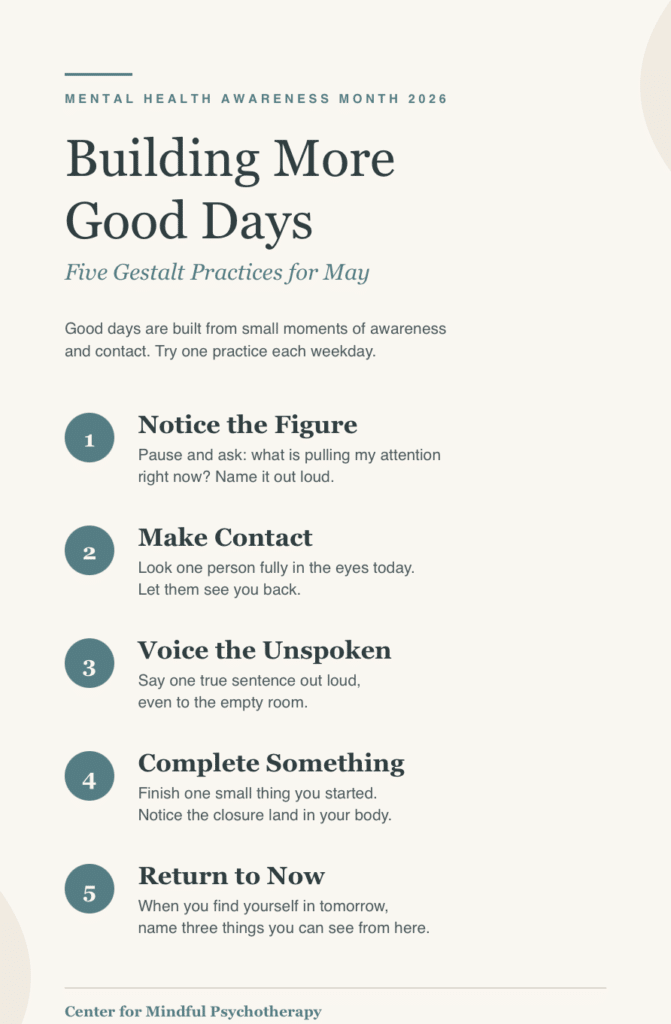
One evidence-informed approach to building your toolbox comes from Gestalt therapy, which offers five simple practices for cultivating present-moment awareness:
Knowing When to Seek Professional Help
Self help and community support are powerful, and they are not always enough. If you are noticing persistent changes in how you feel, function, sleep, or connect, professional support can help. Therapy is for the quiet asks, not just the crises.
If you are not sure whether what you are experiencing warrants therapy, the answer is usually that it does. People rarely regret reaching out for support too early.
Supporting the People Around You
Acting also means showing up for the people in your life. This can be as simple as checking in regularly with friends and family, especially those you sense might be struggling. It can mean learning how to listen without trying to fix. It can mean being honest about your own mental health, which gives the people around you permission to be honest about theirs.
When someone tells you they are struggling, the most helpful response is often presence rather than advice. Ask what they need. Stay with them. Resist the urge to immediately offer solutions.
Building Mental Wellness Into Your Spaces
If you have influence over a workplace, classroom, family system, or community space, you can build mental wellness practices into those spaces. This might look like regular check-ins, mental health days, training in supportive conversations, or making professional resources easy to find.
Workplace mental health, in particular, has become a meaningful piece of the conversation. Employees who feel their mental health is supported are more engaged, more loyal, and frankly more well. Advocating for these structures inside organizations is its own form of action.
Advocate: Working Toward Systemic Change
Advocacy extends mental health care beyond your own circle. It means using whatever capacity you have to push the system toward greater access, equity, and quality.
Storytelling as Advocacy
Sharing your own mental health story, when you choose to, is one of the most powerful forms of advocacy there is. Stories make the abstract concrete. They give other people permission to recognize their own experiences. They reduce stigma in ways that data alone cannot.
You do not have to share publicly to share meaningfully. Telling one person your story can ripple outward in ways you may never see.
Engaging With Policy
Mental health funding, insurance parity, and workforce expansion are all decided by elected officials. Contacting your representatives about mental health legislation, signing up for advocacy alerts from organizations like Mental Health America and NAMI, and voting for candidates who prioritize mental health are all forms of advocacy.
In 2026, the federal Medicaid budget is under particular scrutiny. Medicaid is the largest single funder of mental health and substance use treatment in the United States, and changes to its funding directly shape who gets care. Local elections matter too, including for school boards, city councils, and state legislatures, all of which make mental health decisions.
Supporting Community Organizations
Donating to and volunteering with mental health organizations is concrete advocacy. Look for organizations doing direct service work in your community, especially those serving populations with the least access. Local crisis lines, school-based counseling programs, community health centers, and culturally specific mental health programs all benefit from sustained support.
Even small monthly donations make a meaningful difference because they give organizations the predictability they need to plan and sustain services.
Pushing for Integration
Mental health remains too often siloed from primary medical care. Advocating for integrated behavioral health in primary care settings, in schools, and in workplaces dismantles barriers and normalizes mental health as part of overall health. You can do this by talking to your doctor about whether they offer integrated services, by asking your employer about mental health benefits, and by supporting policies that fund integration.
Self Care in Advocacy
Advocacy is sustaining work, and it can also be exhausting. People who advocate around mental health, especially those drawing on personal experience, can find themselves running on empty. Therapy, supervision, and supportive community matter for advocates as much as for anyone.
If you are doing advocacy work and finding it costly, consider working with a therapist who understands social justice contexts. Several of our associates work with anti-oppressive frameworks and can support you in sustaining the work.
San Francisco Resources
San Francisco has a particular mental health landscape, with both significant resources and significant barriers. Knowing what is available locally helps you act and advocate effectively.
Direct Services
San Francisco’s Department of Public Health operates community mental health services across the city, with locations in different neighborhoods. The San Francisco AIDS Foundation, Lyon-Martin Health Services, and Westside Community Services all offer mental health support tailored to specific communities. Crisis support is available through SF Suicide Prevention and the 988 Lifeline.
Advocacy Organizations
NAMI San Francisco offers support groups, education, and advocacy. Mental Health Association of San Francisco runs peer-led programs and policy work. The San Francisco Behavioral Health Commission gives community members a way to engage with how the city’s mental health services are run.
Community Mental Health Spaces
Beyond traditional clinical settings, San Francisco hosts a thriving ecosystem of mindfulness centers, somatic practitioners, peer support groups, and community healing spaces. These are not substitutes for clinical care when clinical care is needed, but they are meaningful pieces of the mental wellness landscape, especially for ongoing maintenance and growth.
Getting Started
The learn, act, advocate framework is most useful when you start somewhere small. Pick one practice this week. Read one book this month. Make one call to your representative this quarter. Sustained, modest engagement matters more than dramatic gestures that do not last.
If you are looking for therapy as part of your engagement with mental health, our therapist directory features approximately 140 Associate Marriage and Family Therapists serving San Francisco and the broader Bay Area in person, and California through telehealth. Each profile describes the therapist’s training, approach, and areas of focus. Reach out to them directly or contact us for guidance on choosing a therapist.
Browse our Therapist Directory
Frequently Asked Questions
Q: I want to advocate for mental health but I’m not a clinician. Can I still make a difference?
A: Absolutely. Most mental health advocacy is done by people who are not clinicians. People with lived experience, family members, friends, employers, teachers, faith leaders, artists, and concerned neighbors all play essential roles in shifting how mental health is understood and supported. Your perspective and voice matter. The history of mental health advocacy in the United States, including the founding of Mental Health America itself, has been driven largely by non-clinicians who refused to stay quiet.
Q: How do I support a friend who is struggling without overstepping?
A: Start by listening more than advising. Ask what they need rather than assuming. Stay present without trying to fix. Check in regularly, not just once. If you are concerned about their safety, name your concern directly and gently. Help them locate resources if they want help finding a therapist or other support, but respect that the decision to seek help is theirs. Many people who have been through hard times say what mattered most was simply knowing someone stayed.
Q: What if I want to share my mental health story but I’m worried about consequences?
A: This is a reasonable concern. Sharing publicly is not for everyone, and it does not have to be all or nothing. Some people share with one trusted person at a time. Others write privately first to clarify their own thinking before deciding what to share. NAMI and MHA both offer guided storytelling resources. If you are worried about professional consequences, consider what you have to lose and what you might gain. There is no obligation to share, and there is no shame in keeping your story private.
Q: How do I know which mental health organizations to support?
A: Look for organizations doing direct service work in communities you care about. Local organizations often have a more direct impact than national ones. Look at what percentage of donations goes to programs versus administration. Look at whether the organization is led by people with lived experience or by people from the communities served. Charity Navigator and Candid offer ratings, but the most useful information often comes from people who have actually used the services.
Q: What’s the difference between learning and being a saviour?
A: This is a thoughtful question. Learning is about expanding your understanding so you can be more useful. Saviour mentality is about positioning yourself as the rescuer of people you have decided need rescuing. The difference shows up in tone and in action. Learning makes you a better collaborator. Saviour mentality makes you a worse one. If you are unsure, the test is whether you are following the lead of people most affected, or expecting them to follow yours.
Q: How do I start advocacy work without burning out?
A: Pace yourself. Pick a small number of issues you genuinely care about rather than trying to engage with everything. Build sustainable practices around your advocacy: rest, social connection, time away from news and social media, regular check-ins with yourself about how the work is affecting you. Consider therapy, especially with a therapist who understands the particular weight of justice work. Burnout is not a sign that you should stop. It is a sign that the pace needs to change. Sustainable advocacy outlasts heroic advocacy every time.
Q: How does therapy support advocacy work?
A: Advocacy work, especially work rooted in personal experience, can be emotionally taxing. Therapy offers a space to process, reflect, set boundaries, and sustain the energy needed for long-term engagement. Therapists trained in anti-oppressive and social justice frameworks can support you in navigating the particular challenges of advocacy, including burnout, secondary trauma, and the moral injuries that come with doing this work in an imperfect system. Several of our associates work explicitly with these frameworks. Browse our therapist directory and filter for anti-oppressive or systems therapy to find someone who might be a good fit.