

Reviewed by Kathryn Vercillo, MA Psychology | Last Updated: December 2025
What is EMDR Therapy?
Eye Movement Desensitization and Reprocessing (EMDR) is an evidence based psychotherapy that helps your brain process traumatic memories and disturbing life experiences. Through guided bilateral stimulation, typically eye movements, EMDR allows stuck memories to become unstuck, reducing their emotional charge and transforming how you relate to your past.
Rewiring Painful Memories Through Your Brain’s Natural Healing Capacity
Your brain possesses a remarkable ability to heal from psychological wounds, much like your body heals from physical injuries. Yet sometimes traumatic experiences become frozen in your nervous system, replaying with the same intensity years or even decades later. When a car backfires and your heart races with the terror of a long past assault, or when a certain smell transports you instantly to a childhood you thought you had overcome, your brain is signaling that these memories remain unprocessed.
EMDR therapy offers a pathway to unlock these frozen experiences and allow your brain’s natural healing mechanisms to complete what trauma interrupted. At Center for Mindful Therapy, some of our Associate Marriage and Family Therapists bring specialized EMDR training to their work with clients throughout San Francisco. Some of our therapists offer in person sessions in San Francisco neighborhoods from the Mission to the Sunset, while telehealth options extend this transformative therapy to clients across California.
What distinguishes EMDR from traditional talk therapy is its recognition that trauma lives not just in your thoughts but in your entire nervous system. Talking about what happened is valuable, yet it often cannot reach the parts of your brain where traumatic memories are stored. EMDR bypasses the limitations of verbal processing by engaging both hemispheres of your brain through bilateral stimulation, creating conditions for genuine neurological change.
Our therapists work within a supervised model that ensures quality care while making EMDR accessible at rates below what licensed private practitioners typically charge. Each Associate MFT receives individual clinical supervision, bringing both fresh training in the latest EMDR protocols and the guidance of experienced clinicians to support your healing journey.
Browse our Therapist Directory
On This Page:
- Understanding How EMDR Works
- The Eight Phases of EMDR Treatment
- Conditions EMDR Effectively Treats
- What to Expect in EMDR Sessions
- EMDR Compared to Other Trauma Therapies
- Who Benefits Most from EMDR
- Why Choose Our EMDR Trained Therapists
- Beginning Your EMDR Journey
- Frequently Asked Questions
Understanding How EMDR Works

The Adaptive Information Processing Model
EMDR rests on a theory called the Adaptive Information Processing (AIP) model, which proposes that your brain has an innate capacity to process experiences and integrate them into adaptive memory networks. When you have a normal, non traumatic experience, your brain processes the information while you sleep and during waking hours, connecting it to existing knowledge and allowing you to learn from it without emotional disturbance.
Trauma disrupts this natural processing system. When an experience overwhelms your nervous system’s capacity to cope, the memory can become stored in an isolated, dysfunctional form. Instead of being integrated with other memories and knowledge, the traumatic memory remains frozen in time, complete with the original images, sounds, thoughts, emotions, and body sensations. This explains why traumatic memories feel so different from ordinary memories; they are stored differently in your brain.
What Bilateral Stimulation Does
The hallmark of EMDR is bilateral stimulation, which means activating both sides of your brain in an alternating pattern. Most commonly, this involves following your therapist’s fingers with your eyes as they move back and forth across your visual field. Some therapists use alternating tones through headphones, tactile buzzers held in each hand, or gentle tapping on your knees or shoulders.
Research suggests that bilateral stimulation mimics what happens during Rapid Eye Movement (REM) sleep, when your eyes move naturally from side to side as your brain processes the day’s experiences. By recreating aspects of this state while you focus on traumatic material, EMDR appears to facilitate the same kind of memory consolidation and integration that occurs during sleep.
During bilateral stimulation, clients often report that distressing memories begin to feel more distant, as if watching them on a screen rather than reliving them. The emotional intensity typically decreases, new insights emerge spontaneously, and the memory begins connecting to other, more adaptive information in the brain. A client who has carried the belief “I am powerless” since a childhood assault might suddenly recognize, “That happened to me as a child. I am an adult now and I have choices.”
Research published in Frontiers in Psychology demonstrates that EMDR’s effectiveness extends well beyond PTSD, with studies showing positive outcomes for depression, chronic pain, addiction, and anxiety disorders. This expanding body of evidence supports what EMDR’s theoretical foundation, the Adaptive Information Processing model, has long predicted: that many mental health challenges stem from memories that were never fully processed, and EMDR helps the brain complete that integration.
The Neurobiological Perspective
Neuroscience research provides additional insight into why EMDR works. Brain imaging studies show that EMDR treatment leads to changes in activity in key brain regions. The amygdala, your brain’s alarm system that becomes hyperactive after trauma, shows reduced activation. The prefrontal cortex, responsible for rational thinking and emotional regulation, shows increased activity. The hippocampus, which helps integrate memories into your life narrative, also shows changes consistent with improved memory processing.
These neurobiological shifts correspond to what clients experience clinically: decreased emotional reactivity to trauma triggers, improved ability to think clearly about past events, and a sense that traumatic memories have become ordinary memories, present but no longer haunting.

The Eight Phases of EMDR Treatment
EMDR follows a structured eight phase protocol developed by Francine Shapiro, who discovered the technique in 1987. This structure ensures thorough preparation, careful processing, and complete integration of therapeutic gains.
Phase 1: History Taking and Treatment Planning
Your therapist begins by learning about your history, current symptoms, and treatment goals. Together you identify specific memories, experiences, or triggers that will become targets for EMDR processing. This phase also involves assessing your readiness for trauma processing and ensuring you have adequate internal resources and external support.
Your therapist develops a treatment plan that sequences targets appropriately, often beginning with a memory that feels moderately distressing rather than your most overwhelming experience. This allows you to build confidence in the process before addressing more challenging material.
Phase 2: Preparation
Before processing traumatic memories, you need skills for managing distress and maintaining stability. Your therapist teaches you relaxation techniques, grounding exercises, and ways to contain disturbing material between sessions. You learn about EMDR, what to expect during processing, and how to signal if you need to pause.
This phase establishes the therapeutic alliance essential for trauma work. You develop trust in your therapist’s ability to guide you safely through difficult territory and confidence in your own capacity to tolerate the process.
Phase 3: Assessment
When you begin processing a specific memory, your therapist helps you access it fully while creating appropriate distance. You identify the image that represents the worst part of the memory, the negative belief about yourself connected to the experience (such as “I am unsafe” or “I am worthless”), and the positive belief you would prefer to hold (such as “I am safe now” or “I have value”).
You also identify the emotions present when you focus on the memory and where you feel them in your body. Finally, you rate both how disturbing the memory feels (on a scale from zero to ten) and how true the positive belief feels (on a scale from one to seven). These measurements allow you and your therapist to track progress throughout processing.
Phase 4: Desensitization
This is the active processing phase where bilateral stimulation occurs. While holding the target memory in mind along with its associated negative belief, emotions, and body sensations, you follow your therapist’s fingers (or other bilateral stimulus) for sets of approximately thirty seconds to a minute.
After each set, your therapist asks you to take a breath and report whatever you noticed. This might be a change in the image, a new thought or memory, a shift in emotion, or a physical sensation. Without analyzing or directing the process, your therapist simply instructs you to “go with that” and begins another set of bilateral stimulation.
The desensitization continues until the memory no longer causes significant disturbance. This might happen within a single session or may require multiple sessions for complex trauma. Your brain leads the process, making connections and shifts that neither you nor your therapist can predict or control.
Phase 5: Installation
Once the disturbing material has been processed, your therapist helps strengthen the positive belief you identified earlier. While holding the now processed memory together with this positive cognition, you receive additional bilateral stimulation. This installation phase helps solidify new, adaptive ways of understanding yourself and your experience.
Phase 6: Body Scan
Trauma often remains stored in the body even after cognitive and emotional processing. In this phase, you think about the original memory while scanning your body from head to toe, noticing any residual tension, discomfort, or unusual sensation. If any disturbance remains, additional bilateral stimulation targets these body sensations until they resolve.
Phase 7: Closure
Each session ends with stabilization, ensuring you leave in a calm, contained state regardless of whether processing completed. Your therapist guides you through relaxation exercises and reminds you that processing may continue between sessions. You receive guidance about what to expect and how to manage any disturbance that might arise.
Phase 8: Reevaluation
At the beginning of subsequent sessions, your therapist checks the previously processed material to ensure gains have been maintained. If any aspect of the target memory remains disturbing, additional processing addresses it. This phase also evaluates whether treatment goals are being met and identifies any remaining targets.

Conditions EMDR Effectively Treats
While EMDR was originally developed for post traumatic stress disorder, research and clinical experience have demonstrated its effectiveness for a wide range of psychological challenges. The following conditions respond particularly well to EMDR treatment.
Post Traumatic Stress Disorder
EMDR has the strongest evidence base for PTSD, recognized as a first line treatment by the World Health Organization, the American Psychiatric Association, and the Department of Veterans Affairs. Whether your trauma stems from combat, sexual assault, accidents, natural disasters, or childhood abuse, EMDR can help resolve the intrusive memories, hypervigilance, avoidance, and emotional numbing that characterize PTSD.
San Francisco residents dealing with trauma from diverse sources find relief through EMDR. Some carry wounds from the AIDS crisis that devastated communities here in the 1980s and 90s. Others process trauma from fires, earthquakes, or violence. Still others address childhood experiences they have carried for decades. EMDR’s ability to process trauma without requiring detailed verbal narrative makes it particularly valuable when experiences feel unspeakable or when language fails to capture what happened.
The speed of EMDR often surprises clients accustomed to years of therapy producing only gradual change. While complex trauma requires more extensive treatment, single incident trauma sometimes resolves in just a few sessions. Research shows that EMDR produces results equivalent to other evidence based trauma treatments in significantly less time.
Complex Trauma and Developmental Trauma
When trauma occurred repeatedly during childhood, often at the hands of caregivers who should have provided safety, the impacts extend beyond classic PTSD symptoms. Complex trauma affects your sense of self, your ability to regulate emotions, your relationships, and your fundamental beliefs about the world’s safety and your own worth.
EMDR has been adapted for complex trauma through protocols that address not just specific memories but the entire developmental impact of chronic adversity. Treatment proceeds more gradually, with extensive preparation and stabilization. Your therapist helps you build internal resources, establish safety in the present, and process traumatic material in manageable doses.
For adults who grew up in homes marked by abuse, neglect, addiction, mental illness, or domestic violence, EMDR offers hope for healing wounds that traditional therapy sometimes struggles to reach. The bilateral stimulation appears particularly effective at accessing implicit memories, the body based, preverbal impressions formed before you could create narrative memories.
Anxiety
Anxiety often has roots in past experiences that taught your nervous system to anticipate danger. A child bitten by a dog may develop a phobia that persists into adulthood. Someone humiliated during a presentation might experience social anxiety for years afterward. Panic attacks frequently begin during or shortly after stressful life events, even when the connection is not immediately apparent.
EMDR addresses anxiety by processing the experiences that originally sensitized your nervous system. Rather than simply managing symptoms, you resolve the underlying memories that continue generating anxious responses. Many clients find that phobias, social anxiety, generalized anxiety, and panic attacks diminish significantly after EMDR treatment.
The approach also works well for anticipatory anxiety. By processing past failures or humiliations, you reduce the emotional charge that makes future situations feel threatening. Performance anxiety, public speaking fear, test anxiety, and medical procedure phobias all respond to EMDR when the earlier experiences fueling them are identified and processed.
Depression
While depression has many contributing factors, past experiences often play a significant role. Losses, failures, rejections, and traumas can instill negative beliefs about yourself and your future that maintain depressive states. EMDR addresses these experiential roots of depression by processing the memories that gave rise to beliefs like “I am worthless,” “I always fail,” or “Nothing ever works out for me.”
Research shows EMDR effectively treats depression, particularly when depression co occurs with trauma history or when specific negative life events contributed to the depressive episode. Processing these events often allows more hopeful, accurate beliefs to emerge naturally, without the therapist needing to challenge or dispute negative cognitions directly.
Grief and Complicated Mourning
Grief is a natural response to loss, yet sometimes the grieving process becomes stuck. Traumatic loss, such as sudden death, suicide, or witnessing a loved one’s suffering, can complicate mourning. Guilt, anger, or unfinished business with the deceased may prevent grief from moving toward acceptance. Previous losses may be reactivated, compounding current grief.
EMDR helps process the traumatic aspects of loss while honoring the genuine sadness that accompanies significant death. Many clients find that EMDR allows them to access positive memories and feelings about their loved one that grief had obscured. They can remember without being overwhelmed, grieve without getting stuck, and eventually integrate the loss while maintaining connection to what the relationship meant.
A 2024 review in Frontiers in Psychiatry confirms that EMDR is particularly effective for prolonged grief, with research showing clients achieve near complete symptom reduction faster than with other approaches. Perhaps most meaningful for those grieving, EMDR uniquely helps people develop more positive memories of their loved ones, something not found with other grief interventions.
Addiction and Substance Use Disorders
Trauma and addiction frequently co occur, with many people initially using substances to manage intolerable emotional states rooted in unprocessed traumatic experiences. EMDR addresses addiction by processing the underlying trauma, reducing the emotional distress that drives substance use, and resolving the memories and beliefs that maintain addictive patterns.
EMDR can also process addiction related memories themselves, such as traumatic experiences that occurred while using, the shame and consequences of addictive behavior, and triggers that prompt cravings. Treatment typically occurs alongside other addiction recovery supports and is most appropriate for clients who have achieved some initial stability in their recovery.
Chronic Pain and Psychosomatic Symptoms
Pain and physical symptoms sometimes have psychological dimensions, particularly when they began during or shortly after stressful life events, when they lack clear medical explanation, or when they respond inconsistently to medical treatment. EMDR can address the emotional components of chronic pain without dismissing its physical reality.
By processing memories associated with pain onset, trauma stored in the body, and the distressing experiences of living with chronic symptoms, EMDR often provides relief that complements medical treatment. Some clients experience significant reduction in pain intensity. Others find that while pain persists, their relationship to it shifts, with less distress, better coping, and improved quality of life.
Performance Enhancement and Blocks
Beyond addressing pathology, EMDR can help with performance challenges rooted in past negative experiences. Athletes, musicians, actors, and professionals in high pressure fields sometimes develop blocks or anxiety that impairs their performance. Often these difficulties trace back to earlier experiences of failure, criticism, or humiliation.
EMDR processes the memories maintaining performance anxiety while strengthening positive beliefs and desired future outcomes. Many clients find that after EMDR, they can access flow states more easily, perform with less self consciousness, and recover more quickly from setbacks.
What to Expect in EMDR Sessions

The First EMDR Session
Your initial session focuses on getting to know you and assessing whether EMDR is appropriate for your situation. Your therapist asks about what brings you to therapy, your history, current life circumstances, and treatment goals. This conversation helps identify potential targets for EMDR processing and ensures you have adequate stability and resources for trauma work.
Your therapist explains how EMDR works, what happens during bilateral stimulation, and what you might experience during and after processing. You have opportunities to ask questions and address any concerns. If EMDR seems appropriate, you discuss next steps and begin preparation for processing.
Depending on your situation, you might begin learning stabilization and coping skills in this first session, or you might need several preparation sessions before processing traumatic material. Your therapist tailors the pace to your needs, ensuring you feel ready before confronting difficult memories.
The Processing Experience
When you begin processing a target memory, you may notice various experiences during the bilateral stimulation sets. Some clients see the memory like a movie playing in their mind. Others experience intense emotions, body sensations, or find themselves recalling related memories they had not thought about in years. Still others report thinking in ways that feel different from ordinary reflection, with insights arising spontaneously.
The experience varies considerably from person to person and from session to session. Some processing feels intense, with strong emotions surfacing. Other times, the process feels subtle, almost boring, as the memory simply loses its charge without drama. Trust that your brain is working even when you cannot perceive what is happening.
You always remain in control during EMDR. You can stop at any time by raising your hand or speaking. Your therapist checks in after each set, and you can request breaks, adjust the speed of eye movements, or discuss what is arising. The therapist guides the process but does not direct your internal experience.
After Processing Sessions
EMDR activates a continuation of processing that extends beyond the session itself. In the hours and days following treatment, you may notice dreams, insights, memories, or emotions that seem connected to the work. This between session processing is normal and indicates that healing continues.
Your therapist provides guidance about what to expect and how to manage any disturbance that arises. Keeping a brief log of what you notice between sessions helps identify material to address in subsequent appointments. Having self care strategies in place supports your nervous system during this active processing period.
Most clients find that disturbing memories feel progressively less intense as treatment continues. The rate of progress varies based on the complexity of what you are addressing, but many clients report significant relief within the first few processing sessions. Complete treatment of complex trauma takes longer but typically proceeds faster than traditional talk therapy approaches.

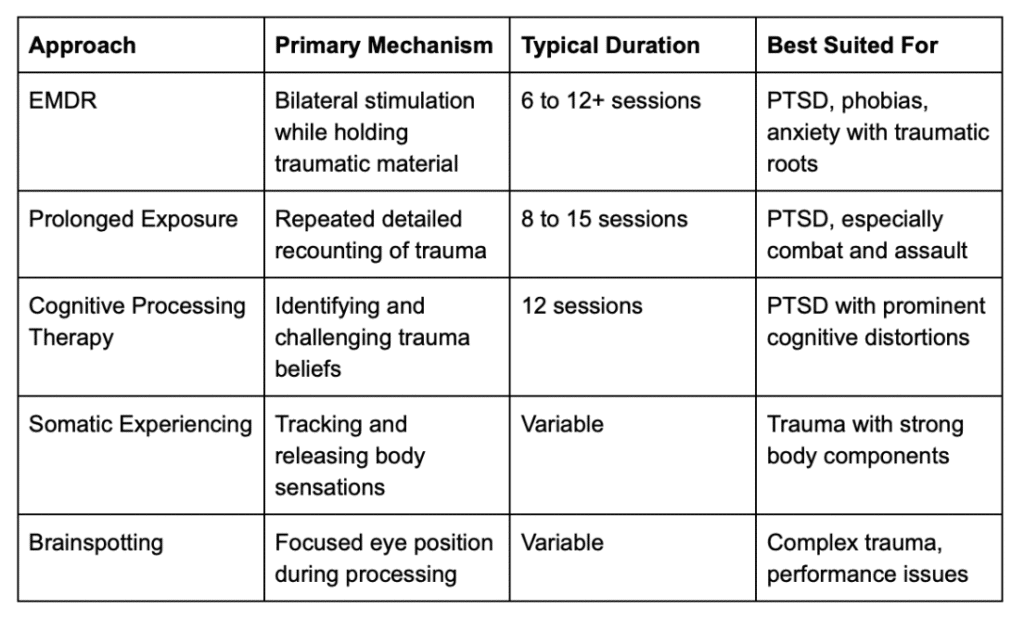
EMDR Compared to Other Trauma Therapies
Several evidence based treatments address trauma effectively. Understanding how EMDR compares helps you make an informed choice about your care.
EMDR and Prolonged Exposure
Prolonged Exposure (PE) is another first line trauma treatment that works by having you repeatedly recount traumatic memories in detail while remaining in the present moment. The idea is that by facing the memory without the feared consequences occurring, your anxiety naturally decreases.
Both EMDR and PE are highly effective for PTSD. EMDR may offer some advantages: it typically requires fewer sessions, involves less direct confrontation with traumatic details, and some clients find it less distressing. However, PE has a longer track record and may be more readily available. Some clients respond better to one approach than the other, and both have strong research support.
EMDR and Cognitive Processing Therapy
Cognitive Processing Therapy (CPT) is another evidence based trauma treatment that focuses on how you think about your traumatic experience. Through structured worksheets and therapist guidance, you identify and challenge unhelpful beliefs that developed after trauma (such as “I should have prevented it” or “I can never trust anyone”).
While CPT primarily works through cognition and EMDR works through memory processing, both ultimately change how you think and feel about traumatic experiences. CPT may appeal to those who prefer a more cognitive, structured approach. EMDR may be preferable when traumatic memories feel too overwhelming to discuss in detail or when trauma occurred before the development of verbal memory.
EMDR and Somatic Therapies
Body based approaches like Somatic Experiencing (SE) and Sensorimotor Psychotherapy share with EMDR a recognition that trauma lives in the body. These approaches focus on releasing traumatic activation from the nervous system through careful attention to body sensations, movement, and posture.
EMDR and somatic therapies complement each other well, and many therapists integrate elements of both. EMDR’s bilateral stimulation may help process cognitive and emotional aspects of trauma efficiently, while somatic approaches address body patterns that EMDR does not directly target. Some clients benefit from EMDR followed by somatic work, or from therapists who weave both approaches together.
EMDR and Brainspotting
Brainspotting, developed by an EMDR trainer, shares EMDR’s use of eye positions and the visual field but takes a more focused approach. Rather than moving eyes back and forth, Brainspotting identifies specific eye positions where trauma appears to be stored and maintains focus there while processing occurs.
Both techniques access and process traumatic material through the visual system. Some clients respond better to EMDR’s more active bilateral stimulation, while others prefer Brainspotting’s quieter, more focused approach. Therapists trained in both can offer whichever seems most appropriate for your needs.
Who Benefits Most from EMDR
Ideal Candidates for EMDR
EMDR works well for people who have experienced identifiable traumatic events that continue affecting their current functioning. Whether the trauma was a single incident like a car accident or assault, or repeated experiences like childhood abuse or domestic violence, EMDR can help if you can identify specific memories that contribute to current distress.
Clients who have difficulty talking about traumatic experiences often find EMDR particularly valuable. Because processing happens internally during bilateral stimulation, you do not need to provide detailed verbal accounts of what happened. Your therapist only needs to know enough to help you target and track the material.
People who have insight into their problems but have not been able to change through talk therapy alone often respond well to EMDR. If you understand why you react certain ways but cannot seem to shift the patterns, EMDR’s access to deeper brain processes may provide what verbal processing could not.
When EMDR May Not Be First Choice
Some situations call for caution with EMDR or suggest other approaches might be more appropriate. If you are actively in crisis, experiencing severe dissociation, or struggling with active suicidal thoughts, stabilization work should precede trauma processing. Your therapist assesses readiness and builds necessary foundations before EMDR begins.
If you have difficulty accessing or tolerating emotions, or if you tend to become overwhelmed and shut down when distressing material arises, additional preparation may be needed. Some clients require several sessions of stabilization and resource building before they can benefit from EMDR processing.
Certain medical conditions, particularly those affecting the eyes, may require modifications to standard EMDR procedures. Let your therapist know about any visual difficulties, neurological conditions, or medications that might affect treatment.
EMDR with Different Populations
EMDR has been adapted for use with children, adolescents, couples, and families. Child protocols use age appropriate language and often incorporate play elements. Adolescent EMDR addresses developmental considerations unique to that stage of life.
EMDR works across cultural backgrounds, though therapists must approach each client’s cultural context with sensitivity and awareness. San Francisco’s diverse population includes people with varied cultural relationships to trauma, mental health treatment, and Western psychological models. Your therapist tailors the approach while respecting your cultural framework.

Why Choose Our EMDR Trained Therapists
Specialized Training in a Supportive Structure
Our Associate MFTs who practice EMDR have completed specialized training in the modality, learning both the technical protocols and the clinical judgment needed to apply them effectively. Many continue advancing their EMDR skills through consultation groups, advanced trainings, and certification programs.
Working within our supervised model means your therapist has consistent access to clinical guidance. When complex situations arise, your therapist consults with experienced supervisors who can offer perspective and direction. This structure supports quality care while allowing our associates to take on challenging cases with appropriate backup.
Accessibility Without Compromising Quality
EMDR therapy in San Francisco often costs more than many residents can afford. Licensed EMDR therapists in private practice typically charge rates that put sustained treatment out of reach for clients without generous insurance or substantial financial resources.
Our model makes EMDR accessible by offering sessions at significantly lower rates than licensed private practitioners. You receive quality treatment from therapists who are passionate about their work, engaged in ongoing learning, and supported by supervision. The savings do not come from cutting corners but from our nonprofit structure and commitment to expanding access.
Integration with Other Approaches
Our therapists do not practice EMDR in isolation. They integrate it with other therapeutic modalities including attachment based work, somatic approaches, mindfulness practices, and cognitive behavioral techniques. This integration allows your therapist to address aspects of your experience that EMDR alone might not reach and to tailor treatment to your specific needs.
Some clients benefit from EMDR as their primary treatment modality. Others use EMDR for trauma processing while doing different kinds of work in other sessions or with other providers. Your therapist collaborates with you to determine how EMDR fits into your overall healing journey.
In Person and Telehealth Options
Some of our EMDR trained therapists offer in person sessions in San Francisco, from offices in various neighborhoods throughout the city. In person work allows for the traditional form of bilateral stimulation using eye movements, though other forms work well too.
Telehealth EMDR has proven effective and makes treatment accessible regardless of where you live in California. Your therapist guides you through modified bilateral stimulation techniques adapted for video sessions, often using self administered tapping or eye movements following a moving image on screen. Many clients find telehealth EMDR just as effective as in person treatment.
Browsing Our Directory
Our therapist directory allows you to search by specialty, location, and session format. Filter for EMDR to see clinicians trained in this approach. Read profiles carefully, attending to therapeutic style, areas of expertise, and anything that speaks to your particular situation.
Many therapists offer brief consultations before you commit to treatment. Use these conversations to ask questions, share concerns, and assess whether this person feels like a good fit. The therapeutic relationship matters enormously; trust your instincts about connection.
Browse our Therapist Directory

Frequently Asked Questions About EMDR Therapy
Q: How is EMDR different from just talking about my trauma in regular therapy?
A: Traditional talk therapy engages your brain’s language and reasoning centers as you describe traumatic experiences and work to understand them cognitively. While valuable, this approach may not access where traumatic memories are actually stored. Research shows that trauma often lodges in subcortical brain regions that language cannot directly reach. You can understand intellectually that a past threat no longer exists while your nervous system continues responding as though danger persists.
EMDR bypasses language by using bilateral stimulation to access memory networks directly. Rather than trying to reason your way to different feelings, EMDR creates conditions for your brain to reprocess and integrate traumatic material naturally. The shifts that occur often surprise clients because they emerge spontaneously rather than through effortful cognitive work. Many clients who spent years in talk therapy without significant improvement find that EMDR produces changes they had stopped hoping for.
Q: Will I have to describe my trauma in detail during EMDR sessions?
A: No. Unlike exposure based therapies that involve detailed recounting, EMDR requires only that you hold the memory in mind during bilateral stimulation. Your therapist needs enough information to help you target the material, but you never need to provide a narrative account of what happened. You can simply say “the incident” or “what happened when I was eight” without elaborating.
This aspect of EMDR makes it particularly valuable for experiences that feel unspeakable or shameful, for trauma that occurred before verbal memory developed, or for clients who find detailed recounting retraumatizing. Your therapist monitors your distress level and ensures processing stays within your capacity. The goal is healing, not storytelling, and EMDR achieves this without requiring you to verbalize what your brain already knows.
Q: How long does EMDR treatment typically take, and how will I know when I am finished?
A: Treatment length varies considerably depending on what you are addressing. Single incident trauma in someone with a stable life history might resolve in three to six sessions of active processing, plus preparation and closure sessions. Complex trauma involving repeated childhood adversity typically requires six months to two years or longer of treatment.
You will know treatment is working when previously distressing memories no longer trigger the same emotional reactions. Triggers that once overwhelmed you become manageable. Negative beliefs about yourself that felt absolutely true begin feeling less convincing. You notice improvements in sleep, mood, relationships, and overall functioning. Your therapist periodically assesses progress using rating scales that track changes in how disturbing memories feel and how strongly you hold positive beliefs about yourself. Treatment concludes when identified targets have been processed and you feel ready to continue life without regular EMDR sessions.
Q: Can EMDR be done effectively through telehealth, or do I need to come in person?
A: Research and clinical experience confirm that telehealth EMDR is effective for most clients. While in person sessions allow for traditional eye movement guidance using the therapist’s hand, telehealth sessions use adapted methods that work equally well. You might follow a moving image on your screen, use self administered bilateral tapping, or hold buzzers that alternate vibration between your hands.
Many clients actually prefer telehealth EMDR because they can do difficult processing work in the comfort and privacy of their own home. There is no commute after an intense session, no need to compose yourself for the public world. You have immediate access to your own space for grounding and self care. For San Francisco residents with demanding schedules, telehealth also eliminates travel time and increases flexibility.
Q: Is EMDR safe? I have heard that it can make things worse before they get better.
A: EMDR is considered safe when practiced by trained clinicians following established protocols. The therapy has been used with millions of people over three decades, and serious adverse effects are rare. That said, engaging with traumatic material is inherently challenging, and temporary increases in distress can occur.
Some clients experience vivid dreams, unexpected emotions, or increased memories surfacing between sessions during active processing. This typically indicates that healing is underway rather than that something has gone wrong. Your therapist prepares you for this possibility and provides tools for managing between session disturbance. The eight phase protocol includes specific attention to stabilization and closure, ensuring you leave sessions in a manageable state and have resources for whatever arises.
True destabilization is uncommon when therapists properly assess readiness and maintain appropriate pacing. If you have a history of severe dissociation, active suicidal thoughts, or current instability, additional preparation work ensures you can tolerate EMDR safely. Your therapist monitors your responses throughout treatment and adjusts accordingly.
Q: What if EMDR does not work for me?
A: While EMDR helps the majority of clients, no treatment works for everyone. If you do not respond to EMDR, it does not mean you are untreatable or that there is something wrong with you. It simply means this particular approach is not the right fit for your brain and your situation.
Several factors can affect EMDR outcomes. Insufficient preparation, inadequate stabilization, or moving too quickly into processing can impede success. Sometimes adjusting the approach within EMDR protocols improves results. Other times, a different trauma treatment like Prolonged Exposure, Cognitive Processing Therapy, or Somatic Experiencing may be more effective for your particular needs.
Your therapist monitors progress throughout treatment. If EMDR is not producing expected changes after a reasonable trial, they will discuss options including modifying the approach or exploring alternatives. The goal is your healing, and that commitment guides treatment decisions regardless of which specific method serves you best.
Q: Can I use EMDR for things other than trauma, like anxiety about the future or improving performance?
A: Absolutely. While EMDR was developed for trauma, the Adaptive Information Processing model suggests that many psychological difficulties involve improperly stored experiences. Anxiety about future events often connects to past experiences that taught your brain to anticipate danger. Performance blocks frequently trace back to earlier experiences of failure, criticism, or humiliation.
EMDR can process these earlier experiences, reducing their influence on current functioning. Additionally, EMDR protocols exist specifically for anxiety about future events and for performance enhancement. These involve imagining challenging future scenarios and processing any disturbance that arises, as well as strengthening positive beliefs and desired outcomes. Athletes, performers, and professionals use EMDR to overcome blocks and access their full potential.
Related Therapy Services
- Brainspotting: A related approach using eye position to access and process trauma, offering an alternative bilateral stimulation method.
- Somatic Therapy: Body centered approaches that address how trauma is stored in physical sensations, posture, and movement patterns.
- Trauma Therapy: Comprehensive trauma treatment integrating multiple evidence based approaches tailored to individual needs.
- Anxiety Treatment: Specialized support for anxiety disorders using proven therapeutic methods including EMDR and other modalities.
Citations:
- Hase, M., Balmaceda, U. M., Ostacoli, L., Liebermann, P., & Hofmann, A. (2017). The AIP model of EMDR therapy and pathogenic memories. Frontiers in Psychology, 8, 1578. https://doi.org/10.3389/fpsyg.2017.01578
- Spicer, L. (2024). Eye Movement Desensitisation and Reprocessing (EMDR) therapy for prolonged grief: Theory, research, and practice. Frontiers in Psychiatry, 15, 1357390. https://doi.org/10.3389/fpsyt.2024.1357390