

Reviewed by Kathryn Vercillo, MA Psychology | Last Updated: March 2026
If you have ever sat in a therapy group and felt like you were constantly explaining yourself, like your life required footnotes just to begin, you already understand why culturally affirming therapy exists. For many BIPOC individuals, therapy has historically been a space designed by and for white, Western frameworks. Healing is possible in many different rooms, but healing is faster, deeper, and more sustainable when you feel truly seen.
Group therapy, in particular, carries the power of shared humanity. When that group is built around shared cultural experience, something shifts. The weight of having to explain lifts. You can move more quickly into the actual work.
Browse our Therapist Directory
What Makes a Group Culturally Affirming
Culturally affirming therapy is not simply the presence of a therapist of color or a group made up of people of color, although both can be meaningful. It is an approach grounded in the understanding that race, ethnicity, and lived cultural experience are not peripheral to mental health. They are central to it.
In a culturally affirming group, the facilitator holds space for topics like intergenerational trauma, racial stress, the complexity of bicultural identity, family loyalty, and systemic harm. These are not treated as distractions from the therapeutic work. They are the work.
This kind of care has practical effects. Research published in Psychiatric Services found that racial and ethnic match between client and therapist is associated with lower dropout rates and greater treatment engagement. When clients feel understood across cultural lines, they stay. And staying is what makes healing possible.
The Role of Expressive Arts in BIPOC Healing
Talk therapy remains enormously valuable. And for many people, especially those navigating collective or intergenerational trauma, language is not always the most direct route to healing. Expressive arts therapy offers another door.
Through drawing, movement, writing, collage, and other creative forms, people can access and process emotional material that lives in the body and in the subconscious. For BIPOC clients, expressive arts can also hold cultural meaning, connecting healing to artistic traditions, ancestral practices, and forms of expression that belong to their own communities.
Growing clinical literature supports expressive arts approaches for trauma, identity work, and grief. For BIPOC populations specifically, creative modalities can also help bridge cultural gaps and invite non-linear, non-Western ways of knowing into the healing process.
Parts Work and BIPOC Identity
Parts work, often associated with Internal Family Systems therapy developed by Richard Schwartz, operates from the premise that we each hold multiple inner parts. Some of those parts carry old pain, old survival strategies, or messages we absorbed long before we had the words to question them.
For BIPOC individuals, some parts may carry the weight of internalized racism or colorism, messages absorbed in childhood about what it means to be enough, to belong, or to be safe. Parts work creates a compassionate structure for meeting those parts with curiosity rather than judgment. It offers a way to understand yourself not as broken, but as complex and adaptive.
When parts work and expressive arts are combined, the results can be especially powerful. Creative work externalizes internal experience in ways that make it easier to observe, process, and ultimately integrate.
The Healing Power of Community
Individual therapy offers privacy, depth, and a focused relationship with one clinician. Group therapy offers something complementary and sometimes irreplaceable: the experience of not being alone.
Healing in community can be particularly meaningful for BIPOC individuals who carry experiences of isolation, erasure, or being the only one in many rooms. A group built specifically for BIPOC participants creates a container where that isolation is interrupted. You arrive as part of a community from the beginning.
Universality, one of the foundational therapeutic factors in group therapy identified by psychologist Irvin Yalom, refers to the profound relief of realizing that others share your experiences. Within a culturally affirming BIPOC group, universality extends beyond individual experience into shared cultural knowledge, a recognition that your story is part of something larger.
Spotlight: BIPOC Healing Circle in Downtown Berkeley
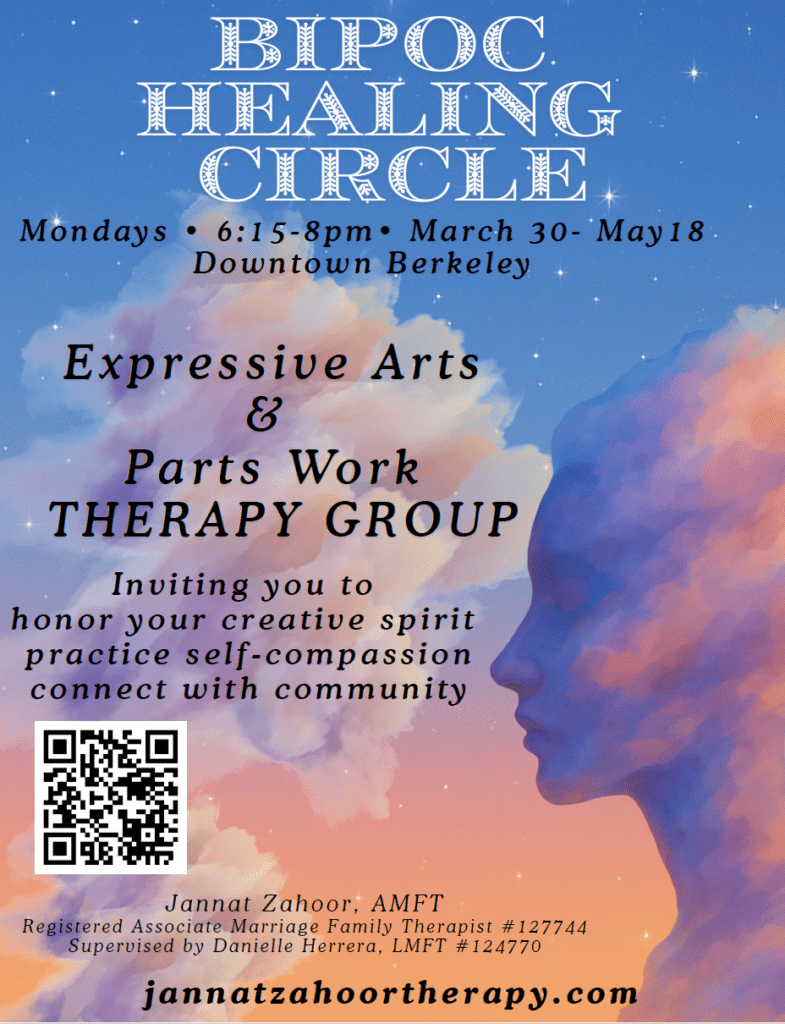
One example of this kind of work is the BIPOC Healing Circle being offered in downtown Berkeley by Jannat Zahoor, AMFT, supervised by Danielle Herrera, LMFT. This group brings together expressive arts and parts work in a space designed specifically for BIPOC community members.
The group runs on Monday evenings from 6:15 to 8:00pm, March 30 through May 18. The group invites participants to honor their creative spirit, practice self-compassion, and connect with community. For registration and more information, visit jannatzahoortherapy.com.
Culturally affirming mental health care is not a specialty niche. It is a standard of care. Groups like this one reflect a growing recognition of that truth across the Bay Area therapy community.
Finding the Right Group for You
If you are considering group therapy or culturally affirming care, the most important step is finding a space where you feel safe enough to begin. That might be a community-specific group, individual therapy, or both.
At Center for Mindful Therapy, our Associate Therapists bring diverse backgrounds and specializations. Many offer culturally affirming, expressive arts-informed, and parts-based approaches. In-person availability varies by therapist location throughout the Bay Area, and telehealth is available across California.