

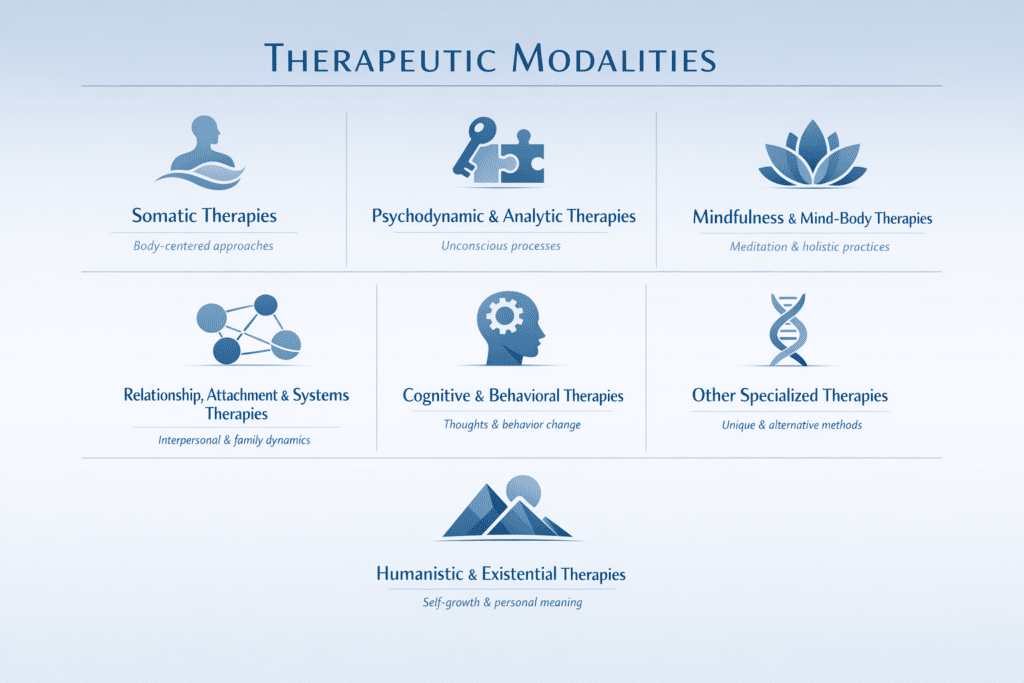
There is no single right way to do therapy. Different approaches work for different people, and the same person may benefit from different approaches at different points in their healing. At Center for Mindful Psychotherapy, we do not practice a single method. Our collective of 125+ therapists brings training across the full landscape of contemporary psychotherapy, from rigorously evidence-based cognitive approaches to body-based somatic work to depth-oriented psychodynamic exploration.
Most of our therapists integrate methods from more than one tradition, drawing on what each client actually needs rather than fitting every person into a single framework. If you have a preference for a specific approach, you can filter by modality in our Therapist Directory. If you are not sure what kind of therapy might suit you, reading this page or speaking with us directly can help you get oriented.
Below you will find an overview of the therapeutic tradition represented in our collective, organized by category. Each section links to a detailed resource page with more information about the specific modalities within it.
Browse our Therapist Directory
Jump to a Section

Somatic Therapies
Somatic therapies start from a fundamental insight: emotional experience, trauma, and chronic stress do not live only in the mind. They live in the body, in the way muscles hold tension, in the catch in the breath before a difficult conversation, in the nervous system patterns that fire before conscious thought catches up. These approaches use body awareness, movement, sensation, and breath as pathways into psychological healing.
If you have ever found that you understand something intellectually but still cannot seem to change it, somatic work may offer what cognitive approaches could not reach. The body holds what the mind has processed and what it has not yet been able to. Somatic therapies work at that level directly.
This category includes:
- Somatic Therapy
- Somatic Experiencing Therapy
- EMDR
- Brainspotting
- Hakomi Therapy
- Relational Somatic Healing
- Dance and Movement Therapy
These are among the most effective approaches available for trauma, anxiety, chronic stress, and the embodied dimensions of psychological experience.
Mindfulness and Mind-Body Therapies
Mindfulness-based approaches integrate present-moment awareness into the therapeutic process, helping people observe their thoughts and emotions without being controlled by them. This is not meditation as a self-help practice; it is the application of contemplative awareness to psychological healing, supported by growing bodies of neuroscience research on how present-moment attention changes the brain.
Mind-body therapies in this category also draw from nervous system science, recognizing that the autonomic nervous system is a central player in emotional regulation, relational safety, and the capacity for genuine rest and recovery. Understanding your nervous system states, and learning to work with them rather than against them, is often foundational to other therapeutic work.

Cognitive and Behavioral Therapies
Cognitive and behavioral therapies are among the most extensively researched approaches in psychotherapy, with strong evidence bases for anxiety, depression, OCD, eating disorders, and many other concerns. They work with the relationship between thoughts, feelings, and behaviors: changing how you think changes how you feel, and changing what you do changes both.
These approaches are typically structured and skills-based. Sessions have a clear focus, you practice skills between appointments, and progress tends to be measurable. For many people, particularly those who appreciate a concrete framework and want to learn practical tools, cognitive and behavioral approaches are highly effective. They are also frequently integrated with other approaches for clients whose needs span multiple dimensions.
“The results of several randomized controlled trials indicated that CBT was effective for a variety of mental problems (e.g., anxiety disorder, attention deficit hypersensitivity disorder, bulimia nervosa, depression, hypochondriasis), physical conditions (e.g., chronic fatigue syndrome, fibromyalgia, irritable bowel syndrome, breast cancer), and behavioral problems (e.g., antisocial behaviors, drug abuse, gambling, overweight, smoking),” according to a 2021 research report in BioPsychoSocial Medicine.
This category includes Cognitive Behavioral Therapy (CBT), Dialectical Behavior Therapy (DBT), and Acceptance and Commitment Therapy (ACT). These three approaches share a family resemblance while each addressing somewhat different clinical needs.
Humanistic and Existential Therapies
Humanistic and existential therapies center the whole person rather than a diagnosis or a symptom. They emerged from a conviction that human beings are not problems to be solved but people to be understood, and that healing comes from authentic relationship, expanded self-awareness, and the courage to live more fully in alignment with one’s own values and experience.
These approaches are particularly well suited for people grappling with questions of meaning, identity, and purpose; those who feel constrained by roles and expectations that do not fit; and those whose suffering is less about a specific condition than about a broader sense of disconnection from themselves or their lives. They are also deeply relational, meaning the therapeutic relationship itself is a central part of what works.
This category includes Humanistic Therapy, Existential Therapy, Gestalt Therapy, AEDP, and Formative Therapy.

Psychodynamic and Analytic Therapies
Psychodynamic and analytic therapies work with depth. They proceed from the understanding that much of what drives our behavior, our emotional responses, and our relational patterns operates below the level of conscious awareness, rooted in early experience and carried forward in ways we may not fully recognize. Making the unconscious conscious, as Freud originally framed it, remains a powerful path to lasting change.
These approaches tend to be less structured and more open-ended than cognitive or behavioral therapies. They follow the material that emerges rather than a predetermined agenda, and they use the therapeutic relationship as both a container for that exploration and a live source of information about how a person relates. For people who want to understand themselves at depth, and who sense that the roots of their patterns run deeper than current circumstances, psychodynamic work often offers what other approaches cannot.
This category includes Psychodynamic Therapy, Jungian Therapy, and Object Relations Theory.
Relational, Attachment and Systems Therapies
We are shaped by our relationships from the beginning of life. The patterns of attachment we develop with early caregivers become templates for how we relate to everyone who matters to us: what we expect from closeness, how we respond to rupture, what we need to feel safe in connection. Relational and attachment-based therapies work directly with these patterns, often producing change that talk therapy oriented toward insight alone cannot achieve.
Systems therapies expand this lens further, viewing individuals within the context of the larger relational systems they inhabit: couples, families, communities. A behavior that looks like a personal failing often makes perfect sense when seen as a role within a system, and addressing it at the system level is frequently more effective than working with the individual alone.
This category includes:
- Attachment-Based Therapy
- Internal Family Systems (IFS)
- Emotionally Focused Therapy (EFT)
- PACT Couples Therapy
- Relational Therapy
- Systems Therapy

Other Specialized Therapies
Healing does not always follow a conventional path. Some of the most powerful therapeutic work happens through approaches that do not fit neatly into the major traditions: creative expression, spiritual frameworks, culturally grounded practices, and modalities that engage dimensions of experience that standard approaches leave largely untouched.
Our collective includes therapists trained in a range of specialized approaches that address specific contexts and communities. These modalities honor the diversity of human experience and the many different pathways through which people find their way to wellbeing.
This category includes:
- Expressive Art Therapy
- Narrative Therapy
- Cultural and Multicultural Counseling
- Anti-Oppressive Therapy
- Harm Reduction
- Motivational Interviewing
- Buddhist and Shamanic Spiritual Counseling
- Transpersonal Therapy
- Equine Assisted Therapy
- Sensory Enrichment
- Trauma Informed Care
How to Choose an Approach
If you have a clear preference for a specific modality, use the therapeutic approach filter in our Therapist Directory to find practitioners with that training. If you are uncertain, a few questions can help orient you.
Do you want to understand what drives your patterns, or learn skills to change them? People drawn to insight and depth often resonate with psychodynamic or humanistic approaches. People who want practical tools and a structured framework often respond well to cognitive and behavioral methods. Neither is better; they serve different needs and can complement each other.
Does your distress live primarily in your body? If you experience significant physical symptoms of stress, if your body responds to triggers before your mind catches up, or if previous talk therapy has felt incomplete, somatic approaches may offer something important. Many of our most effective treatments for trauma and chronic anxiety are body-based.
Are your patterns primarily relational? If what brings you to therapy is fundamentally about how you connect with others, including partners, family, or a persistent sense of difficulty in closeness, relational and attachment-based work often goes directly to the root.
You do not need to figure this out alone. Contact us or browse our Therapist Directory and read through profiles. A brief consultation with a therapist can also help clarify what approach might suit you. The right fit matters as much as the right modality.
Browse our Therapist Directory