


Reviewed by Kathryn Vercillo, MA Psychology | Last Updated: February 2026
Grief has a way of making the world feel smaller. The people around you return to their routines, the condolence cards stop arriving, and yet the weight of your loss remains. You might find yourself wondering why it still hurts this much, or feeling guilty for laughing, or noticing that well meaning friends seem uncomfortable when you bring up the person you lost.
If any of this sounds familiar, you are not alone. And that phrase is not just a platitude. It is actually one of the most important things grief research tells us: healing from loss happens more fully when we do not try to do it by ourselves.
This spring, CMP alumni therapist Elaine Walker, LMFT, is launching a grief group in San Francisco designed specifically for people processing the loss of significant people in their lives. In this post, we will explore why group therapy is uniquely suited to grief work, what Elaine’s group offers, and how to know if a grief group might be the right next step for you.
Announcing: Grief group with Elaine Walker, LMFT
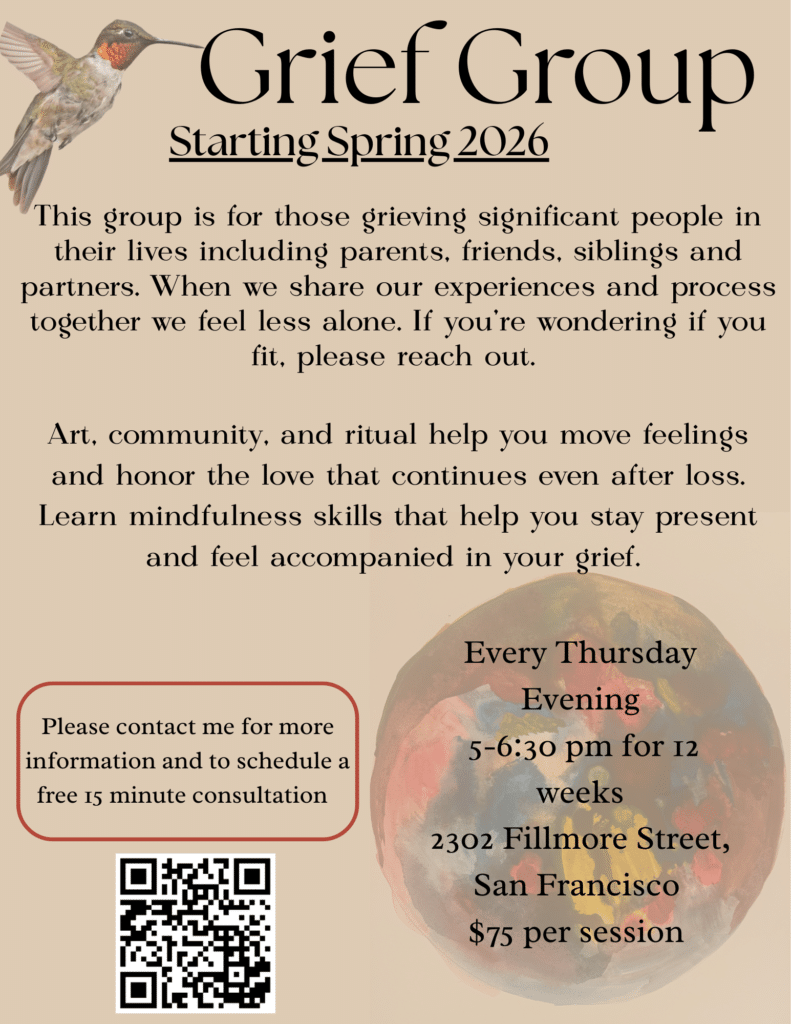
Starting in Spring 2026, Elaine Walker is offering a 12 week grief group for adults who are grieving parents, grandparents, friends, siblings, partners, caregivers, mentors, and other significant people in their lives. The group meets every Thursday evening from 5:00 to 6:30 PM at her office on Fillmore Street in San Francisco.
What makes this grief group different
This is not a group where you sit in a circle and simply talk about your loss, though sharing is certainly part of the experience. Elaine’s approach incorporates art, community, ritual, and mindfulness practices that help you move through the feelings grief brings rather than staying stuck in them. These creative and embodied elements honor something that many grieving people intuit but struggle to articulate: grief lives in the body and in the spirit, not just in the mind.
The group also focuses on honoring the love that continues even after someone dies. Grief and love are not opposites. They exist together, and finding ways to carry both is central to this work.
Grief group details
The group meets every Thursday evening from 5:00 to 6:30 PM for 12 weeks. Sessions take place in person at Elaine’s office on Fillmore Street in San Francisco, and the cost is $75 per session. A free 15 minute consultation is available for anyone wondering whether this group is a good fit. Learn more and contact Elaine through her website.
Elaine Walker, LMFT, is an alumni therapist of the Center for Mindful Psychotherapy who brings a warm, integrative approach to grief work.
Why grief benefits from group therapy

Individual therapy is valuable for grief. Having a therapist who knows your story and can sit with you in your pain provides essential support. But group therapy offers something that even the best individual therapy cannot replicate: the experience of being truly seen by others who understand.
The unique power of shared witness
When you tell the story of your loss in a group and someone across the room nods because they know exactly what you mean, something shifts. The isolation that grief creates begins to loosen. Research in bereavement support consistently shows that one of the most healing factors in grief recovery is the reduction of social isolation. Group therapy directly addresses this.
A 2021 study published in PLOS ONE surveyed 372 bereaved adults and found that nearly 38% rated their overall social support after loss as poor or very poor, with emotional support, specifically being listened to without judgment and feeling accompanied over time, emerging as the most desired and most frequently insufficient form of care. In person and online grief support groups ranked among the highest rated sources of satisfaction, outperforming family, faith leaders, and community members.
In a culture that often rushes people through mourning, a grief group creates space where your timeline is respected. There is no pressure to “move on” or “find closure.” Instead, you are met where you are, week after week, by people who are also learning to live with loss.
Normalizing the grief experience
Grief can make you feel like something is wrong with you. You might worry that crying months or even years after a loss means you are not coping well. You might feel confused by anger, guilt, or even relief mixed in with your sadness. In a grief group, you quickly discover that these experiences are not signs of failure. They are the natural, complex textures of mourning.
Hearing others describe their own unexpected grief reactions gives you permission to have yours. This normalization is one of the most consistently reported benefits of grief group participation.

What grief actually looks like (and why it surprises us)
Most people enter grief with some expectation of sadness. What catches many off guard is everything else that comes along with it.
Beyond sadness: the full spectrum
Grief can show up as irritability, difficulty concentrating, physical exhaustion, changes in appetite, vivid dreams about the person you lost, or a strange numbness that makes you wonder if you are grieving “correctly.” You might feel fine one hour and devastated the next. You might feel nothing at all and wonder what that means.
All of these responses reflect your nervous system working to process a profound disruption. When someone central to your life is no longer there, your brain and body are recalibrating in real time. Understanding this can help reduce the self judgment that so many grieving people carry.
Grief has no timeline
One of the most persistent and damaging myths about grief is that it follows a predictable path. The widely referenced “stages of grief” model, while useful as a general framework, was never intended to be a linear checklist. Grief circles back. It arrives unexpectedly at a birthday dinner or while hearing a song in a grocery store. It can intensify around anniversaries, holidays, or life milestones the person will never see.
Working with grief in a group setting over 12 weeks provides enough time to experience some of these waves and learn, alongside others, how to ride them rather than fight them.
How art, ritual, and mindfulness support grief healing
Traditional talk therapy approaches grief primarily through language. You describe what happened, how you feel, and what you are struggling with. This cognitive processing is important. But grief often exceeds what words can capture.
When words are not enough
Many grieving people describe moments when language falls short. The ache in your chest when you pass their empty chair. The way your hands remember the shape of their hands. The disorientation of waking up and, for one brief second, forgetting they are gone. These are experiences of the body and the senses, not just the thinking mind.
Art, ritual, and mindfulness practices create pathways for processing grief that do not depend on finding the right words. Making something with your hands, participating in a meaningful ritual, or simply practicing staying present with a feeling rather than pushing it away can move grief through your system in ways that talking alone may not.
Mindfulness and presence in grief
Mindfulness practices are particularly valuable in grief work because they build your capacity to be with difficult emotions without becoming overwhelmed by them. When grief surges, the instinct is often to either push it down or get swept away entirely. Mindfulness offers a middle path: staying present with the feeling, noticing where it lives in your body, and allowing it to move through you at its own pace.
Over the course of a 12 week group, these skills build. You develop an internal resource that helps you navigate grief not just during the group sessions but in the moments of daily life where loss catches you off guard.
Who is a grief group right for?
Grief groups serve people across a wide range of loss experiences and timelines. You do not need to have lost someone recently to benefit, and you do not need to have a specific “reason” beyond the fact that you are still carrying grief.
You might benefit from a grief group if:
Are someone who has lost a parent, partner, sibling, friend, grandparent, caregiver, or mentor and are struggling to process that loss. You feel isolated in your grief, perhaps because the people around you seem to have moved on. Likely, you have tried to grieve on your own but feel stuck, numb, or overwhelmed. You are curious about creative and mindful approaches to healing. You want to be around others who understand without you having to explain.

Grief groups and individual therapy
Participating in a grief group does not mean you need to stop individual therapy. Many people find that the two complement each other beautifully. Individual sessions provide space for deeper personal exploration, while the group offers connection, normalization, and the unique healing that comes from shared experience. If you are currently working with a therapist at the Center for Mindful Psychotherapy or elsewhere, a grief group can enhance that work. If you join a grief group and find that you also want to work with an individual therapist, that is helpful, too.
Finding grief support in San Francisco
San Francisco is a city of transplants, which means many residents are grieving far from the communities where their loved ones lived and died. The distance from family, from the places where memories were made, can add an extra layer of isolation to an already lonely experience.
Why local, in person grief groups matter
While telehealth has expanded access to therapy across California, grief work can benefit particularly from being physically present with others. The embodied experience of sitting in a room with people who are also grieving, of making eye contact, of creating art side by side, adds a dimension of connection that a screen cannot fully replicate.
Elaine Walker’s grief group meets in person on Fillmore Street in San Francisco, offering Bay Area residents the opportunity to do this work in shared physical space. For those seeking additional support, the Center for Mindful Psychotherapy offers grief and loss therapy through our collective of Associate Marriage and Family Therapists throughout the Bay Area, with telehealth available across California.
Browse our Therapist Directory
Taking the next step
Reaching out about a grief group can feel vulnerable. You might wonder if your grief is “big enough” to warrant a group, or whether you will be able to handle hearing other people’s stories on top of your own. These are common concerns, and they are worth bringing to a consultation.
Elaine offers a free 15 minute consultation to help you explore whether this group is a good fit. That conversation is simply a chance to ask questions and get a sense of whether the group feels right. There is no obligation and no pressure.
If you are not sure about group therapy but know you need support with grief, we can help you find an individual therapist who specializes in grief and loss. You can browse our therapist directory or contact us for guidance on finding the right fit.
Grief does not have to be carried alone. Whether through a group, individual therapy, or both, support is available.