

Center for Mindful Psychotherapy is a non-profit collective of 125+ Associate Marriage and Family Therapists in the San Francisco Bay Area. You can learn more about each of them by perusing our Therapist Directory. In our Conversations with Clinicians series, we interview therapists in more depth. They share more about the work that they do, the clients that they work with, their inspirations, passions, personal interests and more.
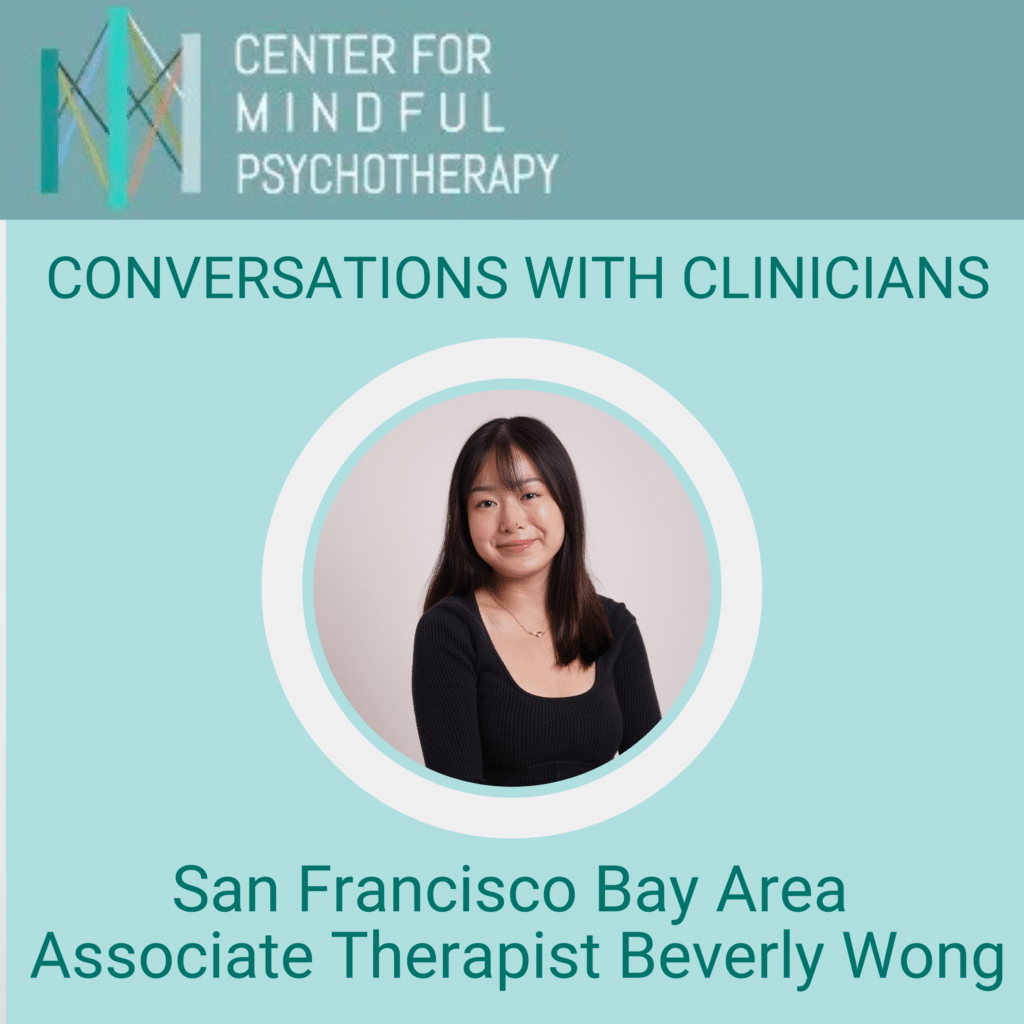
AMFT Beverly Wong brings both clinical range and personal depth to her work. Drawing from psychodynamic therapy, Internal Family Systems, attachment theory, and somatic approaches, Beverly has a particular gift for working with people who look fine from the outside but know something underneath is still unresolved. She has a special connection to AAPI clients and children of immigrants, and brings her own lived experience navigating cultural identity and family expectations to that work. Creative forms of healing, including tarot, junk journaling, music, and film, also shape the way she holds space, even when they don’t appear directly in session.
What is your therapeutic orientation?
My work is integrative and is grounded in psychodynamic therapy, Internal Family Systems (IFS), attachment theory, and somatic approaches. I also sprinkle in aspects of narrative therapy and acceptance and commitment therapy (ACT). My therapeutic orientation is depth-oriented as a whole.
What are your areas of specialty?
My specialties include issues relating to trauma and PTSD, grief and loss, anxiety, emotional regulation, life transitions, identity development, and relationship challenges.
I also work in depth with AAPI and other BIPOC and second-gen clients who may be navigating cultural identity, family and societal expectations, and intergenerational dynamics.
What other modalities inform your work?
Aside from my clinical training, I’m really drawn to creative and embodied forms of healing such as tarot as a reflective tool that informs how I think about inner work, music and film as a way to process experiences, and junk journaling and other forms of creative expression as a vehicle to access emotions when we aren’t able to find the words to describe them. These aren’t things I necessarily bring into every session, but they do shape how I hold space and understand how nuanced the healing process can be.
What is it like to work with you?
I’d say I’m warm, curious, and compassionate. At the same time, I’m also the type of therapist to welcome and model authenticity through laughing with my clients, sitting with them through the heavy emotions, and gently naming something that comes up during our time together when I notice it. Because I work relationally, I care a lot about what’s happening between us in the room because I believe that our therapeutic relationship is part of the work too.
Clients have told Beverly they feel safe enough to say the things they’ve never said out loud, and that there’s never been a sense of judgment in the work.
Who do you LOVE working with?
I love working with people who are ready (or are getting ready) to sit with the uncomfortable stuff. They might not have the words for it yet, but there’s a willingness to try. A lot of the folks I work with have been carrying things on their own for a long time, often wounds from childhood or adolescence that they’re just beginning to realize are still affecting them. They may be starting to question the roles they’ve been playing in their lives and wondering why they feel the way they do even when they look ‘fine’ from the outside. I get excited about working with those who are open to exploring what’s underneath!
I also especially love working with AAPI and children of immigrants. Being second-generation Chinese American, I have my own lived experience navigating challenges around cultural identity, family and societal expectations, and the different ways we learn to shrink ourselves to keep the peace. It can be really special to work with someone where you don’t have to over-explain yourself.
What most inspires you about doing this work?
What inspires me most about this work is having the opportunity to walk alongside clients through the highs, the lows, and everything in between. Everyone I’ve worked with has inspired me in some way. In particular, it’s inspiring to see the resiliency that each and every person holds. Throughout my work, I’m constantly being reminded that change can sometimes come about by just simply leaning into vulnerability and making space for the parts of us we’ve been avoiding. Being able to witness that process has been such a privilege and continues to drive what I do.
Outside of offering therapy, Beverly stays inspired through books, music, and film, and continues her own healing through tarot, junk journaling, and her own therapy.
We’d love some recommendations …
What are your favorite books?
- Favorite therapy books: What My Bones Know by Stephanie Foo, Adult Children of Emotionally Immature Parents by Lindsay Gibson, and Attached by Amir Levine and Rachel Heller.
- Favorite non-therapy books: On Earth We’re Briefly Gorgeous by Ocean Vuong and Norwegian Wood by Haruki Murakami.
- Favorite quote: “We don’t see things as they are. We see them as we are.” — Anaïs Nin
What are some of your favorite films, songs, podcasts, etc.?
Films and TV: Inside Out 1 & 2, Beef (Season 1), Minari, and Didi. They don’t all relate to therapy directly, but they explore themes of identity, family, grief, and what it means to be human in ways that really resonate with me.
Music: Anything by DPR Ian. His music is a creative outlet for exploring his own experience with bipolar 1 disorder. He makes meaning out of his mental health through storytelling and even names different parts of himself that come up, which feels very aligned with the framework I draw from in therapy. Iy also loves R&B as a genre because it taps into so many emotions around relationships, including love, passion, and joy, but also grief, nostalgia, anger, sadness, and acceptance.
Podcasts: Parents Reimagined. I love that it’s inclusive of so many different outcomes, from repair and reconciliation to choosing estrangement, to people who don’t have the answers yet and are still figuring out what they want their relationship with their parents to look like.
Best self-care suggestions?
- Free or low budget: Nothing beats a nice hot shower (or a cold one depending on the effect you’re going for). Going outside, even if it’s just for 5 minutes. Collaging or junk journaling with whatever you have lying around, including old magazines, packaging, receipts, stickers you never used. Being a tourist in your own city and checking out scenic places you don’t often go to. Or simply calling up a friend.
- Somewhere in between: treating yourself to a blind box (just maybe not five in a row).
- At a higher price point: Anything that involves being cared for by someone else, like a massage, a facial, getting your nails done, getting your hair done, or going out and treating yourself to a nice meal.
Best places to laugh and cry in the Bay Area?
- To laugh: a live improv comedy show at Endgames Improv in the Mission.
- To cry: Golden Gate Park. There are so many quieter spots where you can sit on a bench or on the grass and let it all out. If you can’t get yourself to step outside, crying in the shower is definitely an underrated place to cry. It can be grounding to let yourself release and literally wash it all away. You come out a little different too.
If you could sum up in one sentence why someone might go to therapy, what would you say?
To have a space where you don’t have to hold it all by yourself, and where you can get curious about and better understand your inner world.
What is one thing that clients might be surprised to learn about you?
That I don’t have it all figured out either! I think people sometimes assume therapists have everything sorted out or that they have all the answers, but I’m constantly learning, making mistakes, and growing too. Also that I love tapping into my inner child; I love going to concerts and raves, playing video games, or collecting trinkets, photocards, and blind boxes (basically anything cute and quirky)!
What is one takeaway moment from your own experience as a client in therapy?
One of the biggest shifts for me was moving from self-judgment and self-criticism to curiosity and compassion, especially toward the emotions I didn’t want to feel (like anger and anxiety). It was definitely a difficult and painful process. But once I stopped fighting those parts of myself and got curious about them instead, I was actually able to process them and eventually feel a lot better. Turns out self-criticism wasn’t really helping (who knew?). That experience completely shaped how I show up for my clients.
As a second-generation Chinese American, daughter of immigrants, and somewhere on the millennial-gen-z cusp, going on my own healing journey through therapy and other forms of healing helped me to be the therapist I am today. If you’ve been on the fence about therapy, just know you don’t have to be in crisis to start. Wanting support doesn’t mean something is wrong with you. It just means you’re ready to stop holding it all on your own and want to be seen.
How can people contact you?
I have two locations in San Francisco: Lower Pacific Heights and the Financial District. I also see people via telehealth.
Beverly Wong, AMFT #138944, supervised by Monica Ramil, LMFT #108945
- Website: therapywithbev.com
- Instagram: @therapywithbev
- Email: [email protected]
- Phone: (415) 226-6754
Center for Mindful Psychotherapy is a non profit collective of 125+ Associate Marriage and Family Therapists in the San Francisco Bay Area. You can learn more about each of them from perusing our Therapist Directory.